Ten years ago, while studying for an MA in art history at the Courtauld Institute in London, Claire Mander came across the neglected roof terrace of the nearby Temple underground station. She felt strangely drawn to the overgrown space, which offered stunning views of the Thames and the London Eye.
“It was dirty, abandoned, and a magnet for antisocial behavior,” recalls Mander, now director and curator of theColab, an arts charity and incubator that specializes in large-scale outdoor sculptures. She looked into the history of the abandoned space, which was built as part of the Victoria Embankment in 1870. Before that, the site was home to a 17th-century sculpture garden created by the Countess of Arundel.
“It inspired me to imagine how the roof terrace could become a really special women’s sculpture garden,” says Mander. “The ‘hidden in plain sight’ nature of the location felt like the perfect place to address some of the gender imbalance we see in public artworks.”
A survey by Art UK found that out of nearly 1,500 monuments in London, more than a fifth were dedicated to named men, while only 4% were dedicated to women—half as many as those celebrating animals. And of all the public sculptures in London, only 13% were created by women.
Mander kept pushing Westminster council until they finally gave her the go-ahead. With funding from donations and over £500,000 from the council to date, the Artist’s Garden opened in October 2021. It is the world’s first and only public sculpture garden dedicated to the work of female artists. Since then, it has attracted 100,000 visitors a year, commissioned 18 major works, and collaborated with 24 different emerging and established artists.
But now, theColab has been told by Places for London, Transport for London’s property arm, that their license to use the site will not be renewed on 1 October, and they must clear the garden.
A spokesperson for Places for London said: “The terrace and station roof may now need essential repair and safety work, and the space must be cleared to assess what work is required. We are working with Westminster City Council and local stakeholders to explore alternative nearby locations for the Artist’s Garden, while also developing future plans for the terrace at Temple.”
Mander disagrees, saying the repairs are about upgrading the commercial property below the terrace, and according to the scope of work, there is no mention of a major roof overhaul. She believes the space is at risk of being handed over to a private developer. “It’s a prime location with incredible river views, ideal for VIP events selling overpriced cocktails. They don’t understand that this is a landmark project. Their perception seems to be that we’re a small, pathetic female-led charity doing some nice little sculptural things. But we are prepared to take this to court if it comes to that.” They have launched a campaign and petition to save the garden.
Alexandra Hodby, head of programmes at Yorkshire Sculpture Park and a trustee of the gardens, points out that such spaces are of vital cultural and economic value, both to artists and to the cities they are in. “Look at the High Line in New York. It wasn’t even a public space, then it was made public through art. Artists activated it. Now it’s one of the most visited places in the city.”
Hodby believes that sculpture has a unique power to engage the public in a way that art on gallery walls does not. “There’s an immediacy to it—there’s no separation between the work and the world.” This is true. On the day I visit, LLondon is in the middle of a heatwave. Office workers, builders on an early lunch break, and confused tourists all crowd the space. A toddler crawls toward Mexican artist Adeline de Monseignat’s pebbled sculpture Croissant, probably thinking it’s a seesaw. In the distance, I see people taking selfies next to Alice Wilson’s Savoy, a giant forest of colorful wooden beams.
“Of course, seeing art made by women inspires other women who want to create art themselves. But it goes much deeper than that,” says Hodby. “Representation is about being part of a public space and being seen. Visibility lets visitors see themselves, whether it’s at the Artist’s Garden or Yorkshire Sculpture Park, where we try to show a wide range of artists, including non-binary, queer, and younger artists.”
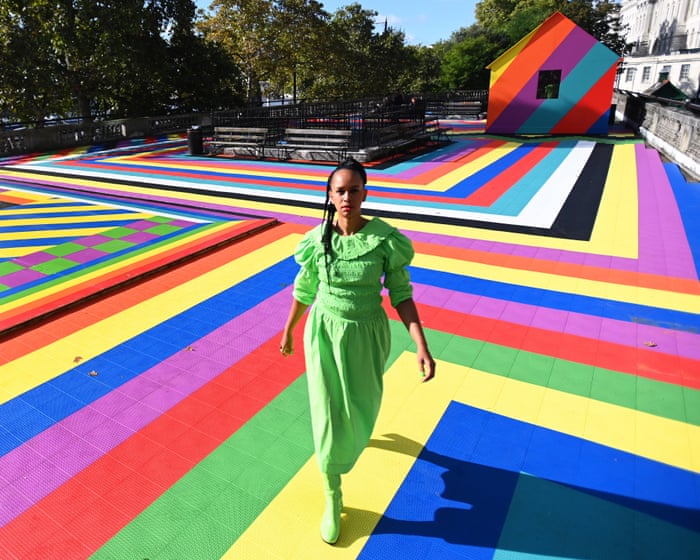
Lakwena Maciver created the site’s opening exhibit, a colorful mural called Back in the Air: A Meditation on Higher Ground. It stretched across the entire 140-square-meter space. For the British-Ugandan artist, the location has special emotional meaning. “When I was a teenager, we’d take the train into town, and I remember sitting in Embankment Gardens eating Skittles with my sister. I’d think about my future but also feel that, as a minority, London didn’t belong to me. Being asked to do the mural was very special because I was invited to contribute something so big. It felt like, I do belong! I’ve never thought about not working on a large scale, but I had so many positive interactions with visitors there that it gave me a lot of confidence.”
Artist Florence Peake created work for the site’s current show, Sculpture in Three Acts. “It’s rare these days in London to find a public space that’s free and doesn’t have a commercial purpose. It’s a place to reflect, take a breath, and be with artworks that might draw you in and create room for thought.”
She believes the garden has provided a much-needed space. “It lets visitors see that women can create huge, monumental work. Of course we can! It’s just that we’re often not trusted to be ambitious and work on a large scale. Our ideas are often dismissed as naive. That’s what I’ve experienced in my 30 years as an artist. A man comes along and says, ‘I want to build a big steel thing sticking 18 meters in the air,’ and he’s called a genius. If a woman suggests the same thing, people exchange worried looks.”
At the center of the garden is the artist’s hut, which currently features a wrap-around photomontage by feminist artist Linder Sterling. “The Artist’s Garden is in Temple, once the territory of the Knights Templar,” she says. “It seems women now have to become warriors and defend our right to take up space there.”
At the back of the montage is a portrait of the Countess of Arundel, reminding us of the women who came before. “On one wall of the hut, you can see the phrase ‘She Is Here,’ the title of the work, written large,” adds Sterling. “Now that the site is under threat, ‘She Is Here’ has become a rallying cry—we’re not going anywhere.”
Frequently Asked Questions
Here is a list of FAQs about the fight to save the worlds only sculpture park dedicated to women
General Background
Q What is We have to become warriors
A Its a campaign to save the Womens Sculpture Park which is the only outdoor sculpture park in the world exclusively featuring works by women artists The fight is against threats like funding cuts land development or neglect
Q Where is this sculpture park located
A The park is typically located in a specific region or country The exact location is part of the campaigns urgency
Q Why is a park just for women artists important
A Because women artists have been historically underrepresented in major museums and public art spaces This park provides a rare dedicated platform for their work challenges the maledominated art world and inspires future generations
Q Who started this park and the campaign to save it
A It was founded by a collective of women artists activists and community leaders The current campaign is led by a nonprofit organization and supported by local and international advocates
The Crisis Challenges
Q What exactly is threatening the park
A The main threats are usually a combination of 1 Loss of funding or government support 2 A real estate development proposal to build on the land or 3 Physical deterioration of the sculptures due to lack of maintenance
Q Is the park actually closing
A Its at serious risk Without immediate action the park could be dismantled sold or redeveloped The campaign aims to prevent that
Q How many sculptures are at risk
A The number varies but its typically a collection of 2050 largescale sculptures by internationally and locally renowned women artists
Q Is this just about money or are there other issues