Bob Dylan tells me: “He sings like a man arguing with destiny. It sounds like the ache is real, that the ruin is real. There’s a cracked truth there. What’s unsettling about him is that he sounds like he’s already living in the aftermath.” Dylan is talking about the late US singer-songwriter Gary Stewart. I had reached out to him because he was one of the few people who spoke highly of this country music maverick.
Even when he was alive, Stewart was a ghostlike figure. He had a moment in the Nashville spotlight in the mid-1970s, but his death in December 2003 at age 59 barely made a ripple. Stewart had been forgotten after he gave up stardom to hole up in a Florida trailer park, where he and his wife Mary Lou used quaaludes, meth, marijuana, and cocaine in massive amounts.
“He was a natural disaster from an earlier time, one older folks still talk about outside of the bait shop,” says Shannon Ashburn, the couple’s daughter. “Growing up with parents who were drug addicts meant I just took this as normal. I loved them and they loved me and they never let any predators in, so I didn’t feel unsafe. But, looking back, I realize it was an insane situation.” A handful of devoted fans – Dylan, Willie Nelson, John Waters, Tanya Tucker – insisted that Stewart was one of the 20th century’s most expressive vocalists, but it seemed unlikely he would gain the kind of posthumous cult following that Nick Drake or Karen Dalton achieved.
But now, after his chaotic life and overlooked death, Stewart is finally being rediscovered thanks to Gary Stewart: I Am from the Honky Tonks, a powerful biography that was an unexpected critical and commercial hit in the US when it was published last November. Its author Jimmy McDonough, whose biographies of Neil Young, Al Green, Tammy Wynette, and Russ Meyer have marked him as a brilliantly unconventional commentator on American lives, chuckles at his good fortune when I call him at home in Portland, Oregon. “Of all my books, this one proved the most difficult to find a publisher for,” he says, “yet it’s getting the best response of any of them.”
Meanwhile, reissue label Delmore Recording Society has just released One Track Mind, a mesmerizing collection of Stewart’s early-1970s demos, and rising country and indie-rock stars such as Ella Langley, Zach Top, Wednesday frontwoman Karly Hartzman, Charley Crockett, and Ryan Davis and the Roadhouse Band now sing Stewart’s praises – and songs.
“He scored a No 1 with ‘She’s Actin’ Single (I’m Drinkin’ Doubles)’,” says Davis, the Kentucky-born singer-songwriter whose 2025 album New Threats from the Soul won wide acclaim. “Gary Stewart is a superhero. He was, as his music still is and always will be, unfathomably real. And of near-ish my own geographic origins, making him simultaneously both realer and yet somehow even more fantastical.” Davis compares Stewart to “a natural disaster from an earlier time, one that the older folks still talk about outside of the bait shop.”
Stewart was born in Kentucky in 1944, one of 12 children, and his family moved to Florida in 1956 after his coal miner father suffered a debilitating injury at work. From his early teens, Stewart – a prodigy who absorbed rockabilly, country, and R&B – was playing in bands and writing songs. He moved to Nashville, playing piano in Charley Pride’s band while seeking publishing and recording deals. Established singers sang Stewart’s songs, but solo success was elusive until Nashville producer Roy Dea convinced RCA to sign Stewart in 1973.
Dea understood Stewart’s strengths – “I never knew anAnyone who impressed me as much as Gary did, Dea told an interviewer, and I’ve seen Elvis, Hank Williams, all of them. In 1974, Stewart had US hits with “Drinkin’ Thing” and “Out of Hand.” His 1975 debut album, also called Out of Hand, earned critical praise, and “She’s Actin’ Single (I’m Drinkin’ Doubles)” hit number one on the country charts that same year.
Over the next three years, Stewart’s albums—Steppin’ Out, Your Place or Mine, and Little Junior—feature some of the most exciting American music of the 1970s. As a singer, Stewart was completely natural; he could deliver ballads like “Quits” and “Ten Years of This” with deep emotional power, then tear into “Little Junior” and “Your Place or Mine” with the energy of someone craving the wild side of life. While punk rock initially had no impact on Nashville, Stewart, with his rough swagger and disdain for Music City’s establishment, captured punk’s spirit; Joe Strummer was a fan.
Often compared to Jerry Lee Lewis—the fierce intensity of his rockabilly-tinged country songs marked them as kindred spirits—and Hank Williams, Stewart shared with Williams a warm yet self-destructive nature. Addiction dulled his talent and led to his exit from the music business. Stewart spent his last 25 years hiding from the world with Mary Lou in a Florida trailer home with blacked-out windows, using drugs.
Ashburn insists it didn’t seem unusual at the time. “The only thing I resented was not being allowed to have sleepovers. I did have one of my girlfriends over once, and then dad overdosed. The ambulance was called and she started panicking, and I was like: don’t worry, this happens all the time! But she called her mom to come pick her up …” Ashburn laughs in disbelief at what was her everyday reality. “Once when dad was on tour, my mom overdosed and I had to drive her to the hospital—I was only 12!”
Stewart and Mary Lou Taylor met when he was 16 and she was 21. They shared a taste for wild, destructive hedonism. Along with the drugs, there were car wrecks, guns, knives, infidelities, and mental illness. In his biography, McDonough sees the pair as examples of a white working class who traded Kentucky’s hills for Florida’s coast—and moonshine for cocaine.
Stewart’s addictions ended his run on the country charts. He got a chance to start over after McDonough tracked down the reclusive singer in 1987 and wrote an 11,000-word profile for the Village Voice. It briefly revived Stewart’s career, and he signed to California indie label HighTone Records the following year, releasing three new albums. Yet these didn’t match Stewart’s best RCA recordings. His voice sounded worn out, his energy was gone—and the buzz around his return soon faded.
Why would a musician who once sounded so fiercely alive choose to numb his senses? No one has an answer, beyond the fact that Stewart just loved getting high. “People were rooting for Gary to make a successful comeback,” says McDonough, “but by then he didn’t really care.” Dea once dryly noted that “you get hooked on Stewart … he’s like a damn drug”—yet drugs snuffed out Stewart’s own spark.
The darkness that engulfed Gary and Mary Lou would eventually overwhelm their family, with the couple’s son Joey taking his own life in 1988 at age 25, with depression and family dysfunction as contributing factors. Ashburn says it was when her parents started taking the opioid painkiller OxyContin that “things really spun out of control.” She says: “Gary was first prescribed it aftAfter he broke his leg in a car crash, they didn’t realize how addictive the painkillers were. Having grown up around addicts and later facing her own battle with addiction, Ashburn now helps others who are struggling with drug dependence.
View image in fullscreen
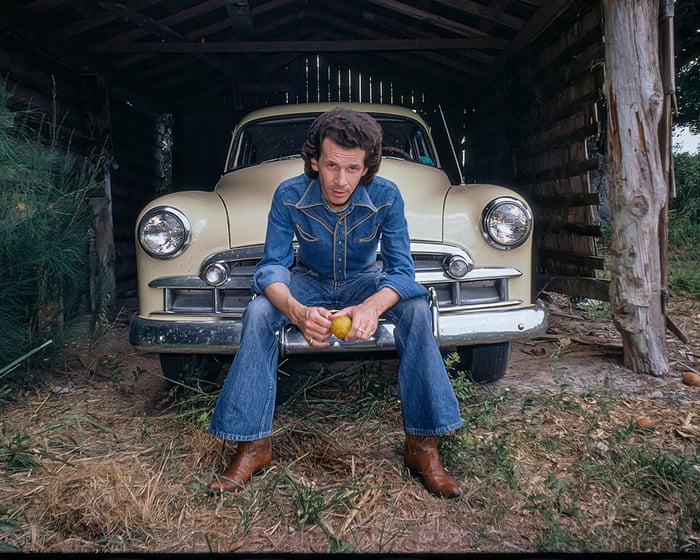
In his Fort Pierce hideaway … Stewart in the 1970s. Photograph: Grandal Stewart
To make a living, Stewart sometimes had to leave the trailer and perform, and on a good night he could still have audiences in stitches. “Dad loved playing honky-tonks and juke joints,” says Ashburn, “simple, down-home places where people came to dance to his music. He’d had a taste of stardom, played big arenas, and didn’t care for it—he preferred the gritty, backwoods spots. And people adored him. In Texas, he was a legend, able to draw 2,000 people to Billy Bob’s in Fort Worth.”
Stewart also had a devoted following on Native American reservations. McDonough believes this is because “Native Americans live a tough life, and in Gary, they heard someone who sang about that life. There was nothing fake about him.”
Mary Lou passed away on 26 November 2003. A heartbroken Stewart took his own life three weeks later. “They were Bonnie and Clyde, Romeo and Juliet,” says Ashburn. “One couldn’t live without the other.” Few noticed Stewart’s death at the time, but Ashburn never gave up believing her father’s music would be recognized again. “I’m determined to get Gary into the Country Music Hall of Fame,” she says. “With Jimmy’s book, the Delmore album of his demos, and Sony finally putting some of his RCA albums on streaming services, things are looking up. I have so many great recordings of him that I’d love to share with the world, because Gary Stewart was one of a kind.”
Gary Stewart: I Am from the Honky Tonks is published by Wolf & Salmon, £34.99. In the UK and Ireland, Samaritans can be contacted on freephone 116 123. In the US, you can call or text the 988 Suicide & Crisis Lifeline at 988 or chat at 988lifeline.org. In Australia, the crisis support service Lifeline is 13 11 14. Other international helplines can be found at befrienders.org.
Frequently Asked Questions
Here is a list of FAQs about the article and the life of Gary Stewart based on the title and the themes it evokes
General Background
Q Who was Gary Stewart
A He was a cult country singersongwriter from the 1970s known for his wild highenergy performances and a unique trembling vocal style He mixed traditional honkytonk with a raw rockandroll edge
Q What does honkytonk hellraiser mean
A It describes someone who lives and performs the hardliving harddrinking barroom lifestyle associated with honkytonk music For Stewart it meant he was a wild man on stage and his songs were full of desperation heartbreak and excess
Q Why is Bob Dylan mentioned in the title
A The article likely highlights how even major legends like Bob Dylan were fans It suggests that Stewarts genius was so undeniable that it earned respect from the highest levels of music even if he never became a mainstream superstar
Q Was Gary Stewart a big star
A He had a cult following and critical acclaim but he never became a huge mainstream country star like Willie Nelson or Merle Haggard He is considered a musicians musician whose influence is bigger than his record sales
Q What is his most famous song
A His biggest hit was Shes Actin Single in 1975 which went to number one on the country charts
His Music Style
Q What made his voice so special
A He had a distinctive highpitched quivering tenor that sounded desperate and emotional He could go from a whisper to a frantic screaming wail in the same line which made his pain feel very real
Q What are the main themes in his songs
A His songs are mostly about loneliness drinking broken relationships and the dark side of love They arent happy songs they are about drowning sorrows and feeling trapped
Q What does His ache is real mean in the context of the article