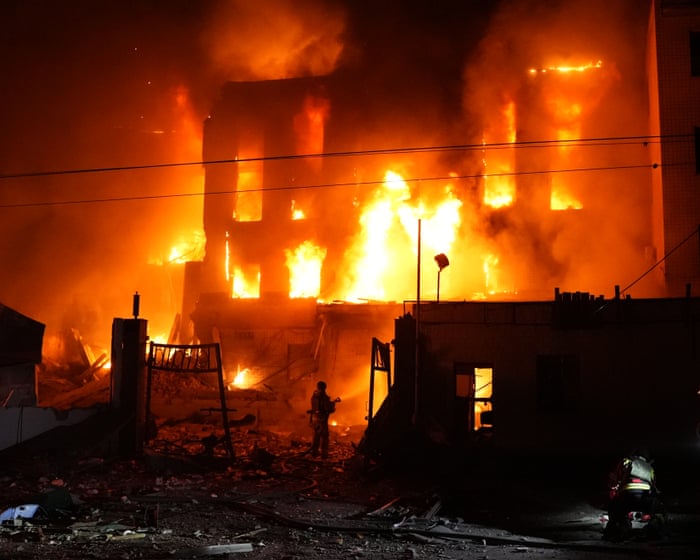
Ukraine’s people face a winter from hell. Having failed on the battlefield, Russia is now launching systematic daily attacks on civilians—on their homes, schools, hospitals, workplaces, and the essential infrastructure that keeps life going. Wave after wave of terrifying daytime ballistic missile and drone strikes hit Kyiv and other cities, destroying supermarket distribution centres, pharmaceutical and medical facilities, logistics hubs, and warehouses. The result is a sharp rise in civilian casualties and growing shortages of food and other basic goods. As a freezing winter approaches, Russia will once again try to destroy Ukraine’s water supplies and power grid, cutting electricity to millions. This is Vladimir Putin’s version of darkness at noon. He would rather kill everyone than admit he has lost.
Russia’s leader reportedly told Donald Trump this week that his “special military operation,” now in its fifth year, was going according to plan. Trump may believe him. Western analysts certainly do not. Failing militarily and suffering huge casualties, his regime faces growing domestic economic and public pressure to wind down the war. Yet Putin seems to think one final big push can break Ukraine’s will. Trump’s renewed meddling—after months of doing nothing, he sent his loyal envoys, Jared Kushner and Steve Witkoff, back to Moscow last weekend (they also visited Kyiv for the first time)—keeps the Kremlin’s delusions of victory alive. Now there is talk of more talks. And all the while, Putin kills and kills. Every day is a crime against humanity.
This prospect of daily mass killings, widespread war crimes, malnutrition, homelessness, and renewed large-scale displacement of Ukrainian civilians—this intensifying Russian campaign of terror—is intolerable. So why don’t the western allies and Nato intervene to stop it?
The main reason is chronic US ambivalence and unreliability, which has turned Ukraine into what seems like an endless war. Former president Joe Biden threw the Ukrainians a lifeline in 2022, then left them to sink or swim. Trump has since tried to drown them. Despite halting the ground invasion and taking the fight into Russia’s heartland, Ukraine is more vulnerable than ever to air attack. That is largely because Trump has reversed course on allowing Ukraine to produce Patriot missile interceptors and has paused weapons deliveries. Europe has so far failed to fill the gap. Trump’s fawning and flattery of Putin, on display at last year’s nauseating Alaska summit, and his bullying of President Volodymyr Zelenskyy, undermine Ukraine’s resistance, European security, and hopes for a quick settlement. Vulnerable civilians pay the price.
Many Ukrainians are weary of war. About 60% oppose ceding Donbas land to Russia, but a similar number would support a ceasefire, backed by western security guarantees, that freezes current positions, a recent poll suggests. Most Russians also want it to stop. And like Moscow, Kyiv is feeling the financial strain, despite a $100bn EU loan. There is clearly a deal to be done. But Putin (like Trump over Iran) ignores public opinion. The indifference of authoritarian leaders to the popular will, let alone global opinion, is another reason endless wars multiply. Whether the conflict is in Ukraine, Gaza, or Iran, ordinary people watching from the sidelines feel powerless to influence events. Familiarity dulls the senses over time. The horror of it all is scary and upsetting. It is easier to look away.
View image in fullscreenVladimir Putin and Donald Trump meet at the Elmendorf-Richardson military facility in Alaska, 15 August 2026. Photograph: Julia Demaree Nikhinson/APEfforts to halt the US-Israel war on Iran, which began in February and has now spread to the Red Sea (Trump, remember, said it would only last a few weeks), and the relentless post-2023 violence in occupied Palestine, are hampered, as in Ukraine, by the absence of credible, independent peace processes. This is another major factor fFueling the modern forever war phenomenon. Trump clumsily inserted himself into the Kyiv-Moscow argument, blatantly favoring one side. At no point did he trouble himself about the rights and wrongs of Putin’s war of choice. He aimed not to save lives but to win a Nobel peace prize (plus lucrative Russian energy deals). Self-serving motives have similarly upset hopes of rescuing Gaza’s civilians from the Israeli military and Hamas. Trump’s “board of peace” and 20-point plan are primarily vehicles for his ego and greed, not a plausible route out of a political, military and humanitarian dead-end. As for ending the Iran debacle, the US president has lost interest. His refusal, like Putin, to accept the obvious, admit he failed to achieve his war aims, and seek a compromise with Tehran undercuts regional mediators and Gulf state allies, who rightly fear fighting will drag on indefinitely. Desperately needed: impartial, UN-empowered peace envoys to knock heads together. Forever wars develop and grow entrenched in the absence of authoritative, universal legal frameworks respected and observed by all. The contempt shown by Trump, Putin and Israel’s leader, Benjamin Netanyahu, for basic principles of the post-1945 world order – rule of law, national sovereignty, oversight and enforcement by the international court of justice and international criminal court – directly contributes to the prolongation of conflict. Once the rules are cast aside, anything goes. That has ineluctably led to war crime atrocities such as those experienced in Gaza since the 7 October massacres; in Bucha, Mariupol and other towns and cities across Ukraine; and in Minab, southern Iran, where a US Tomahawk cruise missile allegedly killed more than 100 schoolgirls in February. Almost invariably, the culprits escape punishment. It’s impunity made law. It’s forever anarchy. Another increasingly common feature of endless wars is the obstruction of full public scrutiny and accountability through independent media and UN investigations. Since the war with Hamas began, Israel’s army has tightly restricted international journalists’ access to Gaza. Despite the efforts of brave reporters, this policy has inevitably disguised and distorted the true picture of what happens there, not least for Israelis. Likewise, the US defense secretary, Pete Hegseth, releases only limited, selective information about Iran-related operations. This has led, for example, to under-reporting of the extent and cost of successful Iranian strikes on US bases in the Gulf. Russian state media routinely censor news from Ukraine. Most Russians have little idea how badly the war is going. Generally speaking, public ignorance facilitates abuses and prolongs conflict. Forever wars are ultimately caused by failing, foolish leaders. For sure, generals foul up. In battle, things rarely go as expected. Clever strategies backfire. But the core problem is politicians who promise too much, underestimate their opponents, ignore less macho, peaceful alternatives, think they are above the law, will not admit mistakes – and, without shame or compunction, lie to your face. This is an age-old problem with no quick solution. But Ukraine’s people, facing a season from hell, urgently need additional assistance now. skip past newsletter promotion Free newsletter | Weekly Sign up to Matters of Opinion Guardian columnists and writers on what they’ve been debating, thinking about, reading, and more Enter your email Sign up after newsletter promotion Western democracies cannot sit on their hands as the civilian toll from Moscow’s barbarous onslaughts mounts daily. Nato must finally switch to the offensive, make clear more war crimes will not be tolerated, threaten to strike Russian drone and missile launch sites from the air (as previously, repeatedly, urged here) – and force Putin to back off before his forever war becomes everybody’s war. Simon Tisdall is a Guardian foreign affairs commentator Do you have an opinion on the issueWhat issues does this article raise? If you’d like to submit a response of up to 300 words by email for consideration in our letters section, please click here.
Frequently Asked Questions
Here are FAQs based on the themes in Simon Tisdalls article about Putin the war in Ukraine and NATOs role
Beginner Questions
1 What is this article about
Its an opinion piece arguing that Vladimir Putin wont admit the war in Ukraine is going badly for Russia and that NATO needs to do more to help Ukraine especially as winter approaches
2 Who is Simon Tisdall
Hes a British journalist and columnist who writes about foreign affairs mainly for The Guardian and The Observer
3 What does Putin would rather keep killing than admit hes lost mean
It means Putin would rather continue a war he cant win than admit defeat because admitting failure would damage his power and image
4 Why is winter such a big deal in this war
Winter makes fighting harder and life more dangerous for civilians Russia has attacked Ukraines power plants and heating systems so people could face cold darkness and no running water
5 What is NATO
The North Atlantic Treaty Organization a military alliance of mostly European and North American countries including the US and UK Ukraine is not a member
6 What does the article want NATO to do
It calls on NATO to step up send more weapons air defense systems and support instead of holding back out of fear of angering Russia
7 Why doesnt NATO just send troops into Ukraine
NATO members worry that direct fighting with Russia could trigger a much bigger war possibly even a nuclear one So they mostly send weapons and money instead
8 Has Russia actually lost anything
Yes Russia has suffered huge casualties lost territory it captured earlier and failed to take Kyiv But it still holds parts of eastern and southern Ukraine
9 What is an admission of defeat for Putin
Accepting that the war was a mistake withdrawing troops or agreeing to peace terms that give up his goals like controlling Ukraine or toppling its government
10 Why does Putin keep fighting if hes losing
Because stopping would look like weakness could threaten his grip on power at home and would mean admitting he sacrificed thousands of soldiers for nothing
Advanced Questions
11 Whats the strategic logic behind Russias attacks on Ukraines energy grid
Its a way to break civilian morale and