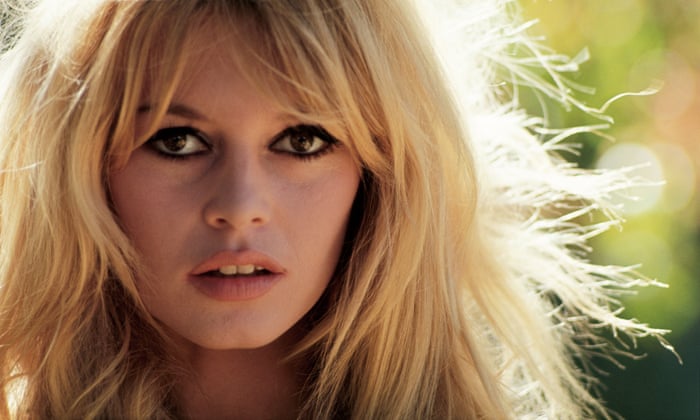
Bardot… there was a time when her name couldn’t be said without a knowing pout on the second syllable. French headline-writers loved calling the world’s most desirable film star by her initials: “BB,” which is “bébé”—a bit of weirdly infantilized tabloid pillow-talk. When Brigitte Bardot retired from movies in the mid-70s to champion animal rights and a ban on baby seal imports, the French press started calling her BB-phoque, a homophone for “baby seal” in French with a nasty hint of an English pun. But France’s love affair with Bardot was destined to sour, despite her fierce patriotism and admiration for Charles de Gaulle (which he reciprocated). As her animal rights campaigning shifted in the 21st century into an attack on halal meat, and then into shrill warnings about the alleged “Islamization” of France, her relationship with the modern world deteriorated even further.
In the 1950s, before the sexual revolution, the New Wave, or feminism, there was Bardot: she embodied sex, youth, and, more importantly, modernity. She was the unacknowledged zeitgeist that inspired young cinematic rebels like François Truffaut to challenge the old order. Bardot was France’s most sensational cultural export; effectively the French Beatles, a liberated and deliciously shameless screen siren who made male American moviegoers gulp and stare with desire in a puritanical land where on-screen sex was still rare and sexiness had to be softened with comedy. Bardot may not have had Marilyn Monroe’s comedic skills, but she possessed an ingenuous charm and real charisma, a gentleness and sweetness often overlooked amid the avalanche of prurient interest and sexist condescension.
She fueled a hungry media industry as a supposed man-eater, whose lovers and ex-husbands obligingly brawled over her in Paris streets for the press. But the relentless intrusion drove Bardot half—or three-quarters—mad. She was a public figure whose image was consumed not just through films but through magazine covers, paparazzi shots, and gloating press stories. Perhaps only Jennifer Aniston, in our own time, has endured something similar.
After several gamine roles with mousy brown hair, Bardot made her spectacular breakthrough at age 22 in 1956 with And God Created Woman, a now very genteel-looking Technicolor romantic comedy. She played a devastatingly desirable blonde, with the wasp-waisted, hip-swaying walk that defined 1950s sex appeal. Her character attracts the self-destructive obsession of an older man—a recurring theme in Bardot’s films—and is desired by younger suitors, including a young Jean-Louis Trintignant in an early role, who would later become her real-life lover. The film was directed by her Svengali-like husband at the time, Roger Vadim, who controlled both her personal and professional life.
Bardot did work with serious filmmakers. Louis Malle directed her in Vie Privée (Private Life, 1961), where she plays a version of herself—the epicenter of hysterical celebrity and voyeuristic disapproval, with blonde Bardot lookalikes everywhere on Paris streets, her character heading toward a tragic, Princess Diana-like fate at the hands of the media. But Bardot also had the unhappy fate of being patronized by the biggest name of all: Jean-Luc Godard. In Le Mépris (Contempt, 1963), she plays Camille, the beautiful wife of Michel Piccoli’s troubled screenwriter. Bardot’s nudity is displayed as the epitome of cinema’s tacky commercialism, yet there is something cynical and misogynistic in Godard’s approach.A wittier and more playful take on Bardot’s immense fame came from Agnès Varda in her 1965 film Le Bonheur (Happiness). A carpenter and his wife consider going to see a movie starring Bardot and Jeanne Moreau (likely Louis Malle’s Viva Maria!, for which Bardot received a BAFTA nomination). His wife asks him whom he prefers: Bardot or Moreau? Gallantly, he replies that he prefers her to either star. Then Varda cuts sharply to his workplace locker—covered in pictures of Bardot. Of course he prefers Bardot! Who didn’t?
As the 1960s went on, Bardot made many mediocre films, though fans retain affection for Shalako (1968), an odd western she made with Sean Connery, whose hairpiece she reportedly found unsettling. Later, she shifted into political activism, in one of the most intensely French moments of the postwar era. While skiing in Meribel in 1965, Bardot was horrified when Charly, a German shepherd belonging to Alain Delon that she was minding, bit a fellow skier on the leg. The victim was none other than French president Valéry Giscard d’Estaing, who was charmed by Bardot’s lavish apologies and the way she slathered ointment on his leg—she turned him into an unlikely political ally. Bardot was teased for her animal advocacy even before she devoted herself to it full-time. Her home in Bazoches, near Paris (now the Brigitte Bardot Foundation), was a place where animals roamed indoors: six goats, a dozen cats, a rabbit, twenty ducks, a donkey, and some sheep. The scent was distinctive.
Bardot made some great films. La Vérité (The Truth, 1960), directed by Henri-Georges Clouzot, is a riveting courtroom drama with Bardot’s character on trial for murder. If her lawyer can prove the crime wasn’t premeditated, she could be acquitted under France’s crime passionnel clause. Flashbacks reveal her desolate life as a runaway, obsessed with men who were obsessed with her, semi-homeless, and drifting into prostitution. Her character scandalizes the court by having read Simone de Beauvoir’s risqué novel The Mandarins. (De Beauvoir was a Bardot fan.) It’s gripping stuff, with a defiant final speech from Bardot denouncing the hypocrisy and cruelty of the judgmental older generation.
But my favorite is En Cas de Malheur (In Case of Emergency, 1958), a terrific crime melodrama adapted from a Georges Simenon thriller and directed by Claude Autant-Lara. Bardot plays a woman accused of violent robbery who seduces her middle-aged lawyer into fabricating evidence to acquit her. The lawyer is played by Jean Gabin, and there’s a crackling chemistry between these two icons of French cinema, old and new. Their scenes together have real tenderness and poignancy, especially when Bardot’s character believes she’s in love with her kind but cynical older man—a great role for Gabin. “On est heureuse!” she declares to the heavens: We are happy! Watching Bardot in this film is enough to make you happy.
Frequently Asked Questions
Of course Here is a list of FAQs about Brigitte Bardot inspired by the perspective of Peter Bradshaws article framing her as the iconic force who became Frances most sensational export
Beginner General Questions
1 Who is Brigitte Bardot
Brigitte Bardot is a French former actress singer and model who became a global icon in the 1950s and 60s She symbolized a new liberated sexuality and helped define French style and cinema for the world
2 Why was she so famous
She was famous for her stunning beauty charismatic onscreen presence and for challenging the conservative social norms of her time Her role in the 1956 film And God Created Woman made her an international sensation and a symbol of the sex kitten
3 What does Frances most sensational export mean
It means that beyond just being a movie star Bardot became a cultural product that defined how the world viewed Franceas a place of beauty erotic freedom sophistication and rebellion She was as influential as French wine or fashion
4 Is she still alive
Yes Brigitte Bardot is still alive She was born in 1934 and retired from acting in 1973 She has since dedicated her life to animal rights activism
5 What are her most famous movies
Her most iconic films include And God Created Woman Contempt directed by JeanLuc Godard and Viva Maria costarring Jeanne Moreau
Advanced Cultural Impact Questions
6 How did she change popular culture
Bardot popularized a specific effortless style the bikini ballet flats tousled blonde hair and cateye eyeliner She presented a image of sexuality that was natural and freespirited which was revolutionary compared to the more polished Hollywood stars of the era
7 What was her relationship with the French New Wave cinema
While not a central figure of the Cahiers du Cinéma criticturneddirector group her starring role in JeanLuc Godards Contempt is a key New Wave film It used her iconic status to deconstruct fame marriage and the filmmaking process itself