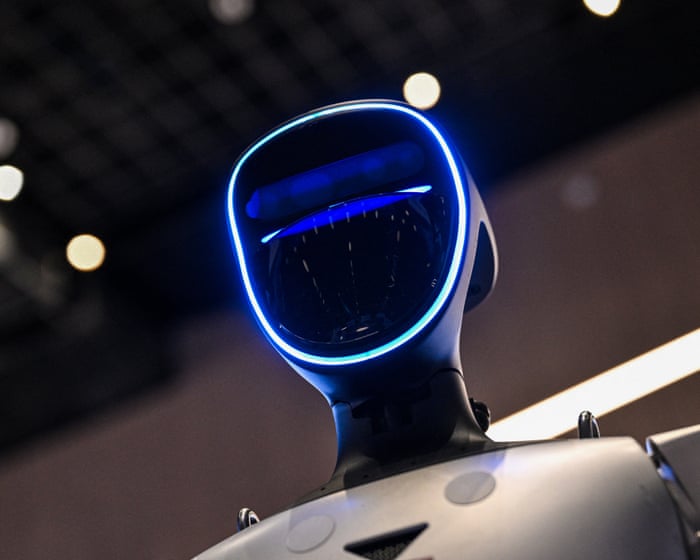
They maintain control and balance, but they don’t deviate from their programming. The technology Galbot is developing is what roboticists call a vision-language-action model (VLA). This aims to allow machines to operate in unfamiliar and changing environments, much like humans. Currently, Galbot’s robots can’t reliably perform tasks that are simple for humans, such as washing dishes. However, founder Wang has told Chinese media he aims to have 10,000 robots handling basic retail and factory work within three years. (Some AI pioneers, like Yann LeCun, are highly skeptical that the current deep learning approach can achieve the results companies like Galbot hope for.)
Chen’s visit was to explore how Galbot’s robots could be used inside an electric vehicle factory—one of the world’s most complex manufacturing settings. Achieving this requires training the robots on a vast number of factory scenarios, but there’s no ready-made database for this. For Galbot to have any chance of deploying robots in such an environment, they need a specialist with decades of complex manufacturing experience. This person must define the right tasks for the humanoid robot, specify the data it needs to learn, and even compensate for what the robot cannot yet do. That’s the expertise Chen offers.
We took an elevator to the top of a tower and entered a meeting room overlooking Peking University’s lush green campus. A senior Galbot engineer soon arrived and began briefing Chen on the company’s latest progress. He explained that Galbot robots had recently been deployed in 10 Beijing pharmacies, dispensing medication 24 hours a day. Powered by Nvidia chips, each robot costs about 700,000 yuan (£76,000). At one point, the engineer paused on a slide detailing the technology behind Galbot’s humanoids.
Before the rise of deep learning, the engineer noted, industrial roboticists like Chen trained machines manually. Programmers wrote explicit instructions for every movement. When something went wrong, they debugged the code and added new lines to handle new situations. Deep learning promises to replace this handwritten code with the more flexible VLA model. A major bottleneck in creating such models—and a key reason the “ChatGPT moment” for robots hasn’t arrived—is the scarcity of training data.
Researchers collect this data in two main ways. The first is a manual process called teleoperation, where humans guide a robot through a precise task, sometimes hundreds of thousands of times. Each task records a data package—including visual information, hand positioning, torque, and depth—known as an “action sequence,” which is later used to train the VLA. This method is labor-intensive, which is why Galbot prefers the second approach: building virtual environments. “It’s like Avatar,” the engineer said, referring to the blockbuster film. “I don’t have to physically step onto the battlefield; I just lie in my pod and can simulate everything.”
The engineer showed us real-world videos of Galbot robots being tested as store clerks, elderly care companions, and delivery robot dogs navigating live street traffic. He claimed the delivery robots could be ready in “two to three years” if sufficient resources were dedicated to the project—though they hadn’t made that decision yet. After learning about all these possibilities, Chen could barely contain his excitement. He proposed a plan to train Galbot’s humanoids to drive a screw. While human workers do this instinctively, breaking it down for a robot reveals numerous micro-decisions: finding the hole, aligning the screw, applying the right pressure and torque, and knowing when to stop. The engineer told Chen that Galbot robots could already grasp and manipulate tools like a screwdriver, but he wasn’t yet sure they could handle the precise alignment.The screw, or knowing how hard to turn it. “Let’s define responsibilities,” Chen reassured him. “What you can reliably handle, and what I’ll take over.”
They agreed on a goal: for the Galbot humanoid to be viable in the factory, it would need to fasten a screw in under eight seconds. The engineer leaned back, slightly overwhelmed. “You guys have such a wide range of engineering expertise.”
“Different genes,” Chen replied smoothly. “We can solve the industry’s problems together.”
After the meeting, I walked a block north to a nearby mall, where Galbot had set up one of its retail robots behind a promotional kiosk. The white, mannequin-like G1 model was on display, with a human worker standing by in case something went wrong. I ordered a Pocari Sweat, a Japanese energy drink, from a tablet. The G1 swiveled toward the shelf, its mechanical arms jutting out like wings, before one pincer grabbed my drink. It placed the bottle on the counter from slightly too high, so the drink bounced a few centimeters to the side, though it didn’t fall over.
Throughout our time together, Chen had emphasized that this technology was advancing faster than I could imagine. But my experience with the G1—essentially a glorified, semi-competent vending machine—left me skeptical. Two months later, in February, I watched the Lunar New Year gala from my apartment. Galbot’s robot appeared in a pre-recorded segment, and it looked different. The pincers were gone, replaced by ten articulated fingers. The arms were no longer bulky but lithe and human-like. When the robot reached for a water bottle on the shelf, it moved much faster and more assuredly than before. How much of this was edited or staged, I don’t know. But I got a taste of what Chen was feeling.
If you’ve seen a Chinese robot dance or do kung fu, chances are it was made by Unitree. Last year, the company shipped over 5,500 humanoid robots, more than any other company in the world. Recently, a viral video showed Chinese pop star Wang Leehom’s concert in Chengdu, where Unitree robots served as backup dancers. Elon Musk reposted it with one word: “Impressive.” These viral performances are good marketing for China, but Unitree’s main customers are labs and universities, including Oxford, Carnegie Mellon, UC San Diego, and Boston Dynamics, which buy the robots and develop software to make them more intelligent. A spokesperson told me Unitree wants their robots to eventually enter factories and homes to “take on dangerous, repetitive, and tedious work for people.”
Late one evening, I was in a cab in Ningbo when I got a message from a Unitree spokesperson. We had planned to meet at their headquarters in Hangzhou the next morning, but the company had abruptly scheduled an “important event” that would shut down all roads near the office. There aren’t many things in China that can stop traffic and disrupt schedules. I checked my phone to see where President Xi Jinping was: two days earlier, he had attended a sporting event in Guangzhou, but it wasn’t clear where he was heading next. The spokesperson asked if I could come tonight. I looked at the time—it was already 7:32 p.m. “We’ll be here,” she assured me. I rushed to the train station.
Despite its global stature, Unitree’s headquarters are surprisingly modest. The company occupies two weathered buildings in Hangzhou’s tech district, inside an old compound flanked by auto dealers and small family shops. When I arrived around 9 p.m., most Unitree employees were just getting off work. I was greeted by three media representatives who escorted me to a display area where an array of robots awaited. One worA purple boxing helmet bobbed as it threw combinations with such intensity that I instinctively stepped back. Nearby, another robot danced the Charleston. Next, a four-legged robotic dog cycled through flips and tricks. Throughout the demonstration, the presenters kept kicking the robots hard, but the machines absorbed every blow without toppling over.
One developer at Boston Dynamics, an American competitor, told me that Unitree’s hardware is highly advanced and remarkably affordable. Their robots start at around $1,600, while comparable American models cost tens of thousands. The Boston Dynamics developer attributed Unitree’s advantage to structural conditions. China has two sprawling metropolitan hubs—the Yangtze River Delta near Shanghai and the Pearl River Delta in Shenzhen—which host dense networks of hardware suppliers. Robot-makers can sometimes walk next door for a replacement part. Tweaking a robot prototype can take less than a day in Shenzhen, but weeks in Silicon Valley, where parts may need to travel across multiple states or oceans. This ease of building also helps explain why there are 330 different types of humanoid robots in China. It turns creative destruction into a routine part of the process. “We commercialize one generation of robots,” said Harry Xu, a robotics entrepreneur and researcher at Tsinghua University. Many from that generation inevitably fail. “Then we build the next generation.”
Another way to view the humanoid robotics industries in the U.S. and China is as a spectrum. At one end sits the general-purpose humanoid—the sci-fi vision of a machine that can do anything a human can. At the other end is a robot trained to do one thing extremely well, sacrificing versatility for commercial reliability. For various reasons—pressure to commercialize, government contracts, intense competition that rewards differentiation and profit over pure research—Chinese companies tend to be pulled toward the more modest, specialized end. Major American tech firms, insulated by deeper venture capital and less immediate commercial urgency, often aim for the holy grail of general-purpose robots. A plausible future is one where the U.S. leads the development of generalized humanoids, while China supplies the world with affordable, reliable robots, each excelling at a specific task. The U.S. may eventually produce a single robot that can mow your lawn, walk your dog, and babysit your children. But while you wait, you might as well buy three Chinese robots that each handle one task, at a fraction of the price.
The morning after my visit, I took a cab back to Unitree’s offices to see what was happening. The block around the perimeter had been cordoned off. I got out and walked about a block to Unitree’s front gate, where three suited men stood guard, scanning each passerby. Beyond three black public security vans, I couldn’t see anything. I checked my phone and saw that Xi Jinping was 750 miles away in Beijing, hosting a visit from King Felipe VI of Spain. I crossed the street and hailed another cab. Once inside, the driver was curious whether I had seen anything outside the factory. He had just dropped off a Unitree employee and was quick to speculate: “There must be an army group inside.”
His guess was reasonable. Two years ago, Chinese state TV broadcast footage of military drills showing Unitree robot dogs equipped with machine guns. American lawmakers have suggested cutting off Unitree from U.S. technologies like semiconductors. Unitree maintains it does not sell to the military nor endorse military modifications by third parties, but one U.S.-based analytics firm claims Unitree sells to Chinese universities that contract with the military. This scrutiny has affected China’s robotics industry. A spokesperson at a top robotics company told me they had been warned by authorities not to speak with Western media. When I asked Unitree’s spokespeople who the company’s…When I asked about their customers and whether they sold more robots overseas or in China, the company simply replied, “We do both.” Later, when I followed up, Unitree explained that the security presence I had seen was not military-related—it was a government delegation visiting to learn about their robots.
During the same week I visited Galbot with Chen Liang, I traveled to the outskirts of Beijing to what the city government calls China’s “largest robot training center.” The center is run by Leju Robotics, a company whose robots learn not from simulations but from real-world examples provided by human data collectors, or teleoperators. Leju’s flagship humanoid robot, Kuavo, is already being used in some electric vehicle factories across China for basic tasks like unstacking cardboard boxes.
In the lobby, a large wall monitor displayed a map of China with five glowing red dots marking each city where Leju has a training center. Next to each dot was the number of action sequences collected at that site. The largest site was here in Beijing, where about 100 teleoperators were arranged in neat rows in a sectioned-off corner of a warehouse. Each workstation had two people assigned to a robot, performing different tasks like wiping a table, organizing cutlery, or moving a glass of water. Upstairs, teleoperators trained robots on industrial tasks such as sorting and packing boxes. Leju and its affiliates sell some of this data to third parties and have also publicly released a portion—100 hours’ worth—for international researchers to use in refining vision-language-action models.
From the side of the room, I watched one worker wearing a VR-like headset guide a robot’s hand to pick up a potato from a table and place it into a basket. The robot then reached for a cloth to wipe the table. Another worker sat at a laptop, logging whether each action was successful into a database. Upstairs, engineers processed this data, which would eventually be used to train a vision-language-action model. At another station, a worker guided a robot to pour water into a bowl, but it missed, spilling water over the edge. The human partner stood up to clean the mess, and they repeated the sequence.
The teleoperators were roughly evenly split between men and women, most appearing to be in their late teens or early twenties. They were hired through a labor dispatch company, part of the often-invisible network that supports China’s economy. These dispatchers recruit workers from villages and vocational colleges, moving them seasonally to where labor is needed—from iPhone assembly lines to enforcing pandemic lockdowns. Now, the same system supplies trainers for the age of humanoid robots.
Leju’s teleoperators came from Shandong in eastern China, where they were part of a vocational training program at a local university, studying majors like “big data” and “the internet.” Before the robotics boom, many of these workers might have labeled road signs for autonomous driving systems or moderated content for tech platforms. They told me they typically perform 15 different tasks a day with the robots, repeating each one 10 times during eight-hour shifts.
Chinese officials have described teleoperation as a “new vocational training program,” but there are already reports of how dehumanizing the work can be. One former employee at a robot training lab in Tesla’s Palo Alto headquarters told Business Insider it felt like being “a lab rat under a microscope.” When I tried to ask the workers about these concerns, a spokesperson intervened. But in my brief conversations with them…They seemed curious about their work. According to recruitment posters, there are no degree requirements, and the pay is around 6,000 to 10,000 yuan per month—similar to what full-time delivery drivers earn, but with better hours.
Ulrik Hansen, co-founder of Encord, a Silicon Valley-based data services company, told me that teleoperation is on the verge of “a huge boom.” Encord already has a teleoperations center in the Bay Area and is soon opening another in Mexico. To those who worry that robots will take workers’ jobs, Hansen likes to say that teleoperations are the “new manufacturing job.” Interestingly, the term “teleoperations” refers both to training a robot and to remotely controlling one. “For every 15 to 20 robots, you need a person to manage them,” Hansen explained. When asked about the majority of workers who wouldn’t end up managing robots, he said new jobs would outnumber those lost, though he didn’t provide specifics.
Every company I contacted declined my request to speak with their teleoperators, so I tried another approach. Job postings for robot trainers are common on social media apps like Little Red Book and Douyin (China’s version of TikTok), where comments are often filled with the same question: “Are you still recruiting?” I reached out to some job seekers, introducing myself as a journalist covering China’s robotics boom. After a few days without a reply, one worker finally responded: “Go ahead.” I typed my first question and hit send, but the message immediately bounced back—my account had been flagged for unusual activity. I must have triggered a spam filter or an algorithm designed to block unwelcome questions from reporters. Teleoperators are at the heart of one of the most significant technological shifts of our time, yet their contributions remain largely invisible.
In China today, new technologies often become normalized much faster than elsewhere. In Chongqing, Saturday nights feature “drone shows” where thousands of drones arrange themselves over the Yangtze River to form giant glowing images in the sky—cityscapes, flowers, animals. In Chengdu, humanoid traffic cops admonish cyclists who stray into motor lanes. Commuters in Wuhan, Shenzhen, and Beijing are hailing driverless taxis. Part of this rapid rollout is due to lower deployment costs, but it’s also the result of coordinated efforts. In the 14 years since President Xi came to power, he has shifted from emphasizing “market-driven” innovation to prioritizing the Chinese Communist Party’s “unified leadership” in setting technological goals. Beijing has extended its influence into every corner of Chinese society, and local governments have become more responsive and competitive in meeting central directives.
During my visits to robotics startups, I often encountered mid-level officials from cities like Shenzhen and Hefei. They sat in meeting rooms, listening attentively to engineers half their age, aiming to attract startups to their regions and nurture them into local champions that bring talent and jobs. The Leju facility—a factory space of over 10,000 square meters inside an industrial park—had been provided to the company by the district government as part of a joint venture agreement just two months before my visit.
Viktor Wang, co-founder of PsiBot, a startup specializing in dexterous robotic hands, told me he had received multiple unsolicited offers from municipal governments eager to help him set up training centers. “It’s not just Beijing—Suzhou, Shanghai, Wuhan, everyone is willing to invest in these robotics projects,” he said. The competition is intense. Each city…In China’s tech landscape, major cities are like sponsors in the Hunger Games, each backing their own champion humanoid robot company: Hangzhou has Unitree, Shanghai has AgiBot, Beijing has Galbot, and Shenzhen has UBTech.
The day after visiting Leju, Wang invited me to test a teleoperation sequence at his Beijing office. The task was simple: pick up clothes from a pile and drop them into a bin. PsiBot is in discussions with the fast-fashion retailer Shein to automate the most basic tasks on their garment lines, and Wang believes this could be achieved by September. I put on a pair of skeletal gloves, connected by Velcro straps to a humanoid robot’s hands beside me. The connection wasn’t as smooth as I had anticipated—it felt clunky, like operating an arcade claw machine. As I tried to grasp the clothing with the robot’s hands, part of me expected to feel some tactile resistance. It took several attempts to get the machine to perform the motion correctly.
I realized that teleoperation isn’t just about performing actions for the robot to learn. During a sequence, you have to move at a pace the machine can register, keep your arms in a fixed position, and avoid normal human actions like scratching an itch—which would “pollute” the data. The process was more physically demanding and surreal than I expected. We’re training robots to act more like humans, but to do so, humans must first act more like robots.
The high-speed train from Beijing to Hefei speeds across the North China Plain, a vast flatland about the size of California. Six days after meeting with Galbot, I boarded the 6 a.m. train, squeezing past drowsy commuters to find my seat. It was still dark outside, with nothing to see but my own reflection. As the train raced south, dawn slowly broke, revealing tilled fields, apartment towers, and electric pylons flashing past the window. Up front, a screen showed Unitree robots performing a synchronized breakdancing routine. Four hours later, we arrived in Hefei.
I had come to tour a newly built Huawei car factory, where several of Chen Liang’s robots—including those for installing wheels, windows, and dashboards—were in operation. Once a rural backwater, Hefei has transformed into an industrial hub that, together with its surrounding region, now produces more cars than Michigan. I took a taxi to a massive factory complex on the southern outskirts, where Huawei manufactures its new ultra-luxury electric sedan, the Maextro S800.
Chen greeted me in the factory cafeteria with his familiar grin. Before we entered the production floor, his engineers helped me into steel-toed shoes while Chen briskly directed his team. Wearing a hard hat and a green vest over his suit, he seemed like a new man—more confident, like a conductor leading his own orchestra.
Car factories are typically divided into four zones. The final assembly area was quiet, clean, and bright, almost like a laboratory, with its support beams and scaffolding painted a porcelain white. As we walked through the storage section, unmanned carts—low, rectangular platforms—zipped by, delivering parts to workstations. Whenever we spotted a human worker, Chen explained their role and why robots still couldn’t handle it.
We started at the flow racks, where workers pick components like sensors and wires and place them into bins. These repetitive “pick and place” tasks are seen as ideal for automation. (In October, Figure AI released a video of its humanoid robot performing a similar task at a BMW plant in South Carolina.) Yet even here, Chen told me, humanoid robots still can’t match human workers. “One employee has to manage many different types of components, and each one requires a different way of grasping it,” he explained.The parts themselves were also changing. Just then, he pointed to a metal bracket still wrapped in foam packaging: “You have to strip that off too. It’s a pretty complicated job.”
As we walked deeper into the Huawei factory, a queue of car bodies moved along an assembly line. Workers lined both sides, jumping in and out of the car shells with drills and other tools, tightening bolts and snapping connectors into place. Watching them, I understood how difficult it would be to automate this process. The work looked far more chaotic and context-dependent than any simple pick-and-place task.
When the Maextro sedan reached Chen’s workstation, the car was hoisted onto a raised platform where three robotic arms sprang into action. One arm locked a dashboard into place while the other two bolted it to the car in seconds. “This is our fully automated dashboard installation,” Chen told me, marveling at his own creation. The Guchi engineers stood behind a monitor, mostly there for troubleshooting. “Before, workers had to guide robotic arms manually, and each car model needed different tooling because the models varied so widely,” said Chen. Not anymore. “The progression is fascinating.”
Chen combines the cautious pragmatism of an engineer with the techno-optimism of a founder. Though he is clear-eyed about the limitations of deep learning, he believes much of the assembly work in the factory will be close to fully automated by the mid-2030s. Like many of his peers in the Chinese robotics industry, Chen views the displacement of human labor with detachment. To him, the advance of technology is as inevitable as the passage of time. When I pressed him to consider the social consequences of his work, he acknowledged that he and his business partners had discussed contingency plans for laid-off workers. Those with higher skills could help train the next generation of robots, he said. He did not mention what would happen to lower-skilled workers.
Back inside the Huawei factory, we reached a station where five or six workers huddled under a raised car, craning their necks to bolt screws and tighten connectors by hand. “Long-term, this causes spinal damage,” Chen told me matter-of-factly. It was better that they be replaced by humanoids.
There are 120 million workers in Chinese factories today, several million of whom—like the workers in front of me—have undergone three to five years of vocational training. I asked Chen what this meant for their successors, those in middle school hoping to train in advanced manufacturing now. “They definitely need to change careers,” said Chen.
Decades ago, China’s infrastructure build-out of apartment towers, skyscrapers, and high-speed rail dazzled the world, but it masked a story of expropriated land, corruption, and waste. Today, something similar is happening. The vast expansion of industries like semiconductors, solar panels, and electric vehicles is impressive to behold, but much of China’s population—facing diminishing economic prospects and alarming youth unemployment—is now wondering what all that effort was for. Even those driving China’s flagship industries sometimes bemoan their situation. At his last company, which built machines for EV batteries, Chen worked 16-hour days, and clients, who often delayed payments, demanded the impossible. “Something that should take a month, they make you finish in 10 days,” he told me. As government subsidies flood the robotics sector, Chen and his peers are bracing for the usual pattern: price wars and cost-cutting maneuvers that leave companies barely able to turn a profit.
A couple of weeks earlier, back at the warehouse in Guchi’s Shanghai headquarters, Chen and I had watched General Motors employees prepare to ship his machines to the West. Chen would shortly…He was traveling to the U.S., where he planned to visit Tesla and General Motors to explore new business opportunities. While successive administrations have emphasized a commitment to decoupling from China, the reality is more nuanced. It isn’t only American businesses that need China—China also needs the U.S. Chen shared with me that working with GM taught him a great deal: how American manufacturers handle process management—the protocols, safety standards, and quality controls that, when properly followed, prevent errors before they occur. This has brought greater discipline to his team. “Working with Americans is no longer optional—it’s inevitable,” Chen told me. And, he added, “Americans pay on time.”
This article was supported by a grant from the Tarbell Center.
Discover a selection of the Guardian’s finest longform writing in one beautifully illustrated edition. In this issue, you’ll find stories about how private equity is plundering the world and what it’s like to grow up in a family of Nazis. Plus: why do we believe the perfect stroller will make us better parents? Order your copy today at the Guardian bookshop. Listen to our podcasts here and sign up to the Long Read weekly email here.
Frequently Asked Questions
Of course Here is a list of FAQs about Chinas robotics revolution designed to be clear concise and in a natural tone
Beginner Definition Questions
1 What exactly is the robotics revolution in China
Its the massive rapid adoption and development of robots across Chinese society primarily in factories but increasingly in services and homes
2 Why is China so focused on robots now
A few key reasons to offset a shrinking and aging workforce to maintain its position as the worlds factory by boosting productivity and quality and to become a global leader in advanced technology moving beyond just manufacturing
3 What kinds of robots are we talking about
Industrial Robots Robotic arms that weld assemble and paint in car and electronics factories
Service Robots Delivery bots in restaurants and hotels cleaning robots in airports and surgical robots in hospitals
Collaborative Robots Smaller safer robots designed to work sidebyside with human workers
Humanoid Robots Advanced robots that walk on two legs and are being developed for more complex tasks
Impact Benefits Questions
4 What are the biggest benefits of this robot boom
For Companies Huge gains in efficiency consistency in product quality and the ability to operate factories 247
For the Economy It helps China move up the value chain producing highertech goods and staying competitive globally
For Workers It can remove people from dangerous dull and dirty jobs potentially leading to safer and more skilled roles
5 Is China just using robots or is it making them too
Both China is the worlds largest user of industrial robots installing more every year than any other country Its also now the worlds largest producer of industrial robots with domestic companies like Siasun and Estun growing rapidly
6 Will robots take all the jobs in China
This is a major concern While robots will replace many repetitive manual jobs the revolution is also creating new jobs in robot programming maintenance system integration and data analysis The challenge is retraining the workforce for these new roles