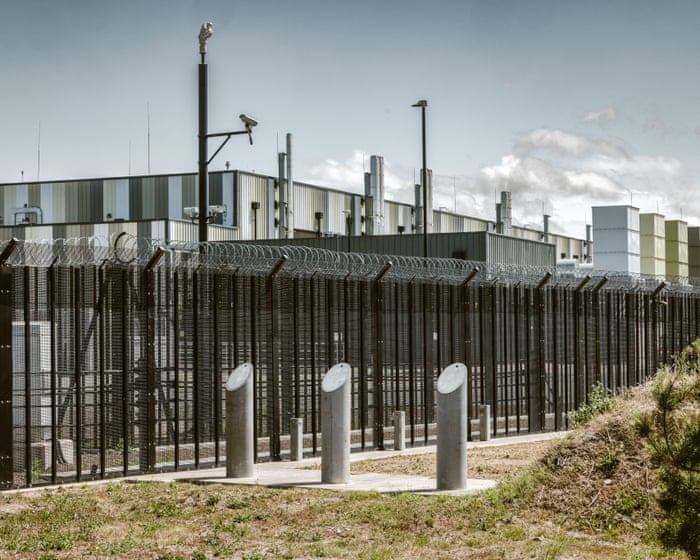
Datacentre planning proposals face many challenges, from securing energy supplies to high construction costs. But the 2,000-acre Prince William Digital Gateway site in Virginia, USA, had an extra problem: it was too close to a Civil War battlefield.
“If the development goes ahead, the solemn nature of this historic site would be spoiled by sitting in the shadow of massive datacentres and their electrical infrastructure,” one legal objection to the plans argued.
The Gateway project is now in doubt after a local court ruling stopped it and a key supporter pulled out.
It’s one of hundreds of large-scale datacentre projects worldwide that are at different stages of development, from risky attempts to ride the AI boom to more serious projects backed by tech giants like Microsoft.
But while the models from cutting-edge AI companies like OpenAI, Anthropic, and Google are improving fast, the datacentres that power their technology are being built much more slowly.
The Uptime Institute, which inspects and rates datacentres, has identified 250 global datacentre projects with energy demands over 100MW—enough to power about 300,000 homes—announced between 2021 and 2024.
It says roughly half of those projects will either not happen or will be delayed. Even if cancellations and delays do occur, there will still be an “unprecedented and rapid” increase in power demand over the next five years, according to Uptime. Mega-projects cancelled last year include Project Range in Arizona, USA, and the Cyberjaya campus in Malaysia. The Prince William Gateway is also on the cancelled list.
This backlog creates problems for AI companies that need datacentres to train and run their models. Google has admitted its cloud business—which uses datacentres to provide AI services like chatbots to companies and users—is “compute-constrained” as demand for more powerful AI models and services grows.
Jay Dietrich, a research director at Uptime, says several factors are working against proposed datacentre projects. These include: proposals from developers without datacentre experience and no committed tenants; the size, scale, and energy and water use of individual projects; the concentration of these projects in “datacentre corridors”; and supply chain issues, including getting the chips needed for them.
“The global supply chain just can’t support the number of projects out there on the timeline that’s planned. The scale is so big that it’s going to slow things down,” he says.
And, as the Prince William legal objection shows, opposition from local community and environmental groups is another ongoing issue to consider.
Uptime says we are entering an era of mega-gigawatt datacentres. It identified six projects last year, each aiming for at least 5GW of power—five in the US and one in the United Arab Emirates. To put that in perspective, Ireland’s peak energy demand is 6GW.
The energy demands are huge. Taking only the projects announced last year, and assuming they run at 25% of their planned power capacity, they would use 1.3% of the world’s projected electricity for 2025, according to Uptime. That’s nearly double the current datacentre demand. About 80% of the new power demand comes from US projects.
Uptime is not optimistic that these power needs will be met.
“Surging datacentre power demands, especially in North America, cannot be supported by power grids already under heavy strain,” Uptime said in a January report.Latest Review
Enter your email
Sign up after newsletter promotion
Datacentres using 6% of electricity supply in UK and US, research says
Read more
In California, datacentres have been sitting empty for years because the local grid can’t supply them with power. In Amsterdam, an Australian datacentre developer recently sued the Dutch grid after its request for a connection was rejected – a worrying sign that points to growing conflict between datacentre projects and the homes, hospitals, and businesses that also need that electricity.
In a warming world with rising geopolitical instability, the choices around building massive AI datacentres – instead of directing those resources elsewhere – will become even more stark.
In the UK, the Guardian’s investigations have shown that the government’s ambitious plans to turn Britain into an AI superpower seem to pay little attention to the trade-offs and resources that might require. When announcing several multi-billion-dollar projects to bring AI “into the veins” of Great Britain, the government didn’t even bother to check the promised sums.
When choosing sites for the UK’s largest AI developments, it appeared to give little thought to whether they had access to electricity.
Some observers are more optimistic. JLL, a US property consultancy, expects around 1,200 datacentres to be built globally between now and 2030 – with demand driven overwhelmingly by AI.
Revealed: landmark Scottish AI project has no prospect of meeting renewables promise
Read more
Andrew Batson, global head of datacentre research for JLL, says he is confident the capacity will be built, adding that lease signings and groundbreakings for the first half of 2026 are slightly ahead of his estimates. Pointing to factors like improvements in battery storage and on-site power generation – meaning less reliance on the local grid – he says energy constraints can also be overcome.
“I am confident that the industry will work through the energy challenges,” he says. “Energy constraints won’t go away, but the industry has been developing and implementing solutions for years, and that legacy of innovation will continue.”
According to an Uptime report published in January, the seven largest planned datacentres in the world are proposing a combined 45GW of on-site power, with gas as the main energy source. The UK’s peak energy demand is 45GW.
The Prince William Gateway submission goes on to acknowledge that datacentres are a “fundamental part of the technology infrastructure that supports the modern economy.” But local resistance and universal problems, like energy supply, are holding back this global revolution.
Get in touch
Contact us about this story
The best public interest journalism relies on first-hand accounts from people in the know. If you have something to share on this subject, you can contact us confidentially using the following methods:
Secure Messaging in the Guardian app
The Guardian app has a tool to send tips about stories. Messages are end-to-end encrypted and hidden within the routine activity that every Guardian mobile app performs. This prevents an observer from knowing you are communicating with us at all, let alone what is being said.
If you don’t already have the Guardian app, download it (iOS/Android) and go to the menu. Select ‘Secure Messaging’.
SecureDrop
If you can safely use the Tor network without being observed or monitored, you can send messages and documents to the Guardian via our SecureDrop platform.
Our guide at theguardian.com/tips lists several ways to contact us securely and discusses the pros and cons of each.
Show more
Frequently Asked Questions
Here is a list of FAQs about how delays in data center projects are impacting the AI revolution
BeginnerLevel Questions
Q Why do data centers matter for AI
A AI models especially large ones like ChatGPT need massive amounts of computing power Data centers are the physical buildings that house all the supercomputers needed to run these AI systems Without them AI cant work
Q What kind of delays are happening with data centers
A Delays include getting permits to build shortages of construction materials a lack of skilled electricians and engineers and long waits to get connected to the power grid
Q How does a delay in building a data center actually affect me
A It means the AI tools you use might become slower more expensive or stop improving New more powerful AI features could also take longer to launch
Q Is this just a problem for big tech companies
A No It affects startups universities hospitals and small businesses that want to use AI to improve their products or services If they cant get access to computing power they cant innovate
Q Is the AI revolution really at risk or is this an exaggeration
A Its a real risk The current AI boom requires a massive rapid expansion of data centers If we cant build them fast enough the growth of AI will slow down potentially leading to a bottleneck where demand exceeds supply
AdvancedLevel Questions
Q What is the main bottleneck causing these delays
A The biggest bottleneck is power Modern AI data centers consume as much electricity as a small city Utility companies cant build new power plants or upgrade the electrical grid fast enough to keep up with demand
Q Are there specific examples of major projects being delayed
A Yes For example several largescale data center projects in Northern Virginia have faced multiyear delays due to power grid constraints Similarly projects in Ireland and the Netherlands have been paused due to grid capacity limits
Q How does the shortage of GPUs play into this
A Its a double problem First there arent enough advanced chips like Nvidias H100 or B200 GP