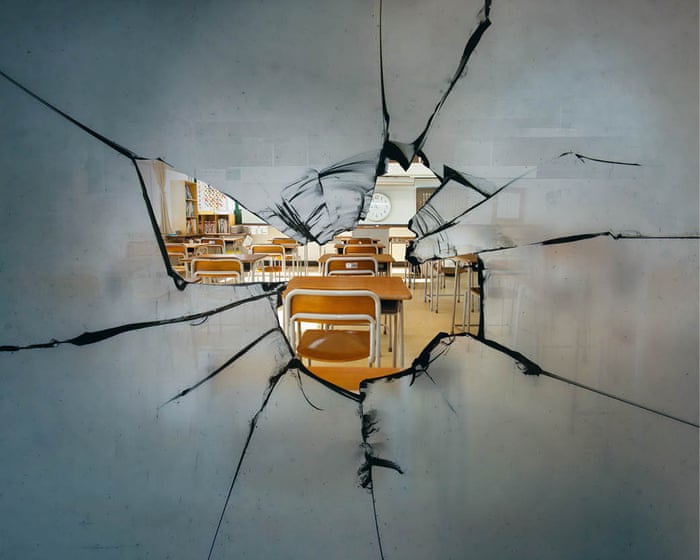
Like most French primary schools on Wednesdays, Marcel Pagnol school in the eastern suburbs of Lyon was closed on 19 June 2024. But at 6.30pm that evening, two boys turned up late for school – by two years. Former pupils there, the 13-year-olds struggled to break through the crispy lattice of the front-door window with a garden fork and a broom. Using a window-breaker, they finally made an opening large enough to force their way in without hurting themselves. What happened next is captured in a video the pair later posted on Snapchat. Once inside, they prowl the classrooms, corridors and canteen, swinging scooters around and smashing up computer equipment, setting off fire extinguishers and upending furniture. They help themselves to pouches of Capri-Sun from the fridge: “I don’t give a fuck – I’m taking the lot.” The boy not filming sets small fires as they move through the building, squirting each one with a little jet of lighter fuel. “I love what’s happening here!” says his accomplice. “I love fire.” But the exhilaration soon turns to panic. With a thick black canopy of smoke creeping along the ceiling of the main corridor, they realise it’s time to go: “Come on, come on, there’s smoke everywhere. Fuck, I can’t see a thing!” They’re soon scarpering into the surrounding streets in broad daylight, the cameraman sipping his Capri-Sun as a column of smoke rises from the school and police cars converge on the site. It’s a pattern of carnivalesque destruction – like the mass burning of cars during urban riots – that seems distinctively French. The Marcel Pagnol arson was perhaps the most serious incident of a phenomenon that has swept the whole of France in recent years: comprehensive trashings of school premises that go well beyond isolated acts of vandalism. There were at least 15 cases in 2025; a similar number in 2024. The damage inflicted on at least 24 high schools across the country during this month’s student protests seems to some extent to fit this pattern – though these actions are fuelled by particular shared grievances, including dilapidated facilities and endemic staff shortages. Perhaps attacks on schools like Marcel Pagnol should have served as canaries in the coalmine for rising tension, resentment and nihilistic feeling among students towards the institutions supposedly there to guarantee their future. Such events crop up in other countries, but here they seem to fit a pattern of carnivalesque destruction – like the mass burning of cars during urban riots – that seems distinctively French. In a sense, trashings are the country’s equivalent of school shootings in America – though obviously far less deadly and generally perpetrated by groups, not loners. To highlight a few: smashed computers and broken windows at Rabelais secondary school in Vitry-sur-Seine in March 2024, the fourth break-in in six months; graffiti of a swastika, an anarchist symbol and anti-Rassemblement National (RN) slogans left behind by ideologically confused hooligans at André Malraux secondary school in Baignes-Sainte-Radegonde, near Bordeaux; “Foke les profs” (Fuck the teachers) scrawled amid the devastation at Jean Moulin primary school in Montgeron, on Paris’s southern edge; one primary school and two nursery schools laid waste to in 2025 in working-class neighbourhoods of the Provençal city of Arles. View image in fullscreen Rabelais secondary school in Vitry-sur-Seine, a commune in the south-eastern suburbs of Paris, suffered four break-ins in six months in 2024. Photograph: Jean-Christophe Verhaegen/AFP/Getty Images In a strikingly large number of cases, it is primary schools that are attacked. When the perpetrators are caught, they are often children of early secondary-school age returning to wreak havoc. In many cases, they’re trashing the same schools in which their younger siblings are still taught. “My sister’s got school here“Tomorrow,” crows one of the intruders in the video from École Marcel Pagnol. On one hand, there’s a festive lawlessness in these acts: paint-splattered walls, toppled shelves, and a rainbow of play bricks scattered across play areas. On the other, there’s a kind of psychological self-harm in the play, like destroying the family home, which is also seen in this month’s lycée attacks. It’s hard to reconcile this puzzling mix of motives.
What’s clear is the impact on the surrounding community. Two years after the attack, on a humid June Monday morning—the last before summer holidays—pupils and parents are strolling up to Marcel Pagnol to start the school day. It’s in the suburb of Meyzieu, a relatively well-off and ordinary commuter town of Lyon, set in farmland that stretches toward the city airport. The school’s cream, two-story blocks have been restored to pristine condition—at a cost of €1.9 million to the Meyzieu municipality (partly covered by insurance).
But the attack caused a real sense of violation. “I’m sad,” six-year-old Lino told reporters from TV station BFM right after the arson. “All my drawings burned.” And the feeling still lingers. “They set the school alight with a toxic product,” says Evan, a boy of eight or nine with his thumbs inside his backpack strap. “There were flames.” Audrey Granger, a member of the parents’ association, points out that the children had to process seeing their charred drawings on the walls and burnt exercise books. She didn’t tell her daughter, who attended the nursery school next door, what had happened. “We wanted to leave her in her own little bubble,” she says.
“It was as if you left your office and someone said to you: you have no right to come back,” says Juliane Fauriat, the headteacher. “You didn’t anticipate it, you have to leave everything behind, which is very difficult.” Her staff removed salvageable equipment in crates provided by the town hall; two traumatized teachers walked out with empty boxes from their entirely burnt-out classrooms.
Two sources tell me that the break-in at Louise-Michel was in response to online ‘challenges’ teenagers set each other on social networks.
The following academic year, Marcel Pagnol’s 240 pupils were housed in prefab annexes on an empty field opposite—a novelty for some of them. But with the canteen severely damaged, lunchtime had to be split between two other school sites: one a bus ride away for the younger children; another 15 minutes’ walk away for the older ones. “They had to do it in the heat of summer and in winter,” says Sabrina, a mum in a flowery dress lingering at the end of the school run. “Can you imagine? My daughter was crying sometimes—she was always running late.”
The two 13-year-old perpetrators—one of whom shows his face in the video and names the other—were caught almost immediately. They had no criminal record and were unknown to the police; one had an “irreproachable” academic record, says Sandrine Carroz, a coordinator with the municipality’s education services. The other was going through a “fragile period, where communication with his parents was complicated.” But there had been nothing to indicate he might erupt in this way. Sylvie Normand, the deputy mayor of Meyzieu, the area served by École Marcel Pagnol, says: “I think these were young people who dared each other to do something and who came up with a bad idea, which went through their heads without them thinking about the consequences.”
The online lynch mob assembled: “Give them another chance—they were just expressing their anger at having to retake year 3 for the fifth time” is one sarcastic comment under a news report posted on YouTube. Others hint at the societal and ethnic tensions inflaming French public life—heiA reprisal for anti-drug operations in the nearby Grésilles neighbourhood, it was one of the small minority – 5% – of cases where violence in French schools is committed by outsiders (the Paty and Bernard attacks being the most extreme examples). The other 95%, including many school trashings, comes from people within the system itself: teachers, pupils, other staff. So a response beyond perimeter security is required.Seated on a bench in a small park down the hill from École Marc Bloch, on the north-western edge of the southern city of Montpellier, the president of the parents’ association, Manuella Delbecq, talks of her anger and exasperation in the face of attacks there: “We knew it was kids from the neighbourhood who were breaking in, setting fire to, stealing from and trashing schools. So the message we wanted to get across was: this is your little brother’s, your cousin’s school.”The most serious trashing at Marc Bloch occurred over the weekend of 5-6 August 2023. The intruders had an easy entry point, thanks to scaffolding that had been erected to upgrade the premises. They deactivated the alarm, then set about the usual mayhem: laying waste to seven classrooms, spraying them with paint from the cupboards and overturning an aquarium, in which luckily there were no fish.A teacher at the school says the interlopers left a few calling cards: a half-eaten salad with a fork still in it; an opened but untouched beer bottle. The tags of “DZ” – the international abbreviation for Algeria – sprayed on the wall suggested their background. The police took fingerprints from the desecrated classrooms, but no arrests or convictions were made. A nightwatchman and a dog surveilled Marc Bloch for the rest of the summer, while the renovations continued; they stopped yet more intruders before the start of the school year in September. Most pupils, shielded by their parents, had no idea about the destruction.View image in fullscreenManuella Delbecq, who heads the Hauts-de-Massane neighbourhood committee and is a former president of the parents’ association at École Marc Bloch, near the school in Montpellier. Photograph: Gregoire Bernardi/The GuardianDelbecq is accompanied by Naïma Hamada and Nadia Abzaoui, the parents’ association’s secretary and treasurer, respectively. Their neighbourhood of Les Hauts de Massane is the comparatively affluent tip of the larger, rundown La Mosson district on Montpellier’s west side. The trio, along with other parents, had already protested outside the school after an earlier trashing in 2020, in which intruders caused €30,000 worth of damage in a new annexe. No one has ever been held responsible for any of these incidents.As much as demanding reinforced security at Marc Bloch itself, the group said they were signalling their outrage to the perpetrators themselves – that such disrespect of community property wouldn’t stand. In doing so, they wanted to show they were the kind of parents who took active interest in the quality of their children’s education. “We don’t drop them off and then they can do whatever they want,” says Abzaoui. “No – we’re involved in their lives.” Their aim was counteracting stereotypes of disenfranchised, disengaged families with immigrant backgrounds. “It’s that kind of stigmatisation and fingerpointing that means a lot of parents don’t get involved,” she says.They hoped to shift the mood among the parents. “There’s a kind of shame,” says Delbecq. “They think they don’t have the right to be heard.” Before arriving in the southern city in 2002, she grew up in the 1980s in the underprivileged Parisian district of Vitry-sur-Seine. “There was a mutual respect between parents and schools then,” she says.The association tried to organise a silent march in March 2021 after other schools on the west side of Montpellier were sThey were similarly targeted. But the parents from those schools, who had initially reached out, never showed up; only the trio and a handful of other mothers from Marc Bloch marched with their banners toward the hulking tower blocks in La Mosson. Hamada was crestfallen; people seemed unwilling to turn out for fear of reprisals from the drug gangs, who were either protecting the teenagers involved in the trashing or didn’t want any spotlight on the neighbourhood that might interrupt their trade.
View image in fullscreenNadia Abzaoui (left) and Delbecq from the parents’ association at École Marc Bloch are trying to improve the relationship between parents and teachers at the school. Photograph: Grégoire Bernardi/The Guardian
This inertia is mirrored within the walls of Marc Bloch itself, the trio believe – something else they wanted to shake up through protesting. Delbecq describes a pattern of self-imposed silence from the school after disruptive incidents like the trashings: “They don’t want to talk about them.” She adds: “It doesn’t say anything, in the hope that it will buy peace. But, in fact, it’s led to something else, which is that disruptive youth are able to take up more and more space.”
The stonewalling the group describes seems consistent with the culture of #pasdevague (don’t make waves), to quote the ironic hashtag under which French teachers have for years posted on social media about the lack of support from their hierarchy when faced with school violence, especially when caused by ethnic and cultural conflicts. In the case of École Marc Bloch, the parents’ association claims it was told to stop speaking to the media and frozen out. The school did not reply to inquiries for this article.
The association has ceased its activities now; a rift that seems to be typical of what Debarbieux describes as the “catastrophic” levels of parental input into the French education system. In Meyzieu, Normand, the deputy mayor, says rebuilding these links between schools, support workers and parents is her priority in the wake of the Marcel Pagnol arson. “You have to get down on the ground,” she says. “It’s those people who’ll help you improve things.”
Outside École Marcel Pagnol, the heatwave has broken, the school year is winding down, and all is back in good order. The fire damage has been erased; the gate monitors watch the perimeter for disruptions (they interrogate one annoying Guardian journalist). But once the stream of excited faces have passed inside, what happens there? Maybe not even those in uniform can tell us. Before they melt away into the suburbs, two mothers marvel at what really disturbed their offspring: “The only thing they were shocked about was the fact it was other children who did it.”
Frequently Asked Questions
Here is a list of frequently asked questions about the vandalism of primary schools in France by teenagers
The Basics
What is happening in France with these schools
Teenagers are breaking into their old primary schools to vandalize them They are causing damage to classrooms equipment and buildings
Who is doing this
The vandals are usually teenagers who used to attend these specific schools when they were younger
What kind of damage are they causing
They are smashing windows breaking furniture spraying graffiti and destroying school supplies
Why are they targeting primary schools
The teens often say they feel these schools are worthless or not respectable They see them as childish places that dont deserve care
Is this a new problem
While school vandalism has always existed this specific trend of former students attacking their old primary schools is a growing concern in certain areas of France
Understanding the Motivation
Why do they think the school is not worthy of respect
Many of these teens come from middle or high schools that are larger and more modern They view their old primary school as small babyish and irrelevant to their current lives
Are they trying to steal things
Usually no The main goal seems to be destruction and showing off to friends rather than stealing valuable items
Is this a form of protest
Not usually It is rarely about politics or education policy It is mostly about boredom peer pressure and a desire to feel powerful by destroying something
What role does peer pressure play
It plays a huge role Many teens might not vandalize alone but they join in because their friends are doing it or they want to look tough in front of the group
The Impact
How does this affect the younger children
The young students are often scared and confused They lose their safe space and may have to move to temporary classrooms while repairs happen
How does it affect the teachers
Teachers are often heartbroken They spend their own money and time making classrooms nice and seeing them destroyed is very discouraging
Who pays for the repairs
The local government usually pays This means tax money that could be used for books or new computers goes to fixing broken windows and doors instead
Does this happen in other countries
Yes