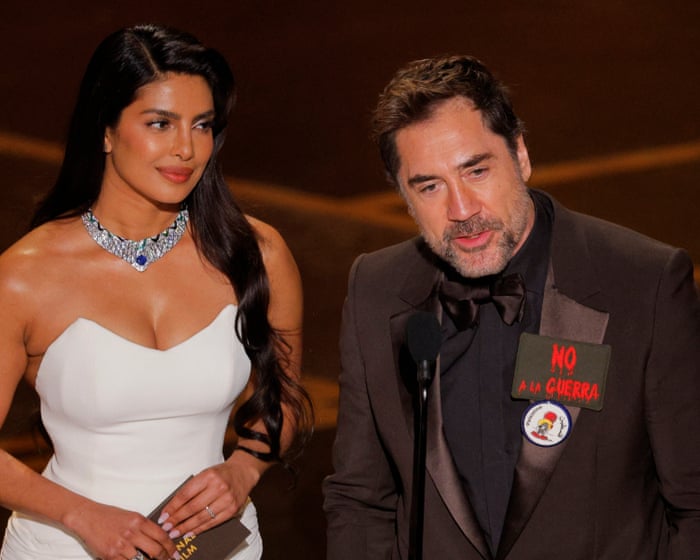
At the 98th Academy Awards, host Conan O’Brien began his opening monologue with a warning for viewers who are easily offended. “I warn you, tonight could get political,” O’Brien said. “If that makes you uncomfortable, there’s an alternative Oscars being hosted by Kid Rock at a Dave & Buster’s down the street.”
I initially rolled my eyes at the idea that Hollywood’s biggest night was prepared to confront the world’s harsh realities. Yet, this year’s Oscars proved to be unusually contentious for such a glamorous event—even with all the usual sparkle.
This shift could be due to the strong presence of socially conscious films among the nominees. Paul Thomas Anderson’s One Battle After Another won six awards, including Best Picture, while Ryan Coogler’s Sinners took home four trophies. It might also stem from growing pressure on celebrities to voice their opinions. Or perhaps the escalating crises around the world have simply become too glaring to overlook.
While presenting the award for Best International Feature Film, Javier Bardem spoke with blunt conviction: “No to war, and free Palestine.” The Dolby Theatre in Los Angeles erupted in applause.
As the night’s biggest winner with six awards, One Battle After Another secured Best Picture, Director, Adapted Screenplay, Supporting Actor (Sean Penn), Editing, and the Academy’s new Best Casting award. This epic, decades-spanning film follows a rebel group battling a brutal authoritarian faction that detains immigrants in an effort to “make America great again.”
In his acceptance speech for Best Adapted Screenplay, Paul Thomas Anderson seemed to acknowledge the parallels between his film and today’s political landscape. “I wrote this movie for my kids, to apologize for the mess we’re leaving them in this world,” he said. “But also to encourage them, hoping they’ll be the generation that restores some common sense and decency.”
Meanwhile, Joachim Trier, director of Sentimental Value, appeared to take aim at shortsighted world leaders—possibly a specific one—while accepting the Best International Feature Film award for Norway. “All adults are responsible for all children,” he stated. “Let’s not vote for politicians who fail to take that seriously.”
Last year, the Academy of Motion Picture Arts and Sciences expanded its membership by 40% to promote diversity. About 45% of new invitees were people of color, and 41% were women. Throughout the evening, winners emphasized inclusion and the importance of pioneers.
“I stand here because of the people who came before me,” said Michael B. Jordan as he accepted the Best Actor award for Sinners. He credited Black trailblazers like Sidney Poitier, Denzel Washington, Halle Berry, Jamie Foxx, Forest Whitaker, and Will Smith.
In an emotional speech for Best Animated Feature, KPop Demon Hunters co-director Maggie Kang shared, “I’m sorry it took us so long to see ourselves in a movie like this. But it’s here now. That means future generations won’t have to yearn for representation. This is for Korea and Koreans everywhere.”
At a pre-Oscars press conference, O’Brien had remarked that balancing politics and humor is a “very, very thin line.” On Sunday night, he walked that line skillfully. After the first commercial break, the host joked about Donald Trump’s habit of naming American institutions after himself, quipping, “We’re coming live from the ‘has a small penis theater.’”Rien joked, “Let’s see him put his name in front of that.”
One of the evening’s most powerful speeches came from the team behind Netflix’s documentary short All the Empty Rooms, which highlights the empty bedrooms of children killed in school shootings. “My daughter Jackie was nine years old when she was killed,” said Gloria Cazares, a subject of the film, while accepting the award for best documentary short alongside the filmmakers.
“Since that day, her bedroom has been frozen in time,” Cazares continued. “Gun violence is now the number one cause of death in kids and teens. We believe that if the world could see their empty bedrooms, it would be a different America.”
The team behind the best documentary feature winner, Mr. Nobody Against Putin, seemed to address ICE killings in the U.S. in their acceptance speech. “We act complicit when a government murders people on the streets of our major cities,” said co-director David Borenstein. “When we don’t say anything when oligarchs take over the media and control how we produce and consume it. We all face a moral choice, but even a nobody is more powerful than we think.”
In a rare tie, the Oscar for best live action short film went to both The Singers and Two People Exchanging Saliva. In an acceptance speech for the latter, co-director Natalie Musteata thanked the academy “for supporting a film that is weird and queer and made by a majority of women.”
The Academy Awards has a track record of keeping politics at arm’s length, but this year signaled that this ethos may be shifting. Last year, Adrien Brody, Daryl Hannah, and the No Other Land filmmakers were among the few who addressed political issues. Best actor winner Brody spoke of the importance of learning from the past to “not let hate go unchecked,” while presenter Hannah went off-script to declare “Slava Ukraini!” (“Glory to Ukraine”). Meanwhile, No Other Land co-director Yuval Abraham called for an end to the Gaza conflict and the release of Israeli hostages.
On the Oscars red carpet tonight, filmmakers from the Middle East spoke pointedly about current conflicts in the region. The team behind best international feature nominee The Voice of Hind Rajab wore pins designed in collaboration with artist Shepard Fairey, demanding a “permanent ceasefire” to the Israel-Gaza war. The film’s Palestinian lead actor, Motaz Malhees, was unable to attend the Oscars due to the U.S. travel ban. “You can block a passport,” Malhees wrote. “You cannot block a voice.”
The Iranian directors of best documentary feature film nominee Cutting Through Rocks expressed their solidarity with the people of Iran. “Change is possible from within, not the other way around,” said co-director Sara Khaki. “We are here to stand by the rights of our people.”
Meanwhile, lighthearted bits at the Dolby Theatre took aim at AI, reflecting widespread Hollywood concern over the technology that threatens many film industry jobs. While presenting the awards for best animated feature film and short film, actor and comedian Will Arnett said, “Tonight, we celebrate people, not AI,” as the audience clapped. “Animation is more than a simple command: it’s an art form that deserves to be protected.”
Early in the evening, the show aired a fake commercial for AI Ventura Crossroads, a fictional company that preserves classic films for the iPhone generation by making them “very skinny” and “very tall.” The ad showed clips of classic films such as North by Northwest and When Harry Met Sally that had been butchered after being cropped to fit vertical video formats.
Towards the end of his opening monologue, O’Brien took on a serious tone while discussing the pressures of the current political climate. “Everyone watching right now…””We are all too aware that these are very chaotic and frightening times around the world,” he said. “It is at moments like these that I believe the Oscars are especially meaningful: 31 countries across six continents are represented tonight, and every film we honor is the result of thousands of people speaking different languages, working hard to create something beautiful.”
On Sunday night, many of those voices could be heard more clearly than ever.
Frequently Asked Questions
Frequently Asked Questions About Free Palestine Abolish ICE at the Oscars
BeginnerLevel Questions
What do Free Palestine and Abolish ICE mean
Free Palestine This is a slogan and movement advocating for Palestinian rights often calling for an end to Israeli occupation equal rights and Palestinian selfdetermination At events like the Oscars its a call for attention to the humanitarian situation in Gaza and the West Bank
Abolish ICE This is a call to dismantle US Immigration and Customs Enforcement the agency responsible for immigration enforcement and deportations Critics argue it has a history of inhumane practices family separations and should be replaced with a more just immigration system
Why were these topics brought up at the Oscars
The Oscars is one of the worlds mostwatched events Celebrities and artists use this platform to raise awareness about causes they believe are urgent hoping to reach a massive global audience and spark conversation
Is it normal for the Oscars to get political
Yes it has a long history From speeches about civil rights and Vietnam to climate change and MeToo winners often use their moment to highlight social and political issues
Who specifically mentioned these issues at the Oscars
While not in acceptance speeches this year several attendees wore pins in solidarity with Palestine The war in Gaza and related issues were a significant topic of discussion and protest outside the ceremony Abolish ICE has been referenced in past awards seasons by filmmakers and actors criticizing immigration policies
Advanced Practical Questions
What are the main goals of the Free Palestine movement as referenced at such events
The immediate goal in the current context is often a call for a permanent ceasefire in Gaza humanitarian aid access and a political solution that ensures safety freedom and equal rights for Palestinians
What would Abolishing ICE actually look like in practice
Proponents dont advocate for no immigration enforcement Instead they propose dismantling the current agency and rebuilding a more humane transparent system focused on due process and community support potentially under different oversight or as multiple more specialized agencies
Whats a common criticism of bringing politics into award shows
Critics argue that these events are for entertainment