In his state of the nation address earlier this year, Hungary’s Prime Minister, Viktor Orbán, outlined a chilling vision for the country’s future. Signaling a new level of aggression in his campaign against truth if re-elected on April 12, Orbán vowed to purge Hungary of “bought journalists” and “fake civil society organizations.”
Media repression is not just a Hungarian problem. According to Sweden’s V-Dem Institute, a leading democracy monitor, it is the most commonly used weapon in the authoritarian arsenal. Strikingly, its latest report finds that U.S. democracy is now at its worst level since the 1960s, marked by a sharp decline in media freedom.
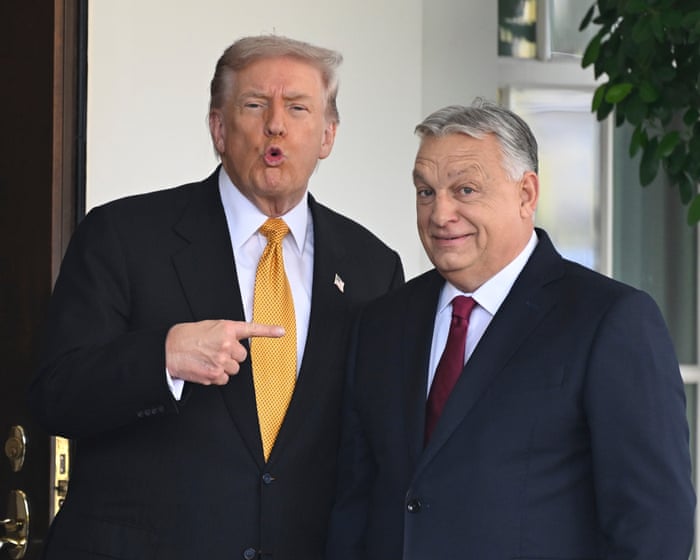
In February, Donald Trump endorsed Orbán for re-election. Likening Orbán to himself, Trump hailed the prime minister as “a truly strong and powerful leader” who has delivered “phenomenal results.” But the former U.S. president has done more than praise Orbán—he has taken a page from the Hungarian leader’s authoritarian playbook by restricting media freedom.
Trump is following the Orbán model of media repression at home. A report I co-authored for the Rule of Law Lab at NYU School of Law and the Hungarian watchdog Mérték Media Monitor makes the parallels clear, documenting Orbán’s systematic attacks on independent media over his 16-year tenure.
Both Orbán and Trump are hostile to independent journalists, routinely using dehumanizing language to refer to them. In Hungary, Orbán has described independent media outlets as “fake news factories” and journalists—alongside judges, rival politicians, and what he calls “bogus civil society” organizations—as “stink bugs” who need to be eradicated. Trump has similarly attacked critical outlets by calling them purveyors of “fake news” and the “enemy of the people.” He has misogynistically hurled epithets such as “piggy,” “ugly,” and “stupid” at female reporters.
Both leaders deny news outlets access, effectively blocking independent reporting. Orbán’s government routinely excludes independent journalists from government events, press conferences, parliament, and other public institutions. In the run-up to next Sunday’s elections, independent reporters have been forcibly removed while covering public campaign events supportive of the ruling party.
The Trump administration barred the Associated Press from the Oval Office and Air Force One because it refused to call the Gulf of Mexico the “Gulf of America.” After a court ruled that the administration’s restrictions on reporters’ access to the Pentagon were unlawful, it closed media offices in the building in an apparent attempt to circumvent the ruling.
Where exclusion fails to silence, both men have turned to using lawfare against independent media. Last month, after a report by Hungarian investigative journalist Szabolcs Panyi alleged that the country’s foreign minister routinely shared details of confidential EU meetings with his Russian counterpart—claims the minister rejected—the Hungarian government filed a criminal complaint accusing Panyi of espionage.
In 2024, the Hungarian government launched an investigation into the leading independent media outlet Átlátszó under the Sovereignty Protection Act, which targets entities allegedly serving “foreign interests.” The investigation was launched despite the fact that the European Commission had opened an infringement procedure against the Orbán government on the grounds that the act violated European Union law.
Orbán’s allies have filed numerous costly lawsuits, known as SLAPPs (strategic litigation against public participation), against independent media outlets to drain them of their resources. In 2024, the prime minister sued several independent media outlets for defamation after they cited an Austrian newspaper interview in which the CEO of…The supermarket chain Spar criticized his government. Trump has also used SLAPPs on a massive scale, filing multibillion-dollar lawsuits against outlets like ABC News, the Des Moines Register, pollster Ann Selzer, CBS News and its parent company Paramount, the New York Times, the Wall Street Journal, and the BBC.
During his second term, arrests or detentions of journalists—sometimes violent and often by law enforcement—have increased. The FBI searched a Washington Post journalist’s home, seizing electronic devices as part of a leak investigation. Earlier this year, federal agents arrested former CNN journalist Don Lemon on questionable charges related to his coverage of a protest in Minnesota. Many view these actions as clear attempts to silence independent media.
Neither Trump nor Orbán has limited their efforts to targeting journalists alone. They have also taken aim at regulatory bodies. Upon taking office in 2010, Orbán quickly passed new media laws to pack Hungary’s media regulatory authority with loyalists. One of the most striking examples of the authority’s subservience was its decision to revoke the broadcasting license of Hungary’s leading independent radio station, Klubrádió—a move the EU court later ruled violated EU law.
In 2018, the authority allowed the government to merge over 470 pro-government outlets into the Central European Press and Media Foundation (Kesma), sidestepping competition rules. It also oversaw the transformation of state-owned public media into a propaganda tool for the government. Between 2010 and 2025, Hungary’s ranking in Reporters Without Borders’ World Press Freedom Index fell from 23rd to 68th out of 180 countries, making it one of the EU’s worst media environments.
Today, Reporters Without Borders estimates that Orbán’s Fidesz party directly or indirectly controls about 80% of Hungary’s media.
While the U.S. has not reached this level of media control, Trump is pursuing a similar strategy through Brendan Carr, his chosen chair of the historically independent Federal Communications Commission (FCC). Carr has publicly stated that the FCC “isn’t independent,” approved media mergers critics say would concentrate ownership among Trump’s political allies, waived FCC rules on broadcast ownership limits, and issued regulatory threats that have pushed television outlets into what historian Timothy Snyder calls “anticipatory obedience.”
Although U.S. media remain more independent overall than Hungary’s, the Trump administration is moving quickly to consolidate its influence. Unlike Hungary, which faces oversight as an EU member, the U.S. lacks any similar check. If left unchecked, Trump’s campaign of media repression could soon surpass the Hungarian model.
Yet even in Hungary, independent outlets have managed to survive against the odds, sustained by public trust and innovative funding. As Hungarians vote next Sunday, Americans and Europeans who value a free press should pay close attention. If the enemies of media freedom are learning from each other, its defenders must do the same.
Amrit Singh is professor of practice and founding faculty director of the Rule of Law Lab at NYU School of Law.
Frequently Asked Questions
Here is a list of FAQs about the article From stink bugs to enemies of the people how Viktor Orbán paved the way for Trumps attacks on the media by Amrit Singh
BeginnerLevel Questions
1 What is this article about
This article examines how Hungarian Prime Minister Viktor Orbáns longterm strategy to discredit and control the media in his country created a playbook that former US President Donald Trump later adopted and amplified
2 Who are the main figures discussed
The main figures are Viktor Orbán the Prime Minister of Hungary and Donald Trump the former President of the United States
3 What does stink bugs refer to
Stink bugs was a derogatory term used by Viktor Orbán and his allies to refer to critical journalists in Hungary framing them as pests or nuisances to be eliminated
4 What does enemies of the people mean in this context
This is a phrase famously used by Donald Trump to attack major US news organizations accusing them of being dishonest and working against the public interest It mirrors Orbáns rhetoric and escalates it to a more dangerous level
5 What is the main connection the article makes
The article argues that Orbán didnt just inspire Trumps style he provided a tested stepbystep model for undermining independent media which Trump then applied in the different context of American politics
Advanced Analytical Questions
6 How exactly did Orbán pave the way What were his tactics
Orbáns tactics over more than a decade included passing laws to control media regulators forcing independent outlets out of business or into governmentfriendly ownership using state advertising to reward loyal media and consistently using public speeches to smear journalists as traitors liars and stink bugs
7 Why is Hungarys media landscape relevant to the US
Its relevant as a case study of democratic backsliding The article suggests that the playbook for eroding democracystarting with attacking the free presscan be exported and adapted even to a longstanding democracy like the United States
8 Whats the difference between calling journalists stink bugs and enemies of the people
While both are dehumanizing