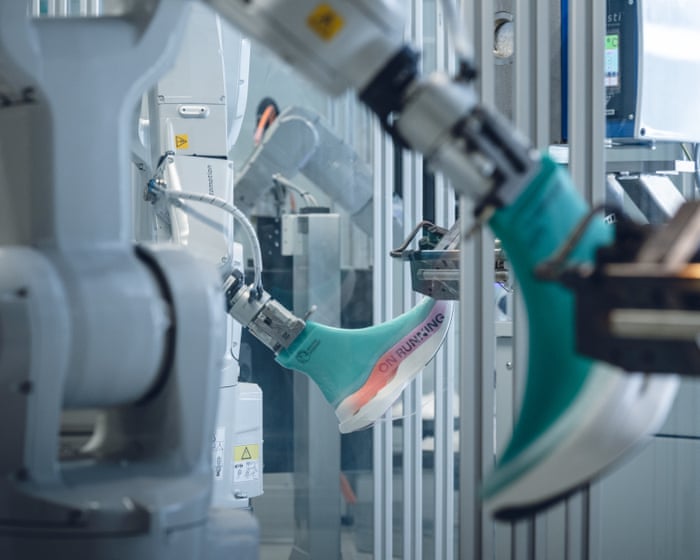
A robot leg whirs in a complex ballet as an almost invisible spray of “flying fibre” builds a high-tech £300 sports shoe at its foot. This nearly fully automated process, like a sci-fi future brought to life, is part of the strategy for On, the Swiss sports brand taking on giants Nike and Adidas with a mix of technology and boldness.
The brand is expanding rapidly after teaming up with former tennis pro Roger Federer to create shoes for his sport, alongside fashion-led collaborations with luxury brand LOEWE, actor Zendaya, and singers FKA twigs and Burna Boy. In China, sales have doubled year-on-year. Growth has been strong in the US and mainland Europe, and this month On will open its fourth London store in Kensington.
“We’re an innovation brand at heart,” says co-founder David Allemann, “because we are really going for the long run.” He’s speaking from On’s Zurich head office, which has the vibe of a tech firm or luxury gym, with light-filled spaces and quirky design features from a spiral staircase and workout room to a hanging fossilised tree.
Allemann says the company’s inspirations are disruptors like Apple and Dyson. These brands were on the “mood board” when On was founded, as they combine “unique design” with “innovation in terms of user-experience or technology.”
Allemann, a former McKinsey consultant, left his job as marketing head for furniture brand Vitra in 2010 to start On with former McKinsey colleague Caspar Coppetti and Swiss Ironman world champion Olivier Bernhard.
Bernhard’s idea was for a shoe that would protect his body from the impact of long-distance running while also promoting speed. The original prototype, developed by the inventive and committed sportsman, started with sections of hose-pipe glued to the bottom of an old pair of trainers.
The three friends, all keen runners, tried out early versions together and invested about £600,000 of their life savings to launch the company. They ordered 1,200 pairs of shoes, sold them at running meets, and eventually convinced specialist retailers to place orders.
In 2021, the trio took the brand public on the New York Stock Exchange at a valuation of $8bn (£5.95bn), raising almost $750m for the business and netting about $120m in cash while retaining a large stake. This year they expect to sell 30 million pairs. The brand is now worth $16bn.
After their innovative design took off, On developed the LightSpray flying fibre technology after a team member met a young student, Johannes Voelchert, at a design fair in 2019. The company funded him for a year to develop his vision, which was inspired by a glue gun used for Halloween spider-web decorations.
“We said: hey, he’s crazy, but we like that because Olivier was crazy as well,” says Allemann.
Voelchert is now part of a team of hundreds of research and technology experts from more than 90 countries and various industry backgrounds, helping develop new ideas for On in Zurich with a particular focus on the Los Angeles Olympics in 2028.
“We call that the explorer spirit,” says Allemann.
The idea is to foster innovation and creativity so that, even as a larger company with 4,000 employees worldwide, the entire business—from designers to manufacturers—can take risks on ideas without necessarily knowing the final outcome. “We’re still able to set sail without exactly knowing where we’re arriving, without calling home the next day,” Allemann says.
He adds that On is now seeing the benefit of “many little sprouts that are growing up,” from its move into different sports—such as…On has expanded from outdoor training and tennis to developing apparel and opening retail stores. Although the small brand holds just 1% of the $450 billion global sportswear market, according to GlobalData, it is growing quickly.
The brand operates in the premium market, with shoes priced from around £120 to £495, excluding seasonal promotions. In comparison, Nike’s shoes range from £60 to £290, and Adidas’s from £40 to £450.
Despite pressure on high-end spending due to the rising cost of living, On’s sales are expected to grow by just over a third this year, reaching nearly 3 billion Swiss Francs (£2.8 billion). The brand has captured up to a fifth of the running shoe market in the UK and other European countries.
On faces strong competition. It is only one-tenth the size of Nike, which holds about 14% of the global sportswear market, while Adidas holds 9%. Both giants have faced challenges in recent years, creating opportunities for newer brands like On and Hoka, as well as revitalized older brands such as New Balance and Onitsuka Tiger, now owned by ASICS.
Last year, On faced a class action lawsuit in the US, where customers claimed its shoes produced a “noisy and embarrassing squeak.” Its CloudTec trainers, designed with holes to create a “running on clouds” sensation, were criticized on social media for the noise. On declined to comment on ongoing legal matters.
On’s Cloudboom Strike LS laceless shoe, made by just nine robots in Zurich and priced at £310, has gained attention after Kenyan runner Hellen Obiri won this year’s New York Marathon and last year’s Boston Marathon wearing them. She also won a bronze medal at the Paris Olympics in a pair.
In Zurich, humans still outnumber the robots in the lab-like room, monitoring their work and completing the final steps. Most of On’s footwear is produced in traditional factories in Asia. However, this year, the brand plans to open its first robot-led factory to create a more accessible version of the shoe. The upper part of the shoe is made from a single, nearly mile-long filament of thermoplastic polyurethane in just three minutes—a process that traditionally takes several hours of human labor.
The factory’s location has not yet been decided but will be close to one of its main retail markets. The long-term goal is to produce on every continent, a significant shift from the current industry, which is largely based in Asia, particularly Vietnam and China.
Co-founder David Allemann says local manufacturing offers “a huge advantage from a sustainability point of view, because you don’t have to ship shoes around the world, but also from an agility to market point of view—you can produce much faster, according to what people want.”
He adds that LightSpray shoes have a 75% lower CO2 footprint than ordinary sports shoes, aligning with On’s goal of creating more sustainable and recyclable products.
Retail expansion is also a key focus. The latest London store will make the UK capital its largest retail center, with plans for up to seven stores in the future. On now has 60 outlets globally and aims to open up to 25 more each year, despite the growth of online shopping.
“We feel there’s still a lot of potential in retail, if done right,” says Allemann. “City centres are still a very important place for society, and shopping and sports are an important ingredient to that.”
With younger generations keen on sports, particularly training and running, Allemann notes that the shops “are not just stores but also communities.”He believes On will continue to grow because sports bring people together in a way the online world cannot. “Running and sports are such an important part of life that we see consumers are willing to invest in great performance, innovation, and comfort, but also in great design and what it says about them,” he says of the city hubs where running clubs begin.
Frequently Asked Questions
Of course Here is a list of FAQs about Game On designed to sound like questions from real customers and enthusiasts
General Brand Identity
Q What is Game On
A Game On is a Swiss sports performance brand that uses advanced technology and innovative design to create highquality athletic apparel and footwear Their goal is to compete directly with giants like Nike and Adidas
Q Where is Game On based and why does Swiss matter
A Game On is headquartered in Switzerland The Swiss association emphasizes precision engineering highquality materials clean design and technological innovationcore values of the brand
Q Whats Game Ons main ambition
A Their bold ambition is to become a major global player in the sports performance market by challenging the dominance of Nike and Adidas not just through marketing but through superior tech and product innovation
Products Technology
Q What kind of products does Game On make
A They focus on performance gear for running training football and other athletic pursuits This includes shoes apparel and likely sportspecific accessories
Q What makes their technology cuttingedge
A While specific tech is proprietary it likely involves advanced material science biomechanical research for better movement and smart integration
Q Are Game On shoes good for running
A Yes performance running is a key category for them Their shoes are designed with their proprietary cushioning and stability technologies aiming to rival top models from established brands
Q Do they make casual or lifestyle wear or just performance gear
A While their core is performance most brands like this also develop athleisure lines Game On likely has lifestyleoriented products that carry their design and comfort technology into everyday wear
Purchasing Practical Info
Q Where can I buy Game On products
A Initially youll likely find them on their official website and through select premium sports retailers As they grow they aim for wider retail and online distribution
Q How does the pricing compare to Nike and Adidas
A Expect similar premium pricing They are positioning themselves as a highend competitor so their toptier performance products will be in the same price range as Nikes and