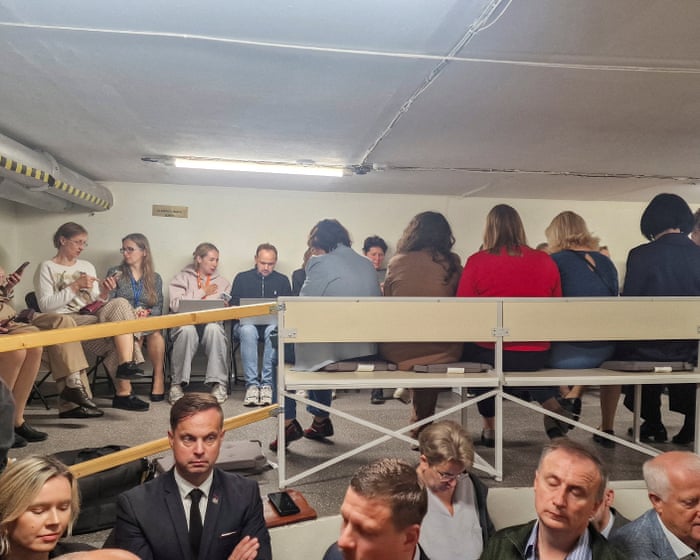
Lithuania’s president and prime minister were rushed to underground bunkers, and residents of the capital, Vilnius, were told to take shelter after a drone violated the country’s airspace. This was the first time a mobile phone “take shelter” alert was issued in an EU and NATO country since Russia’s full-scale invasion of Ukraine began in 2022. Air and train traffic in and around the city were suspended.
The defense ministry’s warning, sent around 10:20 a.m. on Wednesday and lasting about an hour, read: “Air raid alert! Go immediately to a shelter or a safe place, take care of your family members and wait for further instructions.”
Schools moved children to designated shelters, people in offices and apartment buildings went to basements, and Lithuania’s President Gitanas Nausėda, Prime Minister Inga Ruginienė, along with cabinet members and MPs, were taken to bunkers.
After the alert, European Commission President Ursula von der Leyen said Russia and Belarus were directly responsible for a series of drone incursions into EU and NATO airspace in recent weeks. Russian electronic jamming has been blamed for Ukrainian drones crossing into Finland, Estonia, Latvia, and Lithuania, all of which border Russia. A NATO jet shot down a drone over Estonia on Tuesday, and Latvia’s prime minister resigned last week over the incursions.
“Russia’s public threats against our Baltic states are completely unacceptable,” von der Leyen said on social media. “Russia and Belarus bear direct responsibility for drones endangering the lives and security of people on our eastern flank.”
NATO Secretary General Mark Rutte said on Wednesday that even if drones crash-landing in the Baltic states were launched by Ukraine, they were “not there because Ukraine wants to send a drone to Latvia, Lithuania or Estonia. They are there because of the reckless, illegal, full-scale attack of Russia.”
Some EU and NATO members suggested a stronger response might be needed. Poland’s Prime Minister Donald Tusk said on Wednesday: “The Ukrainian-Russian war may soon lead to a situation where we will have to react firmly.”
Lithuania’s army reported detecting a radar signal “typical of an unmanned aerial vehicle” in Belarusian airspace. Vilmantas Vitkauskas, head of the National Crisis Management Centre, said a drone was spotted in the Vilnius area. “Based on the parameters we saw, it’s most likely either a combat drone or a drone designed to deceive systems and lure targets,” Vitkauskas said. “The electronic countermeasures here can’t tell us whether an explosive device detonated or not.”
Lithuania’s Defense Minister Robertas Kaunas said the drone came from Latvia, and it’s unclear whether it crashed or left Lithuania’s airspace. Authorities said NATO fighter jets couldn’t locate it.
Russia’s ambassador to the UN caused outrage on Tuesday by claiming Kyiv would soon launch drones at Russia from the Baltic states and telling Latvia that NATO membership would “not protect you from retaliation.”
Lithuania’s Foreign Minister Kęstutis Budrys on Tuesday accused Moscow of “deliberately redirecting Ukrainian drones into Baltic airspace while waging smear campaigns” against all three Baltic states.
Kremlin spokesperson Dmitry Peskov said on Wednesday that Russia’s military was “closely monitoring the situation” regarding drones flying through Baltic airspace and was working on an appropriate response.
Frequently Asked Questions
Here is a list of FAQs about the reported incident of Lithuanian leaders moving to bunkers after a drone entered the countrys airspace
BeginnerLevel Questions
Q Did the President of Lithuania really go to a bunker because of a drone
A Yes reports indicate that top Lithuanian officials including the President were moved to secure bunkers as a precaution after an unidentified drone entered the countrys airspace
Q Why would a single drone cause leaders to go to a bunker
A Its a standard security protocol If a drone is unidentified and potentially hostile leaders are moved to a safe hardened location to ensure the continuity of government while the situation is assessed
Q Was the drone a threat
A At the time it was treated as a potential threat The drones origin and purpose were unknown Moving leaders is a preventive measure not proof that an attack was imminent
Q Is this a common event in Lithuania
A No While airspace violations happen moving top officials to bunkers is an extreme and rare precaution usually reserved for serious or ambiguous security incidents
IntermediateLevel Questions
Q What kind of drone was it and where did it come from
A Specific details are still emerging Initial reports suggest it was a militarygrade drone possibly originating from Belarus or Russia but this has not been officially confirmed Investigations are ongoing
Q How long were the leaders in the bunker
A The duration was relatively short typically a few hours Once the drone left Lithuanian airspace or was determined to be nonhostile the security protocols were stood down
Q Did this incident trigger any NATO response
A Yes Lithuania is a NATO member The incident likely activated NATOs airpolicing and rapidresponse procedures NATO aircraft were probably scrambled to intercept or track the drone and allied command was notified
Q What is the difference between this and a regular airspace violation
A A regular violation might be a civilian plane or a military aircraft that briefly strays This was different because the drone was unidentified its intent was unclear and it was detected in a way that suggested a possible hostile act prompting the highest level of precaution
Advanced Practical Questions