“I’m not going to start a war. I’m going to stop wars,” Donald Trump said after declaring victory on November 6, 2024. This wasn’t his first promise to pull the U.S. out of foreign conflicts, and Trump’s key allies in conservative media and the “Make America Great Again” (MAGA) movement have all backed his pledge to “put America first.”
Now that the president appears to have broken that promise by launching an invasion of Venezuela—along with threatening future actions against Cuba, Colombia, and potentially Greenland—some have understandably questioned whether Trump’s supporters in MAGA media would criticize him for the inconsistency.
But in the days since U.S. forces captured Venezuela’s president, Nicolás Maduro, and his wife in a nighttime operation that left dozens dead, Trump has received strong backing from his media allies instead. Only a few occasional supporters have expressed reservations.
“Generally, the party is going to stand with him on this, and conservative media is going to stand with him on this,” said former Republican congressman and talk radio host Joe Walsh.
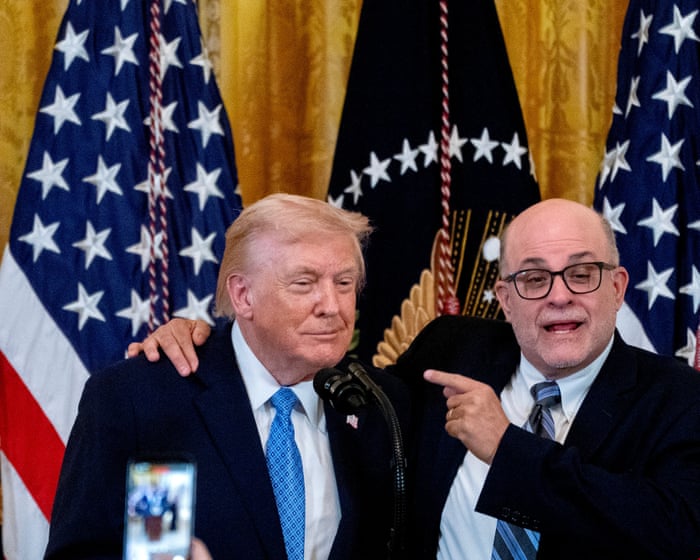
Mark Levin, one of Trump’s staunchest media defenders, not only praised the military action but also called those who questioned its legality—including Senator Bernie Sanders and New York City Mayor Zohran Mamdani—”pure evil” in a Sunday broadcast. “They defend totalitarian regimes against our nation’s own security and interests,” he added. Levin and Fox News host Sean Hannity have also promoted “The Donroe Doctrine,” the idea that Trump’s America holds dominance over the Western Hemisphere.
Conservative commentator Ben Shapiro criticized those on the “so-called isolationist right” who might oppose the administration’s actions, mainly targeting former Fox News host Tucker Carlson. Shapiro said Maduro was ousted by “a conservative Republican president, a gutsy president, who makes the calls to preserve America’s national security and her foreign interests.”
Even Carlson, however, expressed cautious optimism in a Monday episode of his streaming show after Trump endorsed Maduro’s former vice president, Delcy Rodríguez. Carlson said he’s “grateful for the wisdom of not taking out the entire government,” explaining, “Not because I support the government, but because we have clear models in Iraq and Libya and a lot of Syria: it can be very hard to put those things back together again.” He called it “a much wiser approach” to keep the government structure intact while “making sure it’s pro-American.” “That makes me calm down a bit,” he added.
Coverage among opinion hosts on Fox News has also been overwhelmingly positive. Laura Ingraham described Maduro’s capture as “quintessentially MAGA.” “America and the world is a safer, freer place,” Hannity said Monday night. “And this administration, they are making no apologies, nor should they.”
Jesse Watters remarked on The Five Monday, “Donald Trump’s like my surgeon: he’s elegant, and he’s precise, and he went in there with the perfect extraction. This is not regime change. This is just trying to change the regime’s behavior.”
Not everyone is falling in line. Former Fox News host Megyn Kelly, who now runs her own company and has a SiriusXM channel, mocked the pro-Trump coverage on her former network even while reaffirming her support for the president. “I turned on Fox News yesterday, and I’m sorry, but it was like watching Russian propaganda,” she said on her Monday show. “There was nothing skeptical.”It was all enthusiastic cheerleading, saying “yes, let’s go.” And that’s fine. I love our military as much as anyone, and I believe in President Trump, but there are serious reasons to be cautious before we just jump on the bandwagon. She said Trump’s actions to remove Maduro were clearly about global oil dominance and not “this nonsense about law enforcement.”
Kat Timpf, a libertarian commentator and regular panelist on Fox News host Greg Gutfeld’s late-night show, pointed out the inconsistencies in Trump’s past comments about international involvement. “Let me get this straight: we go to a country, we capture their leader, we bomb it, and then we say, ‘We run this country now.’ And that is not war,” she said, “but when they send cocaine over here that people are willingly snorting—that is war? It doesn’t make any sense… I hope I’m wrong. I hope this is suddenly the one regime change that works out well for us and for the people we are supposed to be rescuing, but we do not have a very good track record.” (Timpf said on X that she’s received “very brutal personal attacks” from Trump supporters—and from fellow long-term skeptics of foreign intervention—for expressing concerns about Venezuela.)
Conservative media personality Candace Owens, who has become a regular critic of the president, called it a CIA-led “hostile takeover of a country at the behest of globalist psychopaths.” She wrote in a post on X, adding that “there has never been a single regime change that Zionists have not applauded because it means they get to steal land, oil, and other resources.”
Carlson, too, who had long warned against “regime change” in Venezuela, seemed skeptical that the U.S. should be meddling in other Latin American countries, including Cuba, where Trump seemed interested in intervention. “To spend all your time worrying about Cuba? I love the Cubans here. Love them. But how much money do you want to spend out of your kid’s college fund on regime change in Cuba?”
On his War Room show on Saturday, Steve Bannon, who strongly opposed the U.S. pushing for so-called regime change in Iran this summer, called Trump’s move in Venezuela “a stunning and dazzling strike” and a “bold and brilliant raid”—though he has questioned the long-term consequences.
There was also some disagreement in the Murdoch-controlled print media. The New York Post’s editorial board came out strongly in defense of the raid, writing: “Operation Absolute Resolve was stunningly successful, fresh testimony to the tremendous professionalism of America’s servicemen and women—and of course to the resolve of President Donald Trump.” The Wall Street Journal’s editorial board, however, took a more skeptical view, writing on Saturday that it was “odd” that Trump was “so dismissive” of Venezuelan opposition leader María Corina Machado. The board also criticized Trump for talking excessively about U.S. interest in Venezuelan oil, “which sends a message that the U.S. purpose is largely mercenary.” On Sunday, the board seemed skeptical about the possibility of Venezuela’s current leadership remaining in place. “The Trump Administration talks about its foreign-policy ‘realism,'” they wrote. “But if Maduro 2.0 remains in defiant power in six months, its gamble on his henchmen won’t look very realistic.”
Walsh, a former supporter of the Tea Party movement who left the House of Representatives in 2013, knows the price of opposing Trump. He had his radio show canceled by Salem Radio Network in 2019 after he became a critic of Trump and announced a primary challenge.
“To be in right-wing media, it became clear when he…””First of all, you either get on the train or you don’t. It’s still that way,” he said in an interview. “If 100% of the audience came out against what Trump did in Venezuela, you’d see these people move, but that’s not going to happen.”
Frequently Asked Questions
Of course Here is a list of FAQs about MAGA media figures and their stance on Venezuela reflecting the mix of support and confusion observed
Beginner Definition Questions
1 What is the basic stance of MAGA media figures on Venezuela
Most strongly support former President Trumps hardline approach which involves maximum pressure on the socialist Maduro regime through sanctions recognizing opposition leader Juan Guaidó as the legitimate president and opposing any deals that they see as legitimizing Maduro
2 Why do they support this stance
They frame it as a fundamental battle against socialismcommunism a stand for freedom and a necessary check on foreign adversaries like Cuba Russia and China which support Maduro It aligns with the broader America First ideology of confronting hostile governments
3 What specific event or policy are they usually talking about
They often discuss US sanctions on Venezuelas oil industry and government officials support for the Venezuelan opposition and more recently debates over US immigration policy related to Venezuelan migrants
Advanced Confusion Questions
4 Some hosts say supporting Venezuela policy doesnt make any sense Why the confusion
The confusion often stems from a perceived conflict between two core MAGA principles 1 Fighting socialism everywhere and 2 America First noninterventionism Critics within the space ask why the US should be involved in another countrys politics when domestic issues are pressing
5 Isnt being tough on Venezuela a form of nationbuilding or interventionism that Trump opposed
This is the core of the internal debate Supporters argue its pressure diplomacy not military intervention aimed at collapsing a hostile regime Critics see it as a neoconservativestyle policy that drains focus and resources from US priorities
6 How do they reconcile support for Venezuela sanctions with criticism of high gas prices at home
This is a key point of tension Supporters argue that Venezuelan oil is less important due to US energy independence and that moral standing against tyranny outweighs the cost Critics directly link sanctions to reduced global oil supply and higher prices for Americans
7 Are there different opinions among major MAGA figures
Yes While most are vocally antiMaduro figures like