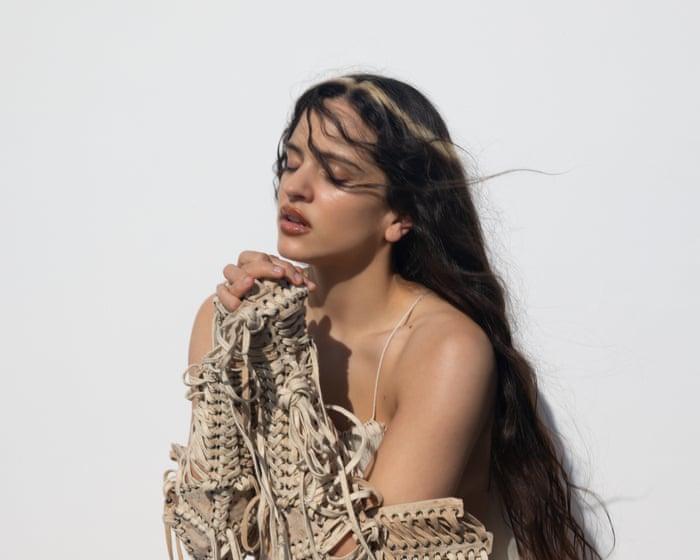
I went into Lux expecting not to like it. Not because I question Rosalía’s immense talent or her deep intellectual curiosity, but because the album’s promotional campaign had already worn on my nerves. The rollout was overwhelming: eager social media reels teasing the music, fashion-driven mysticism, even bringing central Madrid to a standstill—it all felt engineered to signal that this wasn’t just a collection of songs, but a global event demanding reverence.
Over the last decade, Rosalía has become Spain’s biggest pop export, and Lux seems to mark the start of her imperial era. The album debuted at number one in five countries, was voted the Guardian’s album of the year, broke streaming records on Spotify, and reached number four on the US and UK charts—rare territory for non-English-language pop. Multilingual and stylistically broad, Lux is steeped in Catholic imagery, with lyrics in at least 13 languages, circling themes of transcendence, suffering, and grace.
None of this is entirely new in pop, but the album’s atmosphere of luxury, and its framing of spiritual transcendence as a high-end experience, feels out of step during a cost-of-living crisis—especially when the Vatican has recently been unusually vocal in criticizing inequality, excess wealth, and the moral excuses that come with it.
“Why is she doing nun-core now?” I muttered, watching Rosalía iron her clothes in the video for the lead single “Berghain,” backed by a powerful choir and orchestra. A revival of (noticeably white) national-Catholic aesthetics feels like the last thing the world needs, especially when filtered through someone with Rosalía’s reach. Her rise has turned her into a one-woman soft-power campaign for Spanish culture, the undisputed queen of la Marca España (Brand Spain, a government initiative) on the global pop stage.
And yet, once I spent time with the album and the promotional noise began to fade, it became clear that Lux is doing something more interesting and unsettling than just lavish church-inspired pop. Beneath the grandiosity and heavy-handed symbolism lies not a sermon, but an exploration of what it means to live in a world where old certainties are unraveling.
Crisis today is no longer just a temporary exception, but an all-encompassing state—a point driven home in 2022 when Collins Dictionary named “permacrisis” its word of the year. Daily life is filled with moral urgency, and our values feel perpetually “under threat.” Cataloging disasters—genocide, war, climate collapse, inflation, displacement—now feels less like diagnosis and more like content tagging for the almighty algorithm. It was precisely this mix of uncertainty and moralizing that sociologist Ronald Inglehart studied for decades. He argued that existential insecurity pushes societies toward authoritarianism: toward upholding traditional power structures, moral rigidity, religious sanctimony, and patriarchal order.
Spain is no exception. Over the past decade, a network of ultra-conservative voices has moved from the margins to the center of public life, largely through digital means. These groups act as “moral entrepreneurs”: politically savvy and highly mobilized, they present themselves as besieged defenders of life, order, and truth against a hostile secular world. When I first loaded Rosalía’s “Berghain” video on YouTube, the ad that played before it was from the Spanish bishops’ conference, titled “You too can be a saint”—quietly confirming that even sanctity is now delivered by algorithm.
These forces feed off a Spanish cycle of rage-bait, fueled by high-level corruption scandals and politicized courts. The buzzword lately (as elsewhere) is “polarization,” but the history behind it is that of the civil war between las dos Españas (the two Spains): red versus black, Nationalists versus Republicans, Cain…Rosalía, however, wants to look beyond such a binary worldview and explore the whole in all its contradictions.
Rosalía made a surprise appearance to promote her album Lux at Callao Square in Madrid on 20 October 2025.
Lux opens not with a declaration, but with a desire: to live between two worlds (“Quién pudiera vivir entre los dos”), loving both God and the Earth’s sensual pleasures. This is no accident. Rosalía is one of the few global pop stars who conscientiously conducts scholarly research before songwriting. Her breakthrough 2018 album El Mal Querer doubled as her thesis at the Escola Superior de Música de Catalunya and received academic honors. That intellectual approach carries through to Lux. Serving also as an archive of female mystics, each song draws on figures such as Saint Teresa of Ávila, Rabia al-Adawiyya, Sun Bu’er, or Hildegard von Bingen—women for whom devotion, authority, eroticism, and transcendence were never neatly separate.
Lux is exhilarating in its refusal to settle. “Reliquia,” the album’s globetrotting second track, twists lively strings and vocal snippets into unrecognizable shapes before bursting into ecstatic rhythms. When Rosalía sings “No soy una santa, pero estoy blessed” (“I’m not a saint, but I am blessed”), the line lands with the deliberate thud of heretical subversion: divinization without ascent. This echoes one of the “abominable heresies” for which the 17th-century philosopher Baruch Spinoza was excommunicated from both Judaism and Christianity. Writing in the long shadow of the Inquisition—which forced his family’s conversion and exile—he proposed that God and nature are one and the same: that there is no hierarchy, no outside, only a single, endlessly differentiating “substance.”
At its most compelling, Lux projects its dense religious themes onto a maximalist sonic palette, where the sacred is not opposed to the profane but crowded with it. In “Divinize,” Rosalía finds liberation not through escape from the body but through deeper entanglement within it. On “Porcelana,” fragility, fear, and ferocity drive a constantly evolving tension. “Ego sum nihil / ego sum lux mundi” (“I am nothing / I am the light of the world”) she sings in Latin, softly punctuated by simmering flamenco clapping—an alchemy as powerful as anything I’ve heard this year.
These are the moments when Lux comes into focus, when easy dualities are gradually unpacked to reveal a multitude: not two opposed forces at either end of a spectrum, but countless cohabiting ones in constant tension. This is evident in the album’s sprawling liner notes and production credits—Rosalía’s singular talent pushed forward through careful collaboration.
It is not a perfect album: the more traditional pieces occasionally veer into excess or preciousness, and its avoidance of politics can feel less principled than insulated—especially at a moment when reactionary, inquisitorial forces are no longer marginal but wield direct power. Still, Lux gestures toward something more demanding than simple resolution. In the chorus of the album highlight “La Yugular,” an all-encompassing love swells until it abolishes heaven and hell alike. The song ends with Rosalía collapsing scale again and again (“the entire galaxy fits in a drop of saliva”), revealing the self as a site of both immensity and compression, where the strain of containing multitudes within a single body carries its own spiritual charge.
Carlos Delclós is a sociologist and writer based in Barcelona.
Frequently Asked Questions
FAQs Rosalías Lux
Beginner General Questions
Q What is the song Lux about
A Lux is a deeply personal song where Rosalía reflects on her career fame and the pressure to create meaningful art Its about seeking light and clarity in a chaotic world while questioning her own path and purpose
Q Why is it described as epic Catholic pop
A The song uses grand dramatic musical arrangements and religious imagery commonly found in sacred music but within a modern pop structure
Q What does the title Lux mean
A Lux is Latin for light It symbolizes enlightenment hope truth and divine guidancecentral themes shes searching for in the song
Q Is Lux part of a larger album or project
A Yes its the lead single from her third studio album Motomami which is an expanded version of her groundbreaking 2022 album Motomami
Advanced Analytical Questions
Q How does Lux confront a world full of complexity and crisis
A Lyrically it moves beyond personal drama to touch on existential dread and global uncertainty She sings about creating for the crisis and feeling the weight of the world suggesting an artists struggle to respond to a fractured modern reality through her work
Q Whats the musical shift from Motomami to Lux
A While Motomami was experimental fragmented and heavily influenced by reggaeton and electronic beats Lux is more cohesive orchestral and balladdriven It trades avantgarde chaos for a more solemn cinematic grandeur showing a new phase in her artistry
Q Can you explain the key religious and spiritual references
A Beyond the title the songs atmosphere mimics a hymn or prayer The plea for light is a classic spiritual metaphor for seeking truth and salvation It frames her artistic struggle as a almost sacred vocation battling doubt and seeking transcendence