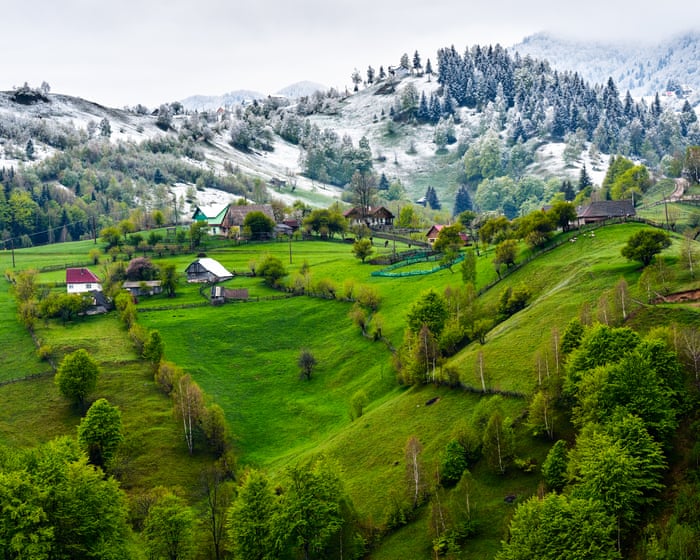
In the Transylvanian village of Pianu de Jos, 51-year-old Dana Chitucescu collects a bag of empty PET bottles, aluminum cans, and glass each week and brings it to her local shop.
Like millions of Romanians in cities and rural areas, Chitucescu has made the country’s two-year-old deposit return system part of her routine. The system is straightforward: when buying soft drinks or alcoholic beverages, customers pay an extra 0.50 Romanian leu (about £0.09) per bottle and get the money back by returning the clean, undamaged packaging to a collection point, usually the same shops where they made the purchase.
Chitucescu earns around 40 lei a week from recycling her own and another family’s bottles. “That pays for the food for my seven cats,” she said. “It’s a great system; everyone in our village uses it, and there’s always a line at the shop.”
Her weekly routine is a small part of a national change that, until recently, seemed out of reach. Romania once had one of the lowest recycling rates in the EU, but in the two years since the system started, beverage packaging collection and recycling has jumped to 94%.
“It’s a zero to hero story,” said Gemma Webb, CEO of RetuRO, the company that runs the system through a public-private partnership with beverage packaging manufacturers and the government. “The returned items are clean, with little contamination, so they can be easily recycled. We also have full traceability, meaning we know every bottle that enters the market.”
According to the company, Romanians returned about 7.5 billion beverage containers between the system’s launch in November 2023 and the end of September 2025. This included 4 billion PET bottles, 2 billion metal cans, and 1.5 billion glass containers. More than 500,000 tonnes of high-quality recyclable materials have been collected. “We are the largest fully integrated deposit return system in the world,” Webb added.
Romania’s turnaround is especially impressive given its starting point. For over a decade, the country was at the bottom of Europe’s recycling statistics. Between 2011 and 2021, its municipal waste recycling rate barely moved, hovering between 11% and 14%, while the rest of the EU made progress.
In 2021, Romania ranked last in the EU for circular material use, with only 1% of materials being recycled and reused in the economy. But in 2018, the government began discussing the deposit scheme. RetuRO started work in 2022 and, on a very tight schedule that included building nine counting and sorting centers nationwide, launched the system in late 2023.
“Now we have one of the largest and most complex logistics networks in Romania,” Webb noted.
Raul Pop, a state secretary in the environment ministry and waste policy expert, pointed out that starting later than other countries may have been an advantage, as Romania could use modern software and traceability tools.
The system operates on a return-to-retail model: shops that sell the containers must either install reverse vending machines or handle returns manually. They receive a financial incentive to cover processing costs, and RetuRO reinvests all profits back into operations.
A nationwide advertising campaign used the traditional Romanian dance, the hora, with people holding hands and dancing in a circle, to symbolize shared responsibility. A recent study found that 90% of Romanians have used the system at least once, and 60% return packaging regularly.
Pop explained that other countries “suffer from their own inertia” because they introduced their systems decades ago.Some countries are now stuck with outdated recycling systems. For them, switching to new models risks confusing consumers, even if it could boost collection rates.
Countries like Poland, Turkey, Bulgaria, Moldova, and Serbia have met with RetuRO and Romanian authorities to learn best practices as they prepare to launch similar programs.
Romania has also established a supportive legal framework. Retailers can be penalized if they refuse returns—even small village shops must accept containers if they sell the products, or they face fines. Large chains have automated return points.
Following the success with beverage containers, there are plans to expand the system to other types of packaging. Alexandra Țuțuianu of Ecoteca, Romania’s first waste management NGO, said, “If you can return a water bottle, you can also return a vinegar bottle, a jar, or a milk carton.”
However, for other packaging like crisp packets made of flexible plastic or shampoo bottles, RetuRO and the government say they are not rushing. “We are still new, and it’s premature to add more to the system,” said Webb. Any expansion would require the same level of research and industry collaboration that went into beverage containers.
Environmental groups have praised Romania’s system but warn that it only addresses a small portion of the country’s total waste. “It’s the largest environmental program and a good practice example—we like it a lot—but it’s not enough to solve Romania’s waste problem,” said Țuțuianu.
Beverage packaging makes up just 5% of all waste in Romania. The country’s overall recycling rate was only 12% in 2024, according to Eurostat, and has never exceeded 14%. Even if all beverage containers were returned, the overall recycling rate would only increase slightly.
Elena Rastei of Zero Waste Romania emphasized the importance of re-use. “Collection tackles visible waste, but re-use transforms it. When packaging is returned, washed, and refilled, it becomes a resource, not waste. One reusable bottle can replace 20 to 50 single-use ones, reduce carbon emissions, and support a circular economy.”
While Romania has become a policy model abroad, for Chitucescu, success isn’t measured in billions of bottles but in what she no longer sees in her community. After heavy rain, bottles no longer wash into streams, and the streets are free of litter.
Her brother, who lives in Spain, is envious. He tells her they don’t have a similar system there, and it’s one of the few things Romania is doing exceptionally well. “He’s jealous of us, and he’s right—it’s beneficial for us and for the environment,” said Chitucescu.
Frequently Asked Questions
Of course Here is a list of helpful and clear FAQs about Romanias new deposit return system
Beginner General Questions
1 What is this new deposit system I keep hearing about
Its a program where you pay a small extra deposit fee when you buy a drink in a singleuse plastic glass or metal container You get that money back when you return the empty container to a designated return point
2 How does it actually work
When you buy a drink you pay an extra 050 RON After you finish your drink you take the empty bottle or can to a reverse vending machine at a store The machine scans the barcode and you get your 050 RON back either as cash a voucher or by bank transfer
3 What kinds of containers are included
The system includes plastic PET bottles aluminum and steel cans and glass bottles that are sold in Romania
4 Why did Romania create this system
The main goals are to dramatically reduce litter increase recycling rates to meet EU targets and create a circular economy where materials are reused instead of being thrown away
5 Where can I return my bottles and cans
You can return them to any store that sells drinks in deposit packaging and is over 80 sqm Smaller shops often have manual collection points Look for the Reciclare or Return signs
Benefits Impact
6 What are the biggest benefits of this system
Less litter Cleaner parks streets and natural areas
More recycling Materials are collected separately and are clean making them more valuable for recycling
Saves resources It takes less energy and raw materials to make new bottles from old ones
You get money back It puts a little cash back in your pocket for doing something good
7 How successful has it been so far
Its been a huge success In its first months the system collected billions of containers achieving return rates of over 8090 This makes it one of the most effective and largest systems of its kind in the world
8 How does this help the environment
By ensuring containers are recycled