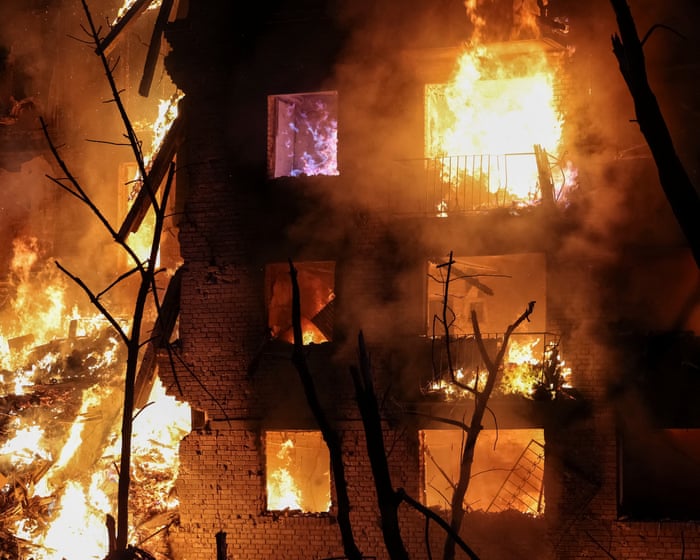
Russia used its powerful hypersonic Oreshnik ballistic missile for the third time in Ukraine during a massive attack on Kyiv and the surrounding region, killing at least four people and injuring dozens.
Ukraine’s President Volodymyr Zelenskyy said the missile struck the city of Bila Tserkva in the Kyiv region. He described a Russian assault that hit a water supply facility, burned down a market, damaged dozens of residential buildings and several schools, and included the Oreshnik missile strike.
“They are genuinely deranged,” Zelenskyy said on Telegram.
Providing more details on Sunday, Zelenskyy wrote on X that at least 83 people had been confirmed injured since midnight, with some deaths resulting from the Russian attack. He said Kyiv was hit the hardest.
Russia’s defence ministry confirmed the use of the Oreshnik, which can carry nuclear or conventional warheads. This marks the third time the weapon has been used in the conflict.
Quoted by local news agencies, the Russian defence ministry said it had carried out successful attacks on Ukrainian military command facilities, airbases, and other military enterprises using Oreshnik, Iskander, Kinzhal, and Zircon missiles.
It said the attack was retaliation for Ukrainian strikes on “civilian facilities on Russian territory.”
Zelenskyy described a “heavy attack” targeting Kyiv that involved 600 drones and 90 missiles of various types, 36 of which were ballistic. “Unfortunately, not all of the ballistic missiles were intercepted – the largest number of hits was in Kyiv. Kyiv was the primary target of this Russian attack,” he wrote on X.
“It is important that this does not pass without consequences for Russia.”
Vitali Klitschko, Kyiv’s mayor, said two people had been killed in the capital and 56 wounded. The head of the surrounding Kyiv region said two people had also been killed there and nine wounded, based on preliminary estimates.
Klitschko said damage had been recorded in every district of Kyiv. He added that an attack on a school started a fire, and another on a business centre trapped people in a shelter.
Svitlana Onofryichuk, a Kyiv resident who had worked for 22 years in the market that was hit, told the Associated Press: “It was a terrible night and there has never been anything like it in the entire war.
“I am very sorry that I have to say goodbye to Kyiv now. I am not staying there anymore. There is no possibility,” she added. “My job is gone, everything is gone, everything has burned down.”
Yevhen Zosin, 74, who witnessed the attack in Kyiv, told AP that when he heard the explosion, he rushed to grab his dog. “Then there was another explosion, and she and I were thrown back like a pin by the shock wave. We both survived, she and I. My apartment was blown to pieces,” he said.
Ukraine’s National Art Museum, which houses one of the country’s largest and most important collections, was also damaged in the blast, the culture ministry said. It posted images of damaged ceilings, broken windows, shattered glass, and debris scattered across floors and staircases.
Staff and services were inspecting the building to assess the extent of the damage. The Kyiv Independent reported that the collection was not damaged.
“Russia is systematically attacking civilian infrastructure and cultural institutions. Each such strike is an attempt to intimidate and destroy our identity,” Tetyana Berezhna, Ukraine’s minister of culture, wrote on Instagram.Ukraine’s foreign ministry was damaged for the first time since World War II, according to Foreign Minister Andrii Sybiha. He said the historic building, which has “unique architectural heritage,” suffered minor damage from nearby explosions. Sybiha added that Russian strikes had “targeted a historic area,” calling it “yet another proof we are dealing with hordes of barbarians, not the heirs of civilisation.” Putin has long claimed that Ukraine is part of Russia’s historic lands to justify his illegal invasion.
Ukraine’s government headquarters were also damaged, with windows blown out, but no one was injured, said Deputy Prime Minister Yulia Svyrydenko.
The intense attack on Kyiv came after Putin vowed revenge on Ukraine, accusing its forces of a deadly drone strike on a student dormitory in Luhansk, a Russian-controlled region in eastern Ukraine. Ukraine denied the accusations and said it had struck an elite drone command unit in the area. The Russian government claimed the attack in Starobilsk killed 21 people and wounded 42 others, and Putin said he had ordered his military to prepare retaliation options.
At a UN Security Council emergency meeting called by Russia, Ukraine’s ambassador rejected Russia’s war crime accusations, calling them a “pure propaganda show.” French President Emmanuel Macron condemned the attacks, including the use of the Oreshnik missile, which he said showed “the dead end of Russia’s war of aggression.”
Responding to the latest strikes on Ukraine, EU foreign policy chief Kaja Kallas said: “Russia hit a dead end on the battlefield, so it terrorises Ukraine with deliberate strikes on city centres. These are abhorrent acts of terror meant to kill as many civilians as possible.” She described the reported use of the Oreshnik as a “political scare tactic and reckless nuclear brinkmanship,” adding that next week EU foreign ministers would discuss “how to dial up the international pressure on Russia.”
Austrian Foreign Minister Beate Meinl-Reisinger, among other European leaders, offered support to Ukraine, saying she was “deeply appalled” by Russia’s massive attack on Kyiv. “These attacks only reinforce what is at stake: Ukraine’s freedom, Europe’s security, our shared values,” she wrote on X.
Hours before the latest attacks, President Zelenskyy wrote on social media that American and European partners had warned Ukraine that Russia was preparing a strike with the Oreshnik missile. Russia first used the Oreshnik on the Ukrainian city of Dnipro in November 2024, then a second time in January in the western Lviv region. Putin has previously claimed that the Oreshnik is impossible to intercept because it travels at 10 times the speed of sound, and that its destructive power rivals that of a nuclear weapon even when armed with a conventional warhead. Although some Western analysts have expressed doubt about those claims, Ukraine has no air defence systems capable of intercepting the missile.
Frequently Asked Questions
Here is a list of FAQs about the reported Russian hypersonic missile strike on Kyiv based on the information available
BeginnerLevel Questions
1 What exactly happened in this attack
Russia launched a hypersonic ballistic missile at Kyiv Ukrainian officials described the attack as deranged because of the type of weapon used and the timing
2 What is a hypersonic missile
Its a missile that travels at speeds of Mach 5 or faster This makes it extremely difficult for most air defense systems to track and shoot down
3 Why did officials call the attack deranged
Officials likely used that word because using such an expensive advanced and hardtointercept weapon to target a city is seen as reckless and disproportionate
4 Was anyone hurt or killed
Reports indicate there were casualties and damage but specific numbers change rapidly The main point is that the missile hit a populated area not just a military base
5 Can Kyivs air defenses stop a hypersonic missile
Its very difficult While systems like the Patriot can intercept some hypersonic threats they are not 100 effective The missiles speed and maneuverability make it a highvalue highrisk target for defenders
AdvancedLevel Questions
6 What specific type of missile was used and why does that matter
Reports suggest it was likely a Kh47M2 Kinzhal or a similar airlaunched ballistic missile It matters because these missiles are designed to evade defenses and carry a heavy warhead increasing the potential for destruction
7 How does this attack differ from previous Russian strikes on Kyiv
Previous strikes often used cruise missiles or Shahed drones which are slower and easier to intercept Using a hypersonic missile signals a shift to a more expensive highpriority weapon possibly to overwhelm defenses or send a political message
8 What is the strategic goal of using such a weapon on a city
Its often a tactic of terror and attrition The goal is to drain Ukraines limited supply of advanced air defense interceptors cause psychological fear and demonstrate that Russia can still strike the capital despite Ukrainian defenses
9 How does this attack affect the wars trajectory
It