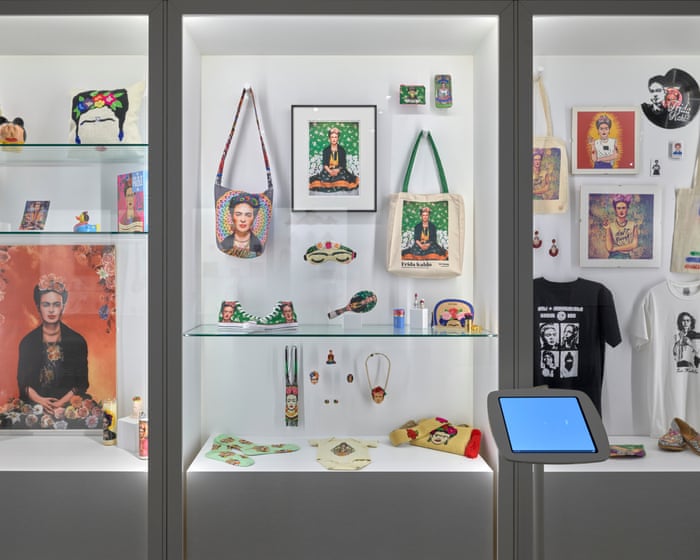
I spend a lot of time in museum gift shops, and no matter where I am in the world, I always come across Frida Kahlo. Her face is everywhere—on socks, dolls, puzzles, water bottles, cushions, jewelry, mugs, egg cups, phone cases, shopping bags, votive candles, notebooks, keychains—basically any product that can be made or printed with an image.
Her face has been simplified into a recognizable set of features: a unibrow, lipstick, and a big floral headdress (her noticeable upper lip hair is usually left out). Kahlo’s life and career have also been stripped of their complexity. Children’s books and popular art books clean up her story, turning it into an inspiring tale of strength in the face of physical pain, pride in her identity, and art overcoming hardship. She’s been reduced to a beautiful but tragic figure.
Tate Modern’s exhibition, which opened earlier this month, is called Frida: The Making of an Icon, and her status now is almost like that of a secular saint. I worry that the real, complicated Kahlo—who was sharp-tongued and shockingly rude, a heavy drug user, a big drinker, a flirt, and a committed communist—has been erased. But Beatriz García-Velasco, co-curator of the Tate show, says: “We shouldn’t apologize for the idea that Frida is universally accessible and inspiring. It shows the incredible range of artists and communities she has inspired: Chicana/o art, feminist movements, disability arts, queer culture, and people all over the world who have claimed her as their own.”
The Tate exhibition isn’t a simple overview. Kahlo’s work is displayed alongside that of her peers and later artists she inspired. One of them is Rio Yañez, a graphic artist who draws “Ghetto Frida,” a character with tattoos that say “Diego” on her neck and “Trotsky” on her armpit. Yañez has said, “I used Ghetto Frida to make fun of how Frida has been commercialized and to take a jab at the art world at the same time.” A classic print of Kahlo hung on the wall of Yañez’s family home in San Francisco’s Bay Area, “just like it did in the homes of so many Chicanos, artists, leftists, radical queers, and Mexicans.”
The show also looks at the broader idea of Fridamania, including large gatherings of Kahlo lookalikes and Camila Fontenele de Miranda’s public portrait project Todos Podem Ser Frida (Everyone Can Be Frida, 2012–20), which invited visitors to cultural events in Brazil to dress up in embroidered fabrics and floral crowns. García-Velasco says, “The commercialization of her image is tied to capitalism and consumerism, but it can also be seen as a form of democratic ownership—a way for people everywhere to literally and figuratively make Frida their own.”
Doesn’t she think some of the products with the artist’s image are a bit… questionable? García-Velasco admits the phenomenon isn’t “without its contradictions,” pointing to the widely criticized Frida Barbie released in 2018. That doll showed the artist—who had mixed Indigenous heritage and often used a wheelchair—as a pale-skinned, non-disabled woman with plucked eyebrows.
She sees a “productive tension” between these sanitized mass-market products and “the handmade devotional objects that honor Kahlo as Santa Frida: nichos [devotional dioramas], ex-votos [votive offerings], and calaca [skeleton] figures. These all represent a very different kind of ownership—one that’s devotional rather than commercial, and rooted in the communities for whom Frida really matters.”She remains a symbol of resistance and identity. The devotion Kahlo inspires comes partly from how contemporary she still feels—whether in her focus on identity or in her exploration of her experiences as a woman. Her open portrayals of pain and heartbreak clearly connect with today’s trend toward self-revelation. She began painting in her late teens after a bus accident that severely damaged her spine and pelvis. In an early drawing, The Accident (1926), she imagines the crash: surrounded by bodies, her own bandaged form lies on a stretcher in the foreground, watched over by her floating, headless figure.
In the brave painting Henry Ford Hospital (1932), she shows herself bleeding on a hospital bed after a miscarriage, surrounded by anatomical drawings, machinery, and personal symbols. The heartbreak of her turbulent relationship with Diego Rivera is laid bare on the canvas. There are grief-filled self-portraits with her hair cut off, as well as her brutal depiction of a literal death by a thousand cuts—A Few Small Nips (1935)—where a man in a fedora stands calmly over a woman’s mutilated body.
All of this speaks to Tracey Emin, whose work is also on display at Tate Modern. “Women can relate to her,” she has said; Kahlo “made images of herself bleeding in the bath, of fetuses coming out of her, and pictures of her family and lovers.” Emin discovered Kahlo as a student and created a painting inspired by the Mexican artist’s portrayal of her family tree. As a tribute, in 2000, photographer Mary McCartney captured Emin dressed fully as Frida. Lying in bed, as Kahlo often was in a life marked by injury and illness, the portrait now seems to foreshadow Emin’s own illness.
The art is still there, still loved, but to some extent, it has been overshadowed by her persona. During her lifetime, Kahlo’s art and her constructed identity as a cultural figure became one. Stepping into the public eye at age 22 as Diego Rivera’s wife, she turned herself into a character—a queen with a braided crown, wearing Aztec beads and traditional Tehuana dress—and it is in this guise that she lives on.
She has been played by Salma Hayek in a 2002 biopic and appeared as a supporting character in Barbara Kingsolver’s novel about political intolerance, The Lacuna. She has even inspired an opera. Earlier this year, the Metropolitan Opera in New York staged El Último Sueño de Frida y Diego by composer Gabriela Lena Frank and librettist Nilo Cruz. The story takes place three years after Kahlo’s death, as she returns to Earth for 24 hours during the Día de Muertos festival: a chance to live a day without physical pain and to take Rivera back to the underworld with her. As Kingsolver has noted, Kahlo and Rivera were “two of North America’s first artistic celebrities.”
One of the most important relationships in Kahlo’s life was with the camera. Her father, Guillermo Kahlo, was a photographer; as a child, she learned how to pose and perform. An early friendship with Italian-born photographer Tina Modotti introduced Kahlo to the idea that she could live a liberated, modern life as an artist. Meanwhile, her long-term lover Nickolas Muray, a pioneer of color photography, took up the camera after a career as an Olympic fencer. Kahlo admired him so much that, in one of her many flights of myth-making, she claimed Hungarian-Jewish ancestry for herself to match his.Writers, along with all the must-read articles and columns, delivered to your inbox every weekend.
Preview the latest
Enter your email
Sign up
After newsletter promotion
View image in fullscreen
Performance art duo Las Yeguas del Apocalipsis in Las dos Fridas. Photograph: Malba Foundation, Museum of Latin American Art of Buenos Aires/Yeguas del Apocalipsis/Tate Collection
In fact, Kahlo’s father was German and of Protestant background. He was born Carl Wilhelm Kahlo in Pforzheim in 1871. Her name is so familiar to us now that it’s easy to forget the woman who’s become a symbol of Mexican identity actually had a German name. People noticed this during her lifetime: with Hitler in power in the 1930s, she sometimes used her other middle name, Carmen, instead (Kahlo was born Magdalena Carmen Frida Kahlo y Calderón).
Even though she often painted herself, since her death in 1954 at age 47, the popular image of Kahlo has mostly come from color photographs taken by Muray (which are simply beautiful) rather than her self-portraits (which are often more complex and painful).
One of the first mass-produced items to feature her likeness was a 1975 silkscreen print by Rupert García called Frida Kahlo (Septiembre). First printed and sold in the San Francisco Bay Area, it presented Kahlo as a symbol for Chicano communities emerging from the civil rights movement of the 1960s. (This was the poster that hung in Yañez’s home as he grew up.) García based his print on a 1939 photograph by Muray – Frida with Magenta Rebozo – and used the hot pink of her shawl as the background color for his own image.
View image in fullscreen
Yasumasa Morimura’s An Inner Dialogue with Frida Kahlo. Photograph: Yasumasa Morimura/Luhring Augustine, New York and Yoshiko Isshiki Office, Tokyo.
By the end of the 1970s, the women’s movement had embraced Kahlo. She was celebrated as an artist who painted her own reality, whose reputation during her life had been overshadowed by her more famous husband. In March 1979, artist Mary Beth Edelson hosted a party in her New York loft to introduce Ana Mendieta to the city’s feminist art scene. The dress code was “come as your favorite artist,” and guests included Louise Bourgeois (who apparently came dressed as herself) and Hannah Wilke. Mendieta dressed as Kahlo: in a photo from the gathering, she sits on the floor at the front of the group, her hair braided with ribbons, her eyebrows penciled into the shape of a hummingbird. At the time, Kahlo’s work was still little known and rarely shown internationally.
That changed in 1982, when feminist theorist Laura Mulvey co-curated an exhibition of Frida Kahlo and Tina Modotti’s work at the Whitechapel Gallery in east London. It was the first survey of Kahlo’s work outside Mexico, and its impact was huge: here was a female artist who had been creating works about birth, abortion, miscarriage, illness, identity, and heartbreak in the 1930s and 1940s. The following year, Hayden Herrera’s bestselling biography was published. Together, the book and exhibition sparked Fridamania. As if to cement Kahlo’s new superstar status, Madonna declared herself a fan and bought several paintings.
View image in fullscreen
I Belong to Samuel Fastlicht (1951), one of many fruit-themed riddles Kahlo painted that year. Photograph: Private Collection
It’s significant that in her posthumous fame, Frida the “character” stepped back into the public eye at almost the same moment her paintings finally reached the mass audience they never had during her lifetime. Perhaps more than any other artist, both during her life and after it, her art and her persona have become inseparable.
‘Is it true she bombed her school?’ My thrilling week in the footsteps of Frida Kahlo
Read more
Despite being elevated to a modern-day secular saint, Kahlo was no saint in real life. Alongside her personal heroism and bold art, it’s important to remember the full picture.It’s important to remember that Frida struggled with self-doubt and disappointment about her own work, and she could also treat the people she loved poorly. If we expect the figures we admire to be perfect and without flaws, we’re setting ourselves up for disappointment. If there’s one thing Kahlo’s art teaches us, it’s not to avoid exploring the more complicated and challenging aspects of life.
Frida: The Making of an Icon is at Tate Modern, London, until 3 January. Hettie Judah is the author of Lives of the Artists: Frida Kahlo (Laurence King Publishing).
Frequently Asked Questions
Here is a list of FAQs about the lesserknown unfiltered side of Frida Kahlo focusing on her personality politics and personal struggles
BeginnerLevel Questions
1 Who is Frida Kahlo
Frida Kahlo was a famous Mexican painter known for her selfportraits and vibrant folkart style She is also known for her tumultuous marriage to muralist Diego Rivera
2 What does the gift shop version of Frida leave out
The popular gift shop version sanitizes Frida It often focuses only on her colorful dresses her unibrow and her pain while leaving out her heavy drinking her foul mouth and her unwavering commitment to communism
3 Was Frida Kahlo really a heavy drinker
Yes She was known to drink a lot of tequila and brandy She often used alcohol to cope with her chronic physical pain and emotional heartbreak especially during her separation from Diego Rivera
4 What does it mean that she was a devoted communist
Frida was a lifelong passionate member of the Mexican Communist Party She believed in Marxist ideology supported the Soviet Union and saw her art as a tool for political revolution and social justice for the working class
5 Why was Frida considered rude
She was famously blunt crude and had a sharp tongue She swore heavily told dirty jokes and wasnt afraid to insult people she disliked including wealthy patrons and fellow artists
Advanced Deeper Questions
6 How did her drinking affect her art and relationships
Her drinking fueled her volatile relationship with Diego Rivera leading to explosive fights It also contributed to her erratic behavior at parties and social events In her later years the drinking worsened her physical health and may have influenced the raw painful emotion in her later selfportraits
7 Was Frida Kahlo a Stalinist or a Trotskyist
This is a key distinction While she was a communist she was initially a Stalinist However she and Diego later hosted Leon Trotsky in her home After Trotskys assassination she was briefly arrested Her politics were more emotional and symbolic than strictly theoretical but she remained a loyal communist until her death