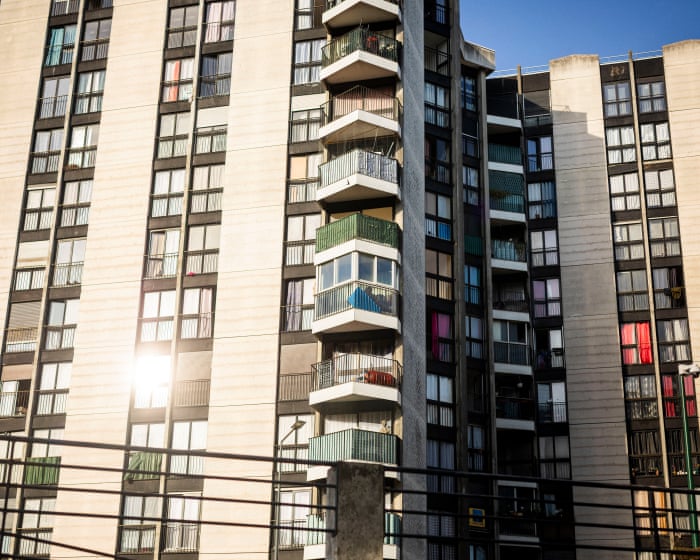
Samira, a 35-year-old single mother and former building caretaker, said she felt desperate as France recorded its highest temperatures ever this week. Living in a sweltering seventh-floor flat on a concrete housing estate south of Paris, she said, “Yesterday I sat down and cried. I thought I was going to die.”
Her apartment in Ris-Orangis, Essonne, is like millions of others in France—poorly insulated and without outside window shutters. “Blazing sun hits my windows all day. I can’t breathe, I feel dizzy, there’s no air,” she said.
“My home is an oven, it’s unbearable. I can only use a fan for short bursts because I’m afraid of the electricity costs. I only get two hours of sleep a night. I’m exhausted. The days feel endless trying to protect my son from the heat. And I know these temperatures are only going to get worse. The government only acts at the last minute. Not enough is being done long-term to protect people.”
Samira’s 10-year-old son, Issam, attends one of the 1,800 schools in France that have been closed because they are dangerously hot. “My classroom on the top floor reached 40 degrees inside,” he said. “It was too hot to have lessons, so we just played games.” He usually goes to bed at 9 p.m., but has been staying up until midnight because it’s only bearable to be outside very late or very early. Samira added, “I feel shut in, physically and mentally.”
This week, more than 44 million people in France—out of a total population of 67 million—have been under the highest red alert for heat. Daytime temperatures have exceeded 40°C in many places and stayed dangerously hot at night.
The extreme heat has led to higher air pollution, more hospital admissions, school closures, and train cancellations. It has caused power cuts to thousands of homes from Brittany to the southeast, leaving people unable to use electric fans or close electric blinds. French nuclear energy output was reduced because high temperatures limited access to cooling water. Hundreds of thousands of poultry have died in the heat, overwhelming carcass collection services.
The impact of the heatwave has been made much worse by the fact that many French buildings and infrastructure are not designed to handle high temperatures. Paris, one of Europe’s most densely populated cities, known for its poorly insulated housing, has long been considered to have the highest risk of heatwave deaths of any capital on the continent. The French government has been criticized for a lack of preparation and for cutting funding for projects aimed at adapting infrastructure to the climate crisis.
A report this month from the NGO Fondation pour le Logement (Foundation for Housing) found that half of all French homes do not provide enough protection from high temperatures, leaving residents dangerously overheated. About 66% of French people struggle to tolerate the heat in their homes.
Maïder Olivier, head of climate advocacy at the NGO, said France has a “massive and worsening problem of heat-trap housing.” She noted that climate inequality in France is growing, with low-income suburban housing estates suffering the most from heatwaves.
“One of the aggravating factors is having no way to escape,” she said. Many residents in heavily concreted estates lack green space around their homes, often work jobs in high temperatures without air conditioning, have to travel on crowded, hot buses, and cannot afford to go on holiday in the summer.
In Grigny, one of the poorest towns in the greater Paris area, 60-year-old Aboubakar, who once worked in a hotel kitchen, wept as he stood below his fourth-floor flat, which he…It could reach 40 degrees inside. “I’m suffocating,” he said. “I can’t afford to buy a fan. My flat doesn’t have any shutters. At night, I can’t sleep—it’s like an oven.” He said the heatwave had taken a toll on his mental health: other problems, like his illness and unstable housing, felt much worse in the heat. “It’s impossible to stay inside my flat during the day, so I come down and sit under a tree,” he said.
Roland, a 20-year-old student doing a youth work apprenticeship, woke up at 7 a.m. to have breakfast with his girlfriend on a bench under some trees, before it got too hot to be outside. “We try to close the shutters and stay in the dark in our flat, but there’s no air,” he said. “It can be depressing. We only dare open a window in the middle of the night. We don’t use electric fans because they cost too much.”
Inès Seddiki, founder of the organization Ghett’up in Seine-Saint-Denis, north of Paris, said young people from suburban housing estates were especially suffering in the extreme heat. “They aren’t causing the climate crisis, but they are the least protected from its effects,” she said. “There aren’t enough medical facilities in their areas for health support, their homes trap heat, and the heatwave has exposed the racism in our society against them.”
She said that when young people from the banlieue leave their areas to try to find relief, for example at the seaside, “some French commentators talk about an ‘invasion’ because it’s a group of 15 to 20 young people who are Black or North African.” She added that the heatwave had revealed “the inequality and segregation in French society.”
Several towns in the wealthiest area west of Paris, including Neuilly-sur-Seine, banned people from other towns from using their municipal swimming pools this week.
Noah, 22, on her way to a communications apprenticeship near Grigny, lives like many students in a small, top-floor shared flat in Paris, under a poorly insulated zinc roof with no shutters on the windows. She said: “There’s no air, we can never sleep more than four hours. We have a tiny balcony, so we put a children’s paddling pool on it and sit in there. What else can we do?”
Frequently Asked Questions
Here is a list of FAQs about the situation described in the article Its like a furnace French people struggle with homes that trap heat as climate inequality increases
BeginnerLevel Questions
1 What does its like a furnace mean in this context
It means that during heatwaves many homes in Franceespecially apartments under metal roofs or poorly insulated buildingsget so hot inside that they feel like an oven The heat gets trapped and wont go away even at night
2 Why are French homes so bad at staying cool
Many older buildings in France were designed to keep heat in during cold winters They have thick stone walls singlepane windows and darkcolored roofs that absorb the sun Theres also very little air conditioning compared to the US
3 Who is most affected by this furnace problem
People living in city apartments under metal or slate roofs lowincome families who cant afford fans or renovations and elderly people living alone in poorly insulated homes
4 What is climate inequality in this situation
It means that richer people can afford to install air conditioning move to cooler areas or renovate their homes Poorer people are stuck in the furnace with no way to escape the heat making the problem worse for them
5 Is this just a summer annoyance or is it dangerous
It is dangerous Extreme indoor heat can cause heatstroke dehydration and worsen existing health problems During the 2003 heatwave thousands of elderly French people died in their own hot apartments
IntermediateLevel Questions
6 Why dont French people just buy portable air conditioners
Portable AC units are expensive to buy and run Many older apartment buildings have weak electrical systems that cant handle the load and the units are noisy and inefficient Plus many landlords refuse to allow window installations
7 Cant they just open the windows at night
In cities opening windows at night lets in hot air noise and pollution In apartments with only one window theres no crossbreeze so the trapped heat just stays inside Also crime is a concern on ground floors
8 What are the main design flaws that make homes so hot