It turns out there really is a true story about cheating in chess involving a vibrating crotch—a whodunnit from over 30 years ago that was only solved last week.
Picture the scene at the 1993 World Open in Philadelphia: a mysterious, unrated player shows up with fake dreadlocks and headphones, and a bulge in his trousers that vibrates. The intrigue multiplies when this unknown amateur, calling himself John von Neumann after the founder of game theory, draws his second-round game against grandmaster Helgi Ólafsson.
“I was sure I was playing a complete patzer,” Ólafsson said later. “He had no idea about the game, and I even thought he was on drugs. He took way too much time to reply to obvious moves, and he was very strange.”
Things got even stranger in round four, when Von Neumann lost on time after just nine moves—despite having two hours for the game. He still ended up winning a few hundred dollars in prize money, but when suspicious organizers asked him to solve a simple chess puzzle, he fled and was never seen again.
So what really happened? According to the new book Lucky Devils, Von Neumann was actually a former US marine named John “The Duke” Wayne, working with his friend, mathematician and gambler Rob Reitzen. Reitzen explains to author Kit Chellel that their dream was to win big in games like backgammon using homemade technology, and chess was their test run.
Their system worked by the Duke transmitting his opponent’s moves using toe switches in his shoes. Reitzen, from his hotel suite, would then send the computer’s suggested reply to a buzzer in the Duke’s trousers. The problem was the reception was patchy, and the computer took ages to calculate even simple moves.
Inside Chess splashed the story on its 1993 front cover, calling it the Von Neumann Affair and warning: “If computers become strong enough to be of genuine assistance to top players then watch out!”
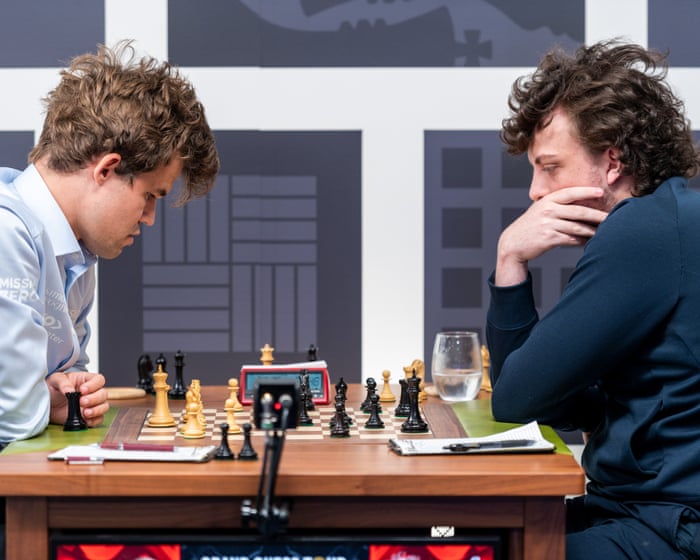
This neatly leads to the new Netflix documentary, Untold: Chess Mates, which revisits the 2022 scandal in which Hans Niemann was accused of cheating after beating world No. 1 Magnus Carlsen.
You may remember what happened: Carlsen shockingly withdrew from the prestigious Sinquefield Cup, posting a GIF on X of José Mourinho saying, “If I speak, I am in big trouble.” Niemann later admitted he had cheated in online games when he was 12 and 16, but denied allegations that he cheated to beat Carlsen by receiving messages through a vibrating sex toy. “Anal beads” became a punchline, and Niemann a punchbag.
The world had moved on by the time Niemann was cleared of cheating in his over-the-board game against Carlsen. But, four years later, grudges still fester. While Netflix uncovers no major new revelations, the documentary serves as a cautionary tale about what can happen when money enters the picture, rules are weak, and trust disappears.
“We had our Covid bump, Queen’s Gambit bump,” says Chess.com’s co-founder and CEO, Erik Allebest, at one point. “Anal beads have been super good to us … don’t use that!” He then starts laughing.
It’s not the only uncomfortable moment. Chess.com knew Niemann had cheated online as a teenager but kept it quiet—something that would raise red flags in other sports. Their stance changed suddenly when approached by Carlsen’s father, Henrik, after his son’s defeat, which again seems unusual.
Remarkably, even as Chess.com’s daily player count soared from one to six million and the company’s valuation approached a billion dollars, its mentality still carried the vibe of a tech-bro startup.
And what about Niemann? His story is even more complicated, especially for those who see the world in black and white. He insults opponents, trashes hotel rooms, and more tha…One person who has met him told me he aspires to be like Bobby Fischer—the brilliant yet deeply controversial and unstable former world champion. And as Niemann himself admits: “I am not a nice guy.”
He is undoubtedly a gifted player, but also a former cheat. Yet how long should the mistakes of youth continue to define him? Some in the chess world still don’t trust him at all, while others admire his resilience. As one person remarked to me: imagine being 19 years old, watching the chess world exploit you for content and drama, and having your name globally linked to a sex toy. Consider the sheer willpower required to endure that.
Carlsen, meanwhile, emerges from the situation looking good, and he pointedly criticizes Chess.com for misleading him into believing it had concrete evidence of Niemann cheating over the board—which it did not.
So what does this evolution from the Von Neumann era to the Niemann scandal reveal? First, that the chess landscape has changed dramatically. In 1993, as one grandmaster explained to me, the idea of an amateur cheating was shocking. That was still a time when Garry Kasparov was seen as a mystical genius who could defeat any computer. Today, even Carlsen would lose to a novice with a phone.
But this isn’t just about vibrating devices or hidden aids—it’s about suspicion itself. While online platforms like Lichess and Chess.com use cheat-detection software, it isn’t flawless. This raises a persistent question: am I facing someone who found a brilliant move through their own mind, or with the help of a computer?
So far, grandmasters caught cheating over the board have mostly used surprisingly low-tech methods, like hiding a phone in the bathroom and checking it between moves. Since the Niemann incident, players are now scanned with wands for electronic devices. Still, no one is entirely convinced these measures are foolproof.
One final note: someone really ought to turn Lucky Devils into a film. Reitzen is still alive, having made and lost several fortunes, but sadly John “The Duke” Wayne died of cancer in 2018. Even so, his name deserves to live on in infamy—despite his more famous namesake. After all, he was the first chess cheat of the modern computer age.
Frequently Asked Questions
Of course Here is a list of FAQs about the article Vibrating crotches anal beads and suspicious minds the long strange history of chess cheats by Sean Ingle
General Beginner Questions
Q What is this article about
A Its a journalistic article that explores the bizarre and long history of cheating in the game of chess from oldfashioned methods to modern hightech scandals
Q Why is the title so strange What do vibrating crotches and anal beads have to do with chess
A The title references real alleged cheating methods Vibrating crotches refers to rumored electronic devices and anal beads refers to a specific infamous scandal where a player was accused of using wireless beads to receive coded moves
Q Is this article a joke or satire
A No its a serious journalistic piece While the methods described are outlandish the article uses them to discuss the very real highstakes problem of cheating in professional chess
Q Who is Sean Ingle
A Sean Ingle is the chief sports reporter for The Guardian newspaper known for his indepth and investigative sports journalism
About the History Examples
Q What are some oldfashioned ways people cheated at chess
A Historically cheats used signals like coughing tapping fingers or prearranged codes with an accomplice in the audience Some even tried to hypnotize their opponents
Q What was the anal beads scandal
A In 2022 Grandmaster Hans Niemann beat World Champion Magnus Carlsen Carlsen implied Niemann cheated leading to wild online speculation One unproven theory suggested Niemann used wireless anal beads to receive vibrating signals from a computer
Q Has anyone been caught using a vibrating device
A There have been confirmed cases in other sports and online chess but no toplevel overtheboard player has been publicly caught midgame with such a device The fear and suspicion of them however are very real
Q What is the most common way cheaters get caught today
A Through statistical analysis of their moves Anticheat software compares a players moves to a perfect chess engine A consistently superhuman