The “shadow fleet” used by Russia, Iran, and Venezuela to circumvent Western sanctions and deliver cargo to customers like China and India is rapidly expanding in both size and scope. There are growing concerns that efforts to counter it are edging closer to dangerous military confrontations.
Complicating matters, Russia has begun placing its own flag on some former shadow fleet tankers, openly challenging Europe. This collection of aging oil tankers—with opaque ownership and questionable registrations—has drawn increasing international attention this year. Responses have included maritime seizures to enforce sanctions, such as the recent US blockade targeting sanction-evading ships in Venezuela.
Earlier this month, US special forces rappelled from helicopters to board the Skipper, a tanker off Venezuela’s coast that the US Treasury had sanctioned in 2022 over allegations it smuggled oil for Iran’s Revolutionary Guards and Hezbollah. Days later, US forces seized a second merchant vessel carrying oil in international waters off Venezuela, even though it did not appear on the US sanctions list.
These US actions follow incidents where Estonia and France intercepted vessels suspected of belonging to Russia’s shadow fleet, as well as recent Ukrainian drone attacks on Russian shadow tankers accused of sanctions evasion. The increasingly aggressive efforts to police the fleet, coupled with evidence that Russia is willing to use military assets to protect its tankers, have led experts to warn of rising confrontation risks.
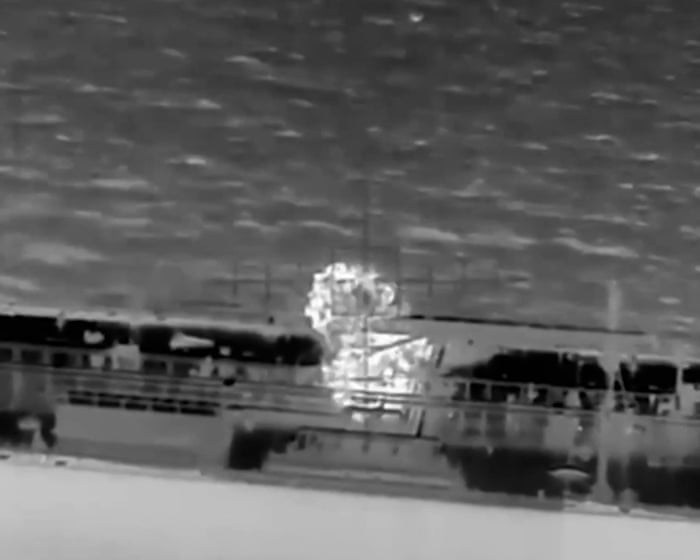
This danger was starkly highlighted when Ukraine announced it had struck a Russian tanker with aerial drones in neutral waters off Libya—marking its first such attack in the Mediterranean, about 1,200 miles from Ukraine’s borders.
“The shadow fleet itself is not a new threat,” said Gonzalo Saiz Erausquin of the Royal United Services Institute. “But it has expanded drastically after Russia’s full-scale invasion of Ukraine in 2022. What we call the shadow fleet has exploded to some 900–1,200 vessels globally. It is not highly structured or homogeneous. These are vessels that Russian interests are able to purchase secondhand—opaquely owned tankers or ones owned by companies prepared to engage in illicit activity.”
The shadow fleet has spawned an entire illicit support network, including a recent proliferation of fake flag registration websites, unscrupulous brokers, and a web of opaque companies facilitating the trade.
The tanker Boracay, intercepted by Estonia and France earlier this year, is a prime example. Acquired in 2020 by a shell company in Seychelles called Baaj Shipping, it was later blacklisted by the UK and EU over suspected links to transporting Russian oil, “irregular and high-risk shipping practices,” and allegations of operating under a fraudulent Benin flag—following other false registrations in Gambia and Malawi. According to Lloyd’s List, the ship—a “textbook example of deceptive shipping practices”—had also been investigated by Denmark.Intelligence services have raised concerns about a ship potentially being used to launch drones against Copenhagen’s airport, as it was operating under a different name. This same vessel was reportedly targeted with a limpet mine at one point.
Countries trying to counter the shadow fleet rely on international laws and conventions regarding seaworthiness, insurance, and safe navigation to pressure these vessels. However, a growing international willingness to enforce these rules—such as the Trump administration’s December announcement to block sanctioned ships from visiting Venezuela—carries its own risks.
Washington is not alone in considering intercepting shadow fleet tankers. In October, French President Emmanuel Macron indicated a greater European readiness to tackle suspicious ships in their waters, stating at a Copenhagen meeting, “We have decided to take a step forward by adopting policies to impede suspicious ships.”
The risks of such policies were highlighted by an incident involving an oil tanker, known successively as Jaguar, Blint, and finally the Russian-flagged Nasledie. When the Estonian navy attempted to intercept it in the Gulf of Finland in May, a Russian Su-35 jet entered Estonian airspace. For analyst Erausquin, this suggests direct Kremlin interest in protecting the shadow fleet.
As Chris Kremidas-Courtney of the European Policy Centre noted in November, the shadow fleet poses threats beyond just supporting Russia’s war economy in Ukraine. He pointed to recent incidents: “Russia-linked vessels have been implicated in drone incursions, cable disruptions, and reconnaissance of critical infrastructure. The Eagle S, a suspected shadow tanker, severed undersea cables after changing flags multiple times, and Estonia’s attempted interdiction of the Jaguar prompted Russian fighter jets to scramble—proof that Moscow sees this fleet as a strategic asset. Europe cannot afford to let these incidents pass unanswered.”
Despite tougher European rhetoric, including discussions about boarding suspect tankers, some analysts doubt there is a strong appetite for maritime confrontation with Russia. One noted, “It’s one thing for the U.S. to board a sanctioned, stateless tanker off Venezuela—what will Venezuela do? It’s a very different calculation for Europeans with Russia. It risks escalating a game of chicken.”
The shadow fleet, especially its Russian component, has thrived over the past three years partly due to U.S. reluctance to sanction major Russian oil producers like Rosneft and Lukoil, and continued Chinese and Indian reliance on Russian oil. Russia has quickly adapted to evade sanctions, with new companies suspected of exporting Rosneft and Lukoil crude emerging.
Recent U.S. sanctions have not significantly impacted one of Russia’s key crude markets: Indian imports of Russian oil have actually increased since October, despite pressure from Trump. This resilience stems from Russia’s adaptability to sanctions and the complex structure of its shadow fleet operations, similar to tactics long used by Iran and Venezuela.
New EU sanctions this month against nine businessmen and entities—including shipping companies in the UAE, Vietnam, and Russia—accused of involvement in the shadow fleet, further illustrate how Russia operates.The fleet involved in trading Iranian energy products and Russian oil remains attractive to shipowners due to the potential profits from operating sometimes run-down vessels.
“Earlier this year, we observed several sanctioned tankers suddenly broadcasting AIS signals showing they were registered with Malawi. We discovered a website claiming to be the Malawi Maritime Administration that did not use a Malawi government domain. Malawian officials later confirmed it was fake. Since then, Lloyd’s List has uncovered an elaborate fraudulent flag operation linked to over 20 separate fake registry websites, many using the same placeholder text.”
These “scam” registrations are being used by ships in the shadow fleet, he noted. Raanan also believes the spread of fraudulent flags and falsely registered ships points to a serious flaw in the shipping industry’s registry system.
Meanwhile, he expects the oil trade that bypasses sanctions to persist despite enforcement efforts. “Sanctioned oil is often sold at a discount, while shipowners transporting these cargoes usually earn a premium for taking on the risk. As long as market participants see the financial incentives as greater than the risks, sanctions evasion is likely to continue.”
Frequently Asked Questions
FAQs The Shadow Fleet of Tankers and Sanctions Evasion
BeginnerLevel Questions
1 What is a shadow fleet of tankers
A shadow fleet refers to a large number of older often poorly maintained oil tankers that operate outside of mainstream maritime regulations They are used to transport oil from countries under international sanctions by hiding their true ownership location and cargo details
2 Why is there a shadow fleet
The shadow fleet exists primarily to evade economic sanctions When countries are sanctioned traditional shipping companies insurers and ports refuse to handle their oil The shadow fleet steps in to move this oil covertly allowing the sanctioned country to keep selling its most important export
3 Why should I be concerned about this
There are three major concerns Environmental Risk These old uninsured ships are more likely to have accidents causing devastating oil spills Safety Risk They often turn off tracking systems and ignore maritime rules creating collision hazards Undermining Sanctions They help fund regimes that sanctions are meant to pressure reducing the effectiveness of international diplomacy
4 How do these tankers evade sanctions
They use a combination of tactics frequently changing their ship names and flags turning off Automatic Identification Systems transponders to go dark conducting risky shiptoship transfers at sea and using complex shell companies to hide their true owners
Advanced Practical Questions
5 What are the specific risks of a shadow fleet accident
An accident could be catastrophic These vessels often lack proper insurance meaning there would be no money to pay for cleanup or damages after a spill Their age and poor maintenance make engine failure fires or hull breaches more likely especially in harsh conditions
6 How does the shadow fleet impact global oil prices and markets
By keeping sanctioned oil flowing the shadow fleet adds supply to the global market which can put downward pressure on prices However it also creates a volatile opaque parallel market that is harder for analysts to track making price predictions less reliable
7 What is being done to stop or regulate the shadow fleet
Governments and maritime organizations are trying to tighten enforcement This includes increased satellite monitoring port state controls that detain non