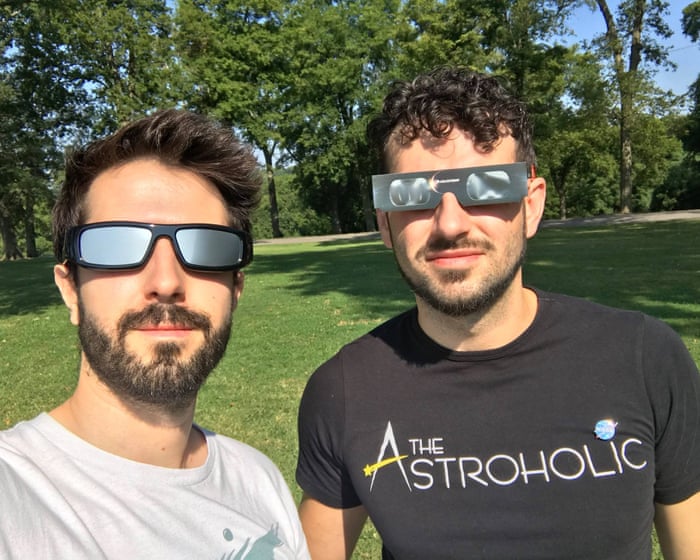
I’ve never driven with more determination than when I was speeding away from Shelby Park in Nashville. We had just reached Davidson Street when my husband shouted, “There! There’s sunlight!” I barely had time to skid into the parking lot of a printing company. We jumped out of the car, put on our dark glasses, and looked up at the sun as it quickly disappeared. It was surrounded by clouds, but a tiny sliver of light was still shining. It was 1:27 p.m. on August 21, 2017. We had traveled all the way from London to Tennessee to see the Great American Eclipse—an astronomical event I had never witnessed before.
As an astronomer born in Italy, I’ve always felt a bit left out. I have a PhD in astrophysics, focusing on galaxy collisions. I’ve seen plenty of celestial events—comets, planetary alignments, fireballs, galaxies, the northern lights—but never a total solar eclipse.
After moving to the UK in 2007, I heard so many stories about the total solar eclipse of 1999. I hadn’t seen it myself because it wasn’t visible from Italy. Several friends told me they went to Cornwall or crossed the Channel to France to catch a glimpse of that once-in-a-century event. The UK won’t have another until September 23, 2090. I felt cheated by geography.
For the next 18 years, I chased partial solar eclipses, telling myself that the difference between 90% coverage and totality couldn’t be that big. It turns out the difference is enormous.
That morning in 2017, the sky was perfectly clear. We found a hilltop park and settled in, ready for the lunchtime show. We kept checking the sun through a small solar telescope while wearing our eclipse glasses. It’s extremely dangerous to look at the sun without them—you don’t want to ruin your eyesight for a quick look at our star.
As often happens when I set up my telescope in a public place, people gathered around. Many had come to see the spectacle, all talking about the wonder of the universe and the upcoming eclipse. I knew the science, but I wasn’t prepared for the experience.
Finally, just before noon, we watched the moon slowly cross the face of the sun. Then, minutes before totality, the worst happened: clouds. Lots of clouds rolling in from every direction. We knew we couldn’t stay put—if we wanted to see the eclipse, we had to move to where the sun was shining. We jumped in the car and chased the last rays into that parking lot.
In the moment of totality, the world around you changes completely. As the moon covers the sun, you’re plunged into a strange twilight. The sun’s outermost atmosphere, the corona, usually invisible to the naked eye, becomes visible. We only had about 50 seconds of the eclipse before a cloud blocked it, but its beauty shook me to my core.
Everything went quiet as birds landed and fell silent, thinking night was coming. My husband and I found ourselves moved to tears. I had expected to see a rare astronomical event, but I gained a new appreciation for the incredible coincidences that make eclipses possible. We live on a planet where the moon and the sun appear to be the same size, so one can cover the other in the sky. You don’t get that on Mars!
In that moment, I understood why solar eclipses have often been seen as omens or signs from the gods, and why astronomers have long tried to predict them: there was power in this knowledge. Suddenly, I felt that seeing just one wasn’t enough—I had to experience more.
In April 2024, my husband and I traveled to Mexico to see the second Great American Eclipse. On a beach in Mazatlán, we watched the moon cover the sun for over four minutes. It was very different from 2017.Because the sun was at the peak of its solar cycle, the corona appeared wispier. The laughter and joyful chatter of the tens of thousands of people gathered to watch instantly turned into a deep, almost religious silence as the sun went black. Once again, I felt an overwhelming appreciation for our extraordinary universe.
Scientists discover 27 potential new planets that orbit two stars in far-off solar systems. Read more.
I now describe myself as an “eclipse hunter.” I’ve already booked trips to Spain for the total eclipses on August 12, 2026, and August 2, 2027. The latter will be the longest eclipse for the rest of the century, with totality lasting over six minutes thanks to an excellent alignment between Earth, the moon, and the sun—so long that one might almost get bored by it. But I know that, for me, this cosmic phenomenon will always be endlessly fascinating.
Invisible Rainbows by Alfredo Carpineti is out on May 21 (Wilton Square Books, £16.99). To support the Guardian, order your copy at guardianbookshop.com. Delivery charges may apply. Do you have an opinion on the issues raised in this article? If you would like to submit a response of up to 300 words by email to be considered for publication in our letters section, please click here.
Frequently Asked Questions
Here is a list of FAQs based on the article title A moment that changed me I saw my first total solar eclipse and its beauty shook me to my core
General Experiential Questions
Q What is the main point of this article
A Its a personal story about how witnessing a total solar eclipse was a profound lifealtering experience The author focuses on the overwhelming beauty and emotional impact of the event
Q Why did the eclipse shake the author to their core
A Because a total solar eclipse is not just a scientific event its a deeply emotional and sensory experience The sudden darkness the eerie silence and the sight of the suns corona can feel surreal and humbling leaving a lasting impression
Q Is this article just about science or is it about feelings
A Its mostly about feelings and personal transformation While it describes the eclipse the core of the story is how the experience changed the authors perspective on life nature or their place in the universe
Technical Scientific Questions
Q What exactly is a total solar eclipse
A Its when the moon passes directly between the Earth and the sun completely blocking the suns light For a few minutes day turns into twilight and you can see the suns outer atmosphere
Q How is a total eclipse different from a partial eclipse
A A partial eclipse is like a bite taken out of the sunits interesting but not dramatic A total eclipse is a full jawdropping event where the sky goes dark stars appear and the temperature drops Most people say a partial eclipse doesnt compare
Q Is it safe to look at a total solar eclipse
A Only during the brief moment of totality is it safe to look with your naked eyes At all other times you need special solar eclipse glasses to avoid permanent eye damage
Practical Planning Questions
Q How can I see a total solar eclipse myself
A You need to be in the path of totalitya narrow band on Earth where the moons shadow falls You can find maps online showing future eclipse paths eg for 2024 in North America or 2027