Ng’ikalei Loito was walking out of the warm waters of Lake Turkana on a sunny afternoon, having just finished swimming with her two sisters-in-law, when she suddenly felt the crushing force of a crocodile’s bite on her legs.
In excruciating pain, she instinctively clung to a partially submerged tree within reach and screamed for help as the crocodile tried to drag her underwater. Loito’s thoughts raced to her five children, and she wondered who would care for them if she died. “When a crocodile attacks, it feels like death is certain,” she said.
As shouting villagers waded into the water, the crocodile eventually let go of Loito’s legs, which were now bloody and badly mangled. She was carried out and taken to a hospital three hours away in a police vehicle.
Attacks on people living along Lake Turkana in north-west Kenya have become more common in recent years. Rising water levels have shifted the habitats of Nile crocodiles—predators that can grow up to six meters long and weigh up to 900 kilograms—closer to human settlements.
The attack on Loito took place in December 2024 in Lowarengak town on the western side of the lake, near the Ethiopian border. At the hospital, medics plastered one leg and put an external fixator on the other. However, by the next afternoon, they found both legs turning green and only one toe responsive, so they decided to amputate.
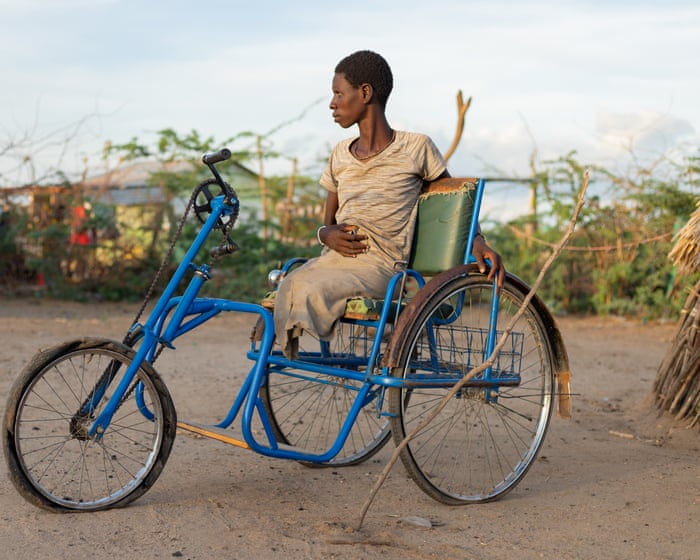
“The legs were completely destroyed,” the 33-year-old recalled in an interview earlier this month at her home in Kalokol town, her tricycle parked nearby. Loito used to cook and sell mandazi, a fried dough, to support her family. She now depends on help from her mother and other relatives she lives with. “My life has totally changed. I am not able to do anything now,” she said.
Lake Turkana, the world’s largest permanent desert lake and largest alkaline lake, is one of eight major lakes along the Kenyan part of the Rift Valley—a geographic depression stretching 4,000 miles from Lebanon to Mozambique. A 2021 government report found the lake’s total surface area had expanded by about 10% over the previous decade.
Many rely on the lake to catch fish for consumption and sale. Rising water levels in Kenya’s Rift Valley lakes have displaced tens of thousands of people and submerged homes, schools, farms, hospitals, and infrastructure.
Researchers attribute the rise to various factors. The 2021 report cited increased rainfall due to the climate crisis as the primary cause, along with tectonic movement in the Rift Valley. Another report that year by the UN Environment Programme suggested climate change may make flooding around Lake Turkana more frequent over the next two decades.
Elijah Chege, county warden for Turkana at the Kenya Wildlife Service, said the overflow has brought crocodiles closer to human settlements. The animals have established new nesting and hunting grounds along the altered shorelines, increasing the likelihood of attacks. Chege added that traditional fishing practices, such as using logs as boats, also expose communities to greater risk.Kenya Chege explained that to tackle the issue, the Kenya Wildlife Service (KWS) runs awareness campaigns in local communities to educate people about high-risk zones and crocodile behavior. He added that the agency also hires local scouts to track crocodile movements.
“We have to teach the community to coexist with these animals,” he said. “We need to balance conservation with community safety. Because, at the end of the day, the crocodiles have to be there. They are in their habitat.”
Chege noted that KWS relocates “problematic” crocodiles and, as a last resort, kills them. Despite these measures, attacks continue. Over the past year, KWS recorded seven deaths and 15 injuries from crocodile attacks, according to Chege.
Achiro Kephas, the referrals and emergency coordinator at Turkana county’s health ministry, said most victims are fishers, many deaths go unreported, and survivors often suffer permanent disabilities.
Stories of crocodile attacks are common in communities around the lake.
Just across the road from Loito’s home, Ng’ispaan Long’olan sat on a wooden chair selling water and charcoal, with two crutches beside him. Long’olan recalled losing his left leg in a crocodile attack in Natirae village one morning in 2018, just a day after his youngest child was born.
He was untying a fishing net in the lake when a crocodile bit his legs. A struggle followed. Feeling his right leg begin to break and thinking he might die, Long’olan poked his middle and ring fingers into one of the crocodile’s eyes.
The animal let go, but Long’olan’s left leg—now crushed and detached from his body—was tangled in the net. Some fishers came by boat but couldn’t free the limb. So he told them to cut it off using a traditional Turkana wrist knife. “I was in so much pain, and the leg was torn and completely damaged,” he said.
Now 44, Long’olan has a metal rod in his right leg, and the two fingers he used to poke the crocodile are numb. He believes the only way to stop the attacks is for KWS to shoot the crocodiles dead.
On a recent boat trip across the choppy waters between Kalokol and the Long’ech peninsula, partially submerged palm trees, electric poles, fences, and buildings could be seen miles from the shore.
“This used to be a popular club,” said Kephas, pointing to the top of a structure sticking out of the water, with wooden frames and a collapsed iron roof.
On the peninsula, families are struggling with repeated crocodile attacks and the loss of land.
Ayanae Loong’orio lost her eight-year-old daughter, Esther Ikimat, in 2024 when a crocodile attacked her while she was swimming in the lake during a school lunch break.
“My legs failed me,” Loong’orio remembered, describing her attempt to reach the scene. “I ended up crawling toward the lakeshore, screaming for help and begging people to save my child.”
A video later posted on social media showed the animal dragging her—with her head and hand hanging from its mouth—deeper into the lake. “Oh, my God! Where is the gun? I wish I had one! Bring the gun now!” a voice is heard saying in Turkana as the crocodile swims away.
A fisher in an engine-powered boat chased the animal and struck it on the back with the boat. The crocodile released Ikimat’s lifeless body, which was then recovered.
In less than two years since the attack, the water has advanced further, so Loong’orio can no longer identify exactly where it happened.
Satellite images from Google Earth fromSatellite images from Google Earth, comparing 1984 and 2022, reveal the expansion of Lake Turkana around Kalokol and the Long’ech peninsula.
Felisters Dapat lost her son under similar circumstances. Daniel Lotaruk was swimming with friends when a crocodile attacked and carried him away. Residents later found only his legs on the shore; the rest of his body was never recovered. Dapat, 31, often returns to the spot where he was swimming, hoping to find his remains. “What can we do?” she asked. “Even if people kill the crocodiles, the animals will still reproduce.”
Angered by such attacks, residents sometimes take matters into their own hands. Last October, people in Kalokol town killed a crocodile they said had been terrorizing the community.
On a recent hot afternoon, about a dozen fishers gathered in a thatched shelter by the lake, listening attentively to Kephas. He was leading an awareness forum on crocodile attacks, covering topics like human behaviors that can provoke attacks, the power of a crocodile’s bite, and the critical need for immediate medical care for victims.
He asked a participant to hold up an image of a crocodile, its sharp teeth clearly visible. “When this crocodile bites you, your chances of survival are low,” he said. “All of us who depend on the lake should avoid behaviors that put us at risk of crocodile attacks.”
Frequently Asked Questions
Frequently Asked Questions Crocodile Attacks at Kenyas Lake Turkana
BeginnerLevel Questions
1 Whats happening at Lake Turkana
Lake Turkana in Kenya is getting larger due to increased rainfall and water inflow As it expands it floods new areas bringing people and Nile crocodilesone of the most aggressive speciesinto closer and more frequent contact leading to a rise in fatal and injurious attacks
2 Why are there suddenly more crocodile attacks
The main reason is the lakes expansion Its swallowing up land pushing communities closer to the shoreline and into the crocodiles habitat More people fishing collecting water or herding livestock near the water increases the chances of dangerous encounters
3 How dangerous are Nile crocodiles
They are extremely dangerous They are large powerful ambush predators responsible for hundreds of human deaths across Africa each year An attack is often sudden and severe leading to loss of life or limb
4 What are the main causes of death or injury in these attacks
Victims typically die from drowning massive blood loss or the trauma of the initial attack Survivors often suffer devastating injuries including crushed limbs deep lacerations and infections frequently leading to amputations
Advanced Practical Questions
5 Is the lake expansion due to climate change
Yes experts link it directly to climate change Increased rainfall in the Ethiopian highlands and changing weather patterns are causing the lake to rise and flood its shores unpredictably
6 Why dont people just move away from the lake
For many communities like the Turkana and El Molo the lake is their ancestral home and primary source of livelihood Relocation is complex involving loss of cultural identity lack of alternative land and no economic means to move
7 What is being done to protect people
Current efforts are limited and challenging They include community education on crocodile behavior distributing safety information and some attempts to relocate the most problematic crocodiles However resources are scarce and the scale of the lake makes physical barriers or constant patrols nearly impossible
8 Are there any early warning systems or deterrents
There are no formal hightech warning systems in place Communities rely on traditional knowledge and vigilance