History may not be about to repeat itself in Serbia, but it is beginning to rhyme. Just over a quarter of a century ago, Serbian citizens turned out in large numbers to vote and inflict a historic defeat on the then strongman in Belgrade, Slobodan Milošević, who was seeking re-election as president. He lost despite his extensive control over the media, the judiciary and the security forces. When he was reluctant to leave office, Serbs poured onto the streets in their hundreds of thousands, finally forcing him out.
On Sunday, a new generation could have the decisive voice in an equally fateful election, this time for the national parliament. Today’s strongman, Aleksandar Vučić, recently resigned as president to fight the election with the aim of shifting the center of power from the presidency to the prime minister’s office.
But Vučić, who has had almost total control of Serbia for 14 years, finds himself on the back foot for the first time since he assumed power, just as Milošević did in 2000. Like his close friend Viktor Orbán, who was decisively beaten in elections earlier this year, Vučić has felt compelled to pull out all the stops to stop the opposition electoral coalition, known as the Student List (SL).
Unlike Orbán’s Fidesz party, Vučić’s Serbian Progressive Party (SNS) is unlikely to be humiliated in Sunday’s vote. Opinion polls vary widely—some give the SL a lead of almost 10 percentage points, while others suggest the race is neck and neck. Pollsters also suggest that the higher the turnout, the greater the chances for the opposition. Some fear that the aftermath could even be violent.
Vučić is throwing everything at the campaign to skew the result his way. He has tightened his grip on the media by supporting a change in ownership of what was until recently the most important independent news group, United Media. Last weekend, 10 prominent journalists from its most important outlet, the TV station N1, resigned in protest against senior editorial appointments believed to favor Vučić and the SNS.
N1 had been key in reporting the rapid rise in support for the student protest movement since it emerged spontaneously in November 2024. Students first took to the streets when the canopy over the main rail station in Novi Sad in northern Serbia collapsed, killing 16 people. The tragedy occurred just months after a Chinese consortium had finished renovating it in what critics claim was a corrupt deal.
View image in fullscreenMass silent protest outside Novi Sad railway station to mark the first anniversary of the canopy collapse that killed 16 people, 1 November 2025. Photograph: Marko Đurica/Reuters
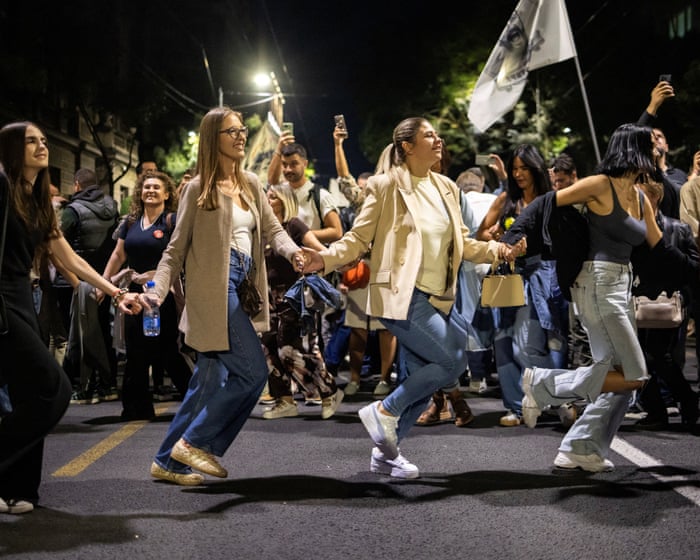
At first, Vučić’s response was to wait until the demonstrations petered out. But despite various attempts to coerce the students to retreat from the streets, the protests grew throughout 2025 and 2026. In March 2025, during a 15-minute period of silence to honor the victims of the Novi Sad disaster, protesters alleged that police deployed a sonic weapon, the US-made LRAD 450XL, causing the crowd to disperse in panic. The government denied using the weapon, and later the interior ministry filed a criminal complaint against a military analyst over his claim that a sonic weapon was probably used.
The demonstrations have shown no sign of letting up in the past two years. The big challenge facing the students was how to channel the undoubted energy they generated through the movement into a coherent political force capable of challenging Vučić. The old opposition parties were riven by factionalism and lacked dynamic leadership. But this summer the students announced they had selected candidates to stand in a new formation, the Student List, including prominent academics, engineers, workers, cultural figures and students. Their straightforward slogan is “Serbia or the mafia.”
Vučić has responded to the challenge by ramping up nationalist rhetoric in recent months in order to mobilize thefar right. He has welcomed support from his neighbour Milorad Dodik, the de facto leader of Republika Srpska, the Serbian entity in Bosnia. Dodik has long been seen as Vladimir Putin’s main ally in the Balkans and has more recently grown close to Donald Trump, whose associates are investing in a gas pipeline with his help. Vučić has also been building support from Moscow. Relations between Putin and the Serbian leader have been strained in the past. Vučić has been supplying Ukraine with a significant amount of munitions while playing a complex game of balancing friendly relationships with both the West and Russia.
But with the gloves off, the Serbian leader has become less guarded. Another sign of how seriously he views the students’ challenge was his decision to allow a recent nationalist gathering — a state funeral for the man known as the “Butcher of Bosnia,” convicted war criminal Ratko Mladić — aimed at boosting his support among nationalists. If, despite all this, the Student List wins the election, the shock waves will be felt across Europe as powerfully as they were when Orbán was defeated. Above all, it opens the possibility of faster integration with the European Union — a move that would be welcomed not just in Brussels but in London as well. Successive British governments have been concerned that the Balkans represent the soft underbelly of European defence, where Russia can exert significant pressure. Since Brexit, Britain’s political influence here is limited, but it has been active in promoting security cooperation across the region with NATO and the EU. Student activists and their supporters have been disappointed by what appears to be indifference from the EU toward their political struggle, and by a general perception abroad that Serbia’s democracy is a lost cause. On Sunday, they aim to prove them wrong.
Misha Glenny is a former central Europe correspondent for the Guardian and the BBC.
Frequently Asked Questions
FAQs Gen Z Protests and the Threat to Serbias Strongman
1 What is this Gen Z protest movement in Serbia
Its a wave of studentled and youthdriven protests that began after a deadly roof collapse at a train station in Novi Sad in November 2024 Mostly young people many of them Gen Z have taken to the streets demanding accountability and systemic change
2 Who is Serbias strongman
President Aleksandar Vui He has dominated Serbian politics for over a decade controlling much of the government media and public institutions
3 Why are people protesting
The immediate trigger was the Novi Sad tragedy which protesters blame on corruption and negligence in construction and oversight More broadly theyre demanding government accountability an end to corruption and free and fair institutions
4 Why would this shake Europe
Serbia is a key country in the Balkans A political upheaval there could shift the regions balance of power affect Serbias path toward EU membership and change its relationship with Russia and Chinaall of which matter to the rest of Europe
5 What is Gen Z
Gen Z generally refers to people born roughly between 1997 and 2012 Theyre the generation now in high school university and early careersand theyve become a major force in protests worldwide
6 Why is Gen Z leading these protests
Young people often feel the effects of corruption and weak institutions most directlythrough poor education few job prospects and a sense of being locked out of decisionmaking They also organize well on social media
7 What does ousting the strongman mean here
It means forcing Vui out of power or fundamentally weakening his controlthrough mass pressure elections or institutional change It doesnt necessarily mean a single dramatic moment
8 Are these protests peaceful
Largely yes The movement has emphasized nonviolence though there have been tensions counterprotests and reports of pressure on demonstrators
9 What role does the media play
A big one Much of Serbias mainstream media is seen as friendly to the government so protesters and independent outlets rely heavily on social media and alternative channels to spread their message
10 What are the main demands of the protesters
Accountability for the Novi Sad disaster