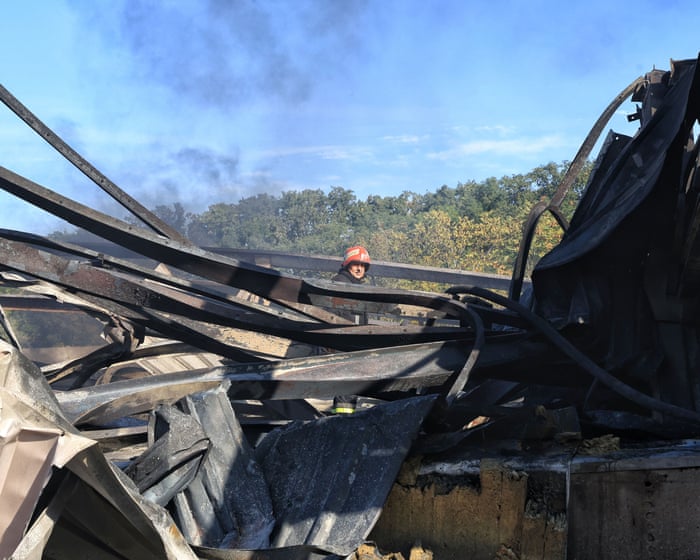
Ukraine’s economy minister says missile alerts cost the country an estimated $45 million (£34 million) for every hour they halt business, as Kyiv looks for ways to keep the economy running under intensifying Russian bombardment. Russia has increasingly targeted the infrastructure that supports Ukraine’s economy, hitting industrial sites, warehouses, logistics hubs, and data centres. Oleksandr Kravchenko, the minister for economy and the environment, described this as an effort to “destroy pretty much the entire economy.”
“What we had not fully anticipated was how quickly Russia would develop these jet-powered drones and use them to target everything,” he said, referring to Russia’s use of new weapons that have pounded Kyiv in recent weeks. Speaking from the heavily protected government building in Kyiv, Kravchenko, a former McKinsey executive who joined the government in the summer, said the attacks were forcing large parts of the economy to repeatedly shut down as workers were sent to shelters, with sirens lasting up to 10 hours a day. “If people are in a bunker, business stops,” he said.
To ease the economic costs, the government recently introduced a new two-tier warning system designed to keep businesses operating during prolonged air raid alerts. A “red” alert warns of a missile threat and requires people to seek shelter, while a “yellow” warning is used for drone threats, allowing many businesses to stay open. More than half of businesses were continuing to operate during yellow alerts, Kravchenko said.
But a yellow alert is no guarantee of safety. That danger was made clear on Monday, when a Russian jet-powered drone struck the National Academy of Sciences in central Kyiv during a yellow alert, killing two people while staff were still inside working.
View image in fullscreenOleksandr Kravchenko, minister for economy and the environment. Photograph: Julia Kochetova/The Guardian
It is one of the difficult trade-offs Ukraine faces as it tries to keep normal life moving while protecting people from an escalating campaign of Russian strikes. Kravchenko said Russian attacks this year alone had caused an estimated $10 billion in damage to fixed assets, with steel plants, warehouses, logistics infrastructure, and, most recently, data centres among the targets. Russia has also effectively blockaded Ukraine’s Black Sea ports, which before the blockade carried the bulk of the country’s exports.
The minister believed the government was better prepared this year for what could be the “hardest, the harshest winter” of the war, with further pressure expected on energy supplies, infrastructure, and businesses already weakened by months of strikes. To protect against future strikes, the government is now discussing ways to allow more private companies to purchase Ukraine’s air-defence system, the minister said, although he cautioned that businesses could never fully protect themselves from Russian missiles and drones.
The ongoing damage from strikes has added to an already severe strain on the state’s finances. The president, Volodymyr Zelenskyy, has recently put Ukraine’s remaining budget shortfall this year at about $27 billion, a figure that has prompted questions among some European governments over how the gap emerged, despite the EU having already agreed a €90 billion loan package for Ukraine covering 2026 and 2027. Kravchenko said the government had since narrowed the shortfall to $20 billion through spending cuts and by identifying additional domestic reserves.
Kyiv was now seeking further support from the EU, Japan, Canada, and the UK, including potentially bringing forward loans that had been earmarked for next year, Kravchenko said.
skip past newsletter promotionFree newsletter |Every daySign up to Headlines EuropeA digest of the morning’s main headlines from the Europe edition emailed direct to you every week dayEnter your email Sign upafter newsletter promotion
“There is very active work with all our international partners to“We need to find additional sources of funding,” he said. Kravchenko rejected suggestions that the shortfall was caused by mismanagement or corruption. He also said it was not due to excessive spending under former defence minister Mykhailo Fedorov, whose efforts to overhaul military procurement and rapidly expand Ukraine’s drone programme had made him one of the government’s most prominent reformers before his dismissal in July, a move that triggered street protests. Instead, he said the gap reflected both weaker-than-expected state revenues and the rising cost of waging the war. “The cost of war is simply increasing,” he said, pointing to the need for more air-defence systems and for Ukraine to accelerate development of drones capable of intercepting Russia’s new jet-powered weapons. But high-profile corruption scandals have also reached Zelenskyy’s inner circle, straining trust in the government both at home and among western donors. A recent poll by the Kyiv International Institute of Sociology found that corruption in government was the most cited concern among Ukrainians, named by 50% of respondents, ahead of mass missile and drone strikes at 40%. The same survey found that 72% believed Zelenskyy bore personal responsibility for corrupt actions by people around him. Kravchenko said progress had been made to tackle the issue but admitted that Ukraine faced both corruption itself and a persistent perception problem both inside Ukraine and abroad. “I very much appreciate the pressure of European partners on reforms,” he said, adding that Ukraine also needed to tackle perceptions of corruption at home and abroad. Ukraine’s external financing needs for 2027 are estimated at $52.6bn, but only about $20bn has so far been secured, according to the minister, with further tax rises and spending cuts under discussion. Asked whether the rise of parties sceptical of support for Ukraine in France and Germany could weaken western commitment to Kyiv, he said: “Am I worried? I think I should be, probably.” “The overall fatigue is increasing in Europe,” he added.
Frequently Asked Questions
FAQs If People Are in a Bunker Business Stops Missile Alerts and Ukraines Economy
Basics
What does if people are in a bunker business stops mean
It means that when air raid alarms go off workers have to stop what theyre doing and take shelter Factories shops offices and services shut down for as long as the alert lasts
What is a missile alert
A warning that missiles or drones may be incoming In Ukraine alerts are announced by sirens phone apps and official channels telling people to go to a shelter immediately
How much do missile alerts cost Ukraines economy
About 45 million for every hour that businesses are halted nationwide
Where does the 45 million figure come from
Its an estimate of lost output the value of goods and services that would have been produced if businesses kept running It comes from economic research on Ukraines wartime losses
Why is the cost measured per hour
Because alerts often last less than an hour but they happen many times a day across the country Small losses add up fast when they hit the whole economy at once
Why It Matters
Why do businesses have to stop during an alert
Because staying at work during a strike is dangerous If employers kept people working theyd risk employee lives and face legal and moral consequences
Cant people just keep working through the alerts
Some critical services do keep running often from protected spaces But most normal businesses cant safely operate with workers in bunkers
Who pays for these losses
Mostly private businesses workers and the government The damage spreads across the whole economy
Is the 45 million loss permanent
Not all of it Some work can be made up later But lost sales spoiled goods and missed deadlines often cant be recovered
Common Problems
What kinds of businesses are hit hardest
Manufacturing retail restaurants logistics and services that need people physically present Anything with tight deadlines or perishable products suffers most
What happens to workers pay during alerts
It varies Some employers pay for shelter time some dont Many workers lose income when shifts are cut short