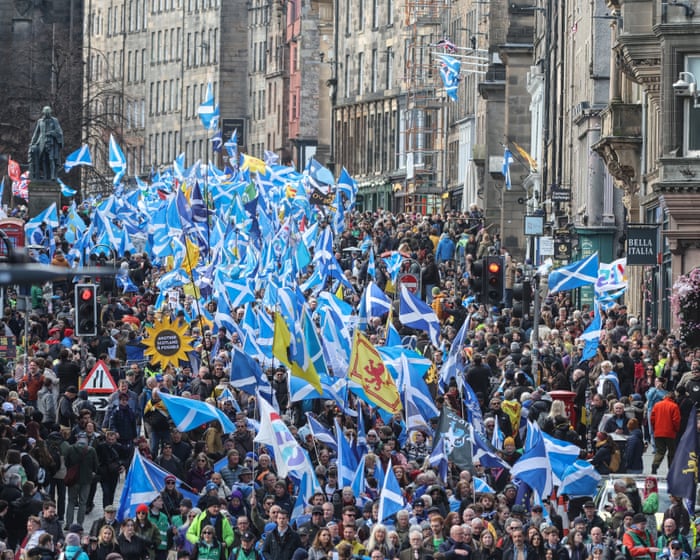
The decision to leave the EU boosted support for Scottish independence, which a decade after the Brexit referendum is now at near-record levels, according to former Scottish Labour leader Kezia Dugdale.
Dugdale said the Brexit vote “creates a frame around fairness” for many in Scotland because, unlike England, Scottish voters overwhelmingly chose to remain in the EU in 2016—by 62% to 38%—yet still saw their country taken out of Europe.
She also believed the UK government’s push for a “hard Brexit” swayed many Scots who had been undecided about Scottish independence when a referendum was held on the issue in 2014.
Support for independence currently sits at around 50%, reaching 55% in some polls.
Dugdale recalled feeling “utterly devastated” when the Leave result was confirmed early on 24 June 2016. That morning, she spoke privately to then First Minister Nicola Sturgeon, telling her: “This changes everything.”
She said many Scots felt they “faced an immediate binary choice of an independent Scotland in Europe or a Boris Johnson-led Brexit Britain,” and that sense of betrayal changed the landscape of Scottish politics.
“I think it sustained support for independence, which otherwise would have fallen back,” she said.
Ruth Davidson, who was the Scottish Conservative leader in 2016 and championed the Remain campaign, was shocked by the Leave result.
She recalled speaking that day to Sturgeon, who tried to persuade her to “move forward together” alongside Dugdale in support of a second independence vote. “I can remember thinking ‘no, no, no’,” Davidson said. “The Remain vote shouldn’t be co-opted for something it wasn’t for.”
In her memoir Frankly, Sturgeon said: “I felt distraught and enraged by the prospect of Brexit and what it said about Scotland’s powerlessness within the UK. I had a strong sense of ‘If not now, when?'”
There was speculation that in the wake of Brexit, support for Scottish independence could surpass 60%, but the tidal wave many expected never came.
Instead, over the past decade, the issue’s importance faded as the political crises that followed Boris Johnson’s hard Brexit, the Covid pandemic, the Ukraine war, and Donald Trump’s chaotic presidencies led to deep insecurity about the economy and public services.
Davidson, a staunch unionist, said she still felt “animosity” towards Johnson, who she believes failed to show genuine leadership and never articulated a clear vision for a unified post-Brexit Britain. But the “Boris effect” on support for independence was much less significant than she had feared.
“There was a hierarchy of concern” for voters, she said. “Whether we were for independence or for staying in the UK was a more material concern than the UK’s relationship with the EU.”
The electoral realities of that tension could be seen as early as 2017.
Sturgeon’s attempts to use Remainers’ anger to build an irresistible case for a second referendum fell flat. Theresa May’s Conservative government resisted her demands. Support for independence dropped during 2017 to below 40%.
In the 2017 general election, the SNP lost 21 Westminster seats and its vote share fell by 13 points as voters punished Sturgeon for demanding a second independence vote. The pro-UK parties, which had previously held only one seat each, enjoyed a revival.
Davidson’s Tories won 13 seats; Dugdale’s Labour won seven, and the Lib Dems four. In the five UK and Holyrood elections since, the SNP has never won 50% of the vote, weakening its claims to a mandate for a second independence referendum.In 2019, as Boris Johnson took over from Theresa May as prime minister and pushed ahead with a hard Brexit—followed by his mishandling of the Covid crisis in 2020—opinion on Scottish independence began to shift.
Nicola Sturgeon, shown here campaigning in Glasgow in 2015, tried to use the anger of Remain voters to push for a second independence vote. Photograph: Murdo MacLeod/The Guardian
As Sturgeon became a strong and steady presence compared to Johnson’s chaotic leadership, support for Scotland leaving the UK rose sharply, reaching 59% by October 2020.
Now, economic decline and worries about the NHS are the main issues in Scottish politics. Dugdale links much of this to Brexit and its effect on the UK economy.
Based on recent estimates from the National Institute of Economic and Social Research, Scotland’s Europe minister, Stephen Gethins, told the Scottish Parliament on 18 June that Brexit cost Scotland £3.3 billion in lost revenue last year and added £250 to food bills.
Professor Mairi Spowage, director of the Fraser of Allander Institute, a leading Scottish economics think tank, said that while Brexit clearly hurt economic output, EU exports, and public finances, its exact effects have been hard to separate from other crises and policy failures.
She noted that the UK’s economic decline can be partly traced to long-term underinvestment by businesses and government since the 2008 banking crisis. Since then, Covid, the war in Ukraine, the Liz Truss government, US trade policy, and conflicts in the Middle East have also taken a toll.
Migration to the UK has also been complicated: the “Boris wave” of post-Brexit migration has made up for a drop in EU workers—partly because EU member states, once a source of migrant labor, have become more prosperous.
Despite efforts by John Swinney, the first minister and SNP leader, to make Scottish independence and rejoining the EU central to the recent Holyrood elections, that strategy didn’t win him the overall majority he wanted.
The SNP got 38% of the vote, its lowest since 2007, and only won the most seats because the opposition was divided. The anti-EU party Reform UK helped cause that split, winning 17 seats and now sharing the title of Holyrood’s second-largest party; some of its voters were EU skeptics who used to support the SNP.
Dugdale, now an associate director of the Centre for Public Policy at Glasgow University, is no longer a Labour party member and voted SNP in the last European parliament election in 2019 to protest Brexit.
Many voters are now driven by anger and disillusionment, partly because they believe Brexit didn’t deliver on its promises. “We’ve had more than 15 years of austerity and 15 years of falling trust in political institutions,” Dugdale said. “If we keep this up long enough, people no longer trust the system to improve their lives.”
Frequently Asked Questions
Here is a list of FAQs about how Brexit changed Scotlands political landscape written in a natural tone with clear simple answers
BeginnerLevel Questions
Q What does This changes everything mean in the context of Scotland and Brexit
A Its a phrase often used to describe how Brexit completely shifted the political debate in Scotland Before Brexit Scottish independence was a big topic but after the UK voted to leave the EU the independence question became linked to Europe and support for independence grew significantly
Q Did Scotland vote to leave the EU
A No In the 2016 Brexit referendum 62 of voters in Scotland voted to remain in the EU Only 38 voted to leave This created a major clash between Scotlands choice and the overall UK result
Q How did Brexit make Scottish independence more popular
A Many people in Scotland felt they were being taken out of the EU against their will This fueled the argument that Scotlands voice doesnt matter in the UK and that the only way to protect Scotlands interests is to become an independent country
Q What is the democratic deficit people talk about
A It means that Scotland voted one way but the UK government took Scotland in the opposite direction This made many people feel that the UK system isnt democratic for Scotland
Q Did Brexit actually change the law in Scotland
A Yes Many laws that were made by the EU were brought back to the UK Some of these areas are devolved to the Scottish Parliament which led to disputes about who gets to make the new rules
IntermediateLevel Questions
Q How did Brexit affect the relationship between the Scottish Government and the UK Government
A It made the relationship much more tense The Scottish Government argued that Brexit required Scotlands consent which wasnt given The UK Government pushed ahead anyway leading to legal battles over things like the Internal Market Act
Q Did Brexit lead to any new laws or powers for the Scottish Parliament