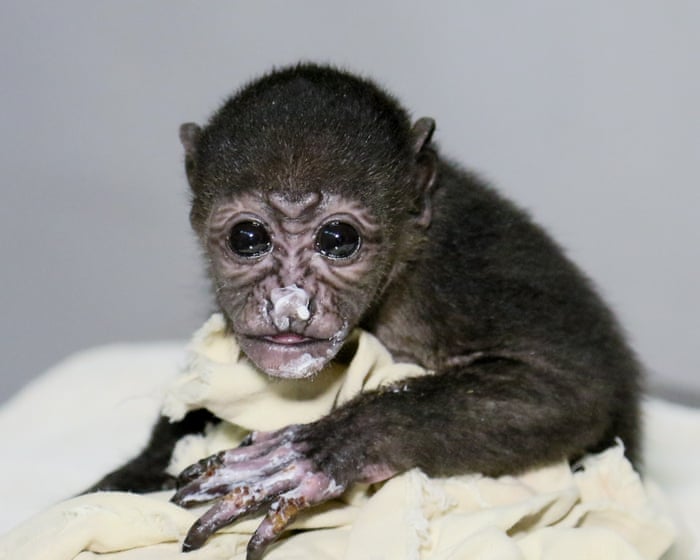
Peque, a small black howler monkey, scratches her head as she sits on a thick wooden branch inside a wire enclosure at a rescue center in Nosara, on Costa Rica’s Pacific coast. She’s one of seven orphaned baby howler monkeys living there.
Last year, Peque was among more than 100 animals brought to International Animal Rescue Costa Rica (IARCR) after being electrocuted on power lines. Primates like monkeys often mistake these lines for trees or vines.
“She was found electrocuted with her mom, who was already dead when we found her,” says Francisco Sánchez, a veterinarian at IARCR. “Her tail and hands were burned.”
The center reported 108 electrocuted animals in 2025, with howler monkeys making up up to 90% of cases. Sánchez says the number has risen since he joined nearly a decade ago, and he blames increased development in the area. Nosara has become a popular tourist spot and a haven for immigrants from the US and Europe.
“Now, we’re seeing new areas [of electrocutions] that didn’t exist before,” he says. “That’s because of new houses, restaurants, and hotels. We’re rescuing animals from deeper inside the forest.”
Still, there’s hope that numbers could drop significantly in the future. In January, Costa Rica’s constitutional court ruled that the state-owned electricity company, the Costa Rican Electricity Institute (ICE), and the Ministry of Environment and Energy (MINAE) had failed to take effective steps to reduce and prevent wildlife electrocutions—mainly involving howler monkeys—on uninsulated power lines in the Nosara district.
“We hope [the ruling] will force Costa Rica’s electricity providers to finally … keep wildlife safe,” says Gavin Bruce, CEO of International Animal Rescue.
The court gave them six months to implement “the necessary measures to correct the problem present in the power lines that ICE has constructed in the district of Nosara using bare wiring.”
The ruling came after 20 conservation groups and rescue centers, including IARCR, launched a campaign called “This Is NOT Pura Vida” (a play on the Costa Rican phrase for well-being and positivity), calling for urgent government action. IARCR then took the case to court.
The ruling could have major implications for wildlife protection across the country, says Gavin Bruce.
“Although this case was built on data from the Nosara area, the problem is nationwide,” he says. “We’ll now monitor how the ruling is implemented and consider how best to extend these protections across the whole country. We hope it will force Costa Rica’s electricity providers to finally do what’s needed to keep wildlife safe.”
In Costa Rica—the only country believed to regularly track wildlife electrocution numbers—electric shock is one of the leading causes of death among wildlife, with 6,262 cases recorded between June 2022 and June 2023.
MINAE says it has already put in place “a broad range of measures aimed at preventing wildlife electrocution incidents” and has “promoted a sustained collaborative process to develop technical and institutional solutions … with the goal of advancing the prevention of wildlife electrocution and protecting biodiversity.”
A global problem
While there’s plenty of research on how power lines often kill birds, there’s a lack of global studies on their impact on mammals, making it hard to measure the full scale of the problem.Justo Martín Martín, an environmental consultant who specializes in this issue—including work for the International Union for Conservation of Nature (IUCN)—says, “There are few systematic studies, but there is plenty of evidence, from scientific articles to social media reports, showing that the problem is global. There are records of primates being killed on power lines in every region where they live, especially in the tropical forests of America, Africa, and Asia, where these animals are most abundant and diverse.”
He adds, “Naturally, incidents are more common where high primate populations overlap with many power lines, especially when forests are broken up into smaller pieces.”
‘We thought they would ignore us’: how humans are changing the way raptors behave
The few studies that exist confirm the problem is worldwide. For example, in South Africa, between 1997 and 2019, about 432 mammals were reported killed on power-line towers and poles, according to an IUCN report. The species included small genets, mongooses, monkeys, and lions. A study in Diani, a tourist town on Kenya’s southern coast, found 370 primate electrocutions between 1998 and 2016.
[Image: Vervet monkeys (Chlorocebus pygerythrus) play near an electricity junction box in Hermanus, Western Cape, South Africa. Photograph: Peter Titmuss/Alamy]
For primates, fragmented habitats are the biggest threat. Martín explains, “Primate habitats—mainly forests—are being broken into isolated patches. Monkeys see power lines as pathways connecting these patches. To them, a power line looks like a line of connected trees. So, they get electrocuted when they try to cross roads or move through deforested areas using electrical cables.”
While the initial shock kills many animals or causes serious injuries like heart problems and kidney failure, there are also secondary effects. Sánchez says, “They might suffer trauma from falling several meters to the ground, or catch fire from the heat around transformers, which can cause burns. And when they land on the ground, they could be hit by a car or attacked by a dog.”
[Image: Mother and baby mantled howler monkeys (Alouatta palliata) in Palo Verde National Park, Costa Rica. Campaigners hope the ruling will be applied nationwide. Photograph: Adrian Hepworth/Alamy]
Martín says the only effective way to eliminate the risk, aside from burying power lines, is to use insulated cables. “You can also add devices on top of poles to stop animals from reaching the conductors, even if they climb up. These measures can be combined with artificial canopy bridges made of ropes, plastics, or other materials, to help animals move safely between forest patches.”
‘Six lanes of tarmac and vehicles doing 70mph’: can ‘green bridges’ help animals cross the UK’s motorways safely?
Standing in the treatment room at the rescue center, Sánchez says he is “really happy that we now have a ruling saying it needs to be addressed. But it needs to be implemented across the rest of the country, because the problem isn’t just here.” He adds that MINAI and ICE are expected to release a three-year action plan by the end of June.
“I’m being realistic because I understand it’s a huge task,” he says. “Even in a small place like Nosara, there’s a lot of work to be done and many stakeholders who need to come together.”
Find more coverage of the age of extinction here, and follow biodiversity reporters Phoebe Weston and Patrick Greenfield in the Guardian app for more nature stories.
Frequently Asked Questions
Here is a list of FAQs based on the article To them a power line looks like a line of trees Costa Rica takes steps to protect howler monkeys from being electrocuted
Beginner Questions
Q Why do howler monkeys get electrocuted on power lines
A Howler monkeys travel through the treetops and use vines and branches as highways They often mistake power lines for tree branches or vines and when they touch two wires at once they get a fatal electric shock
Q How many monkeys die this way
A Unfortunately its a major problem In Costa Rica hundreds of howler monkeys are electrocuted every year making it one of the biggest threats to their population
Q What is Costa Rica doing to stop this
A They are installing insulated jumpers and protective covers on power lines especially in areas near forests They are also working with power companies to make new lines safer for wildlife
Q Does this help other animals too
A Yes Squirrels birds sloths and other treedwelling animals also get electrocuted so these safety measures protect many species
Advanced Questions
Q What exactly is an insulated jumper
A Its a short heavily coated cable that connects two power line segments Unlike bare wire the insulation prevents electricity from passing through if an animal touches it It effectively creates a safe bridge for monkeys to cross without getting shocked
Q Why dont power companies just bury all the lines
A Burying lines is extremely expensive and can damage tree roots Insulating critical sections is a much faster cheaper and more practical solution in dense tropical forests
Q Are there any downsides to insulating the lines
A Yes a few Insulation can degrade in the sun and rain so it needs regular maintenance Also if a tree branch falls on an insulated line it can still cause a fire or power outagethough it wont electrocute an animal
Q How do conservationists know which lines are the most dangerous
A They use GPS tracking of monkey troops citizen reports of electrocutions and satellite maps of forest cover They identify hotspots