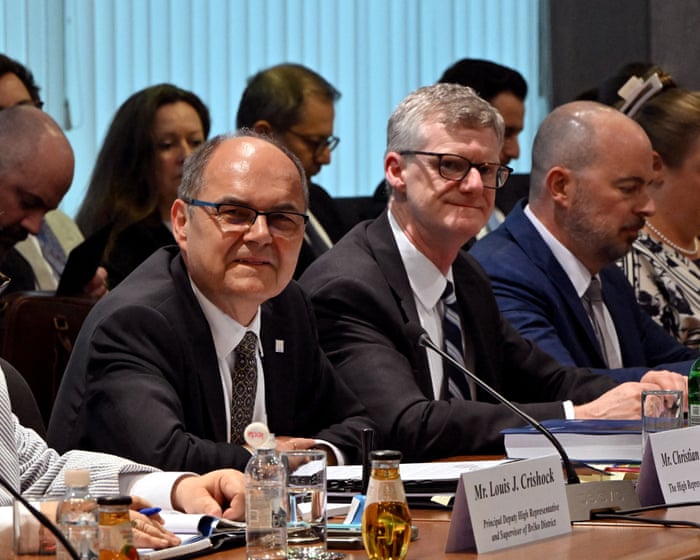
A growing rift between the US and Europe over the future of Bosnia and Herzegovina has come into the open, sparked by a disagreement over a top administrative position. The US has now threatened to “reconsider” its role in international peacekeeping there.
The American embassy in Sarajevo issued the warning after European countries refused to back the US candidate for the new High Representative, the international community’s top envoy. At a meeting this week in Sarajevo of the Peace Implementation Council (PIC) – a multinational group that oversees the 1995 Dayton peace agreement – Washington supported Italian diplomat Antonio Zanardi Landi. Meanwhile, the UK, France, Germany, and most European nations backed France’s envoy to the Western Balkans, René Troccaz.
The Trump administration also pushed to reduce the High Representative’s power to enforce the Dayton principles. The agreement ended a war that killed 100,000 people but has done little to heal Bosnia’s ethnic divisions.
In a post on X, the US embassy in Sarajevo said: “The United States notes that Europe failed to reach consensus on a European candidate and is disappointed that these divisions stopped the PIC from choosing a new High Representative. European indecisiveness, and the PIC’s failure to do its duty toward Bosnia and Herzegovina, is forcing the United States to reconsider our role in the current international presence in the country.”
The US no longer has a large military force in Bosnia, where a small EU peacekeeping mission remains. But it has continued to play an influential role through the PIC and bilateral ties.
The PIC is expected to try again to reach consensus on the High Representative role later this month, when compromise candidates may emerge.
One European official suggested the region might benefit if the US reduced its involvement, as suspicions grow about the Trump administration’s motives. Last year, the US dropped sanctions on Milorad Dodik, the Moscow-backed Serb separatist leader, after a reportedly multimillion-dollar lobbying campaign in Washington.
The US also pressured outgoing High Representative Christian Schmidt to resign after he imposed punitive measures on Dodik for undermining the Dayton agreement.
At the same time, Trump’s relatives and associates have increasingly pursued business interests in Bosnia. In April, the US president’s son, Donald Trump Jr., visited the main Bosnian Serb town of Banja Luka as a guest of Dodik’s son.
Jasmin Mujanović, a Balkans political analyst and author of two books on Bosnia, said the Trump administration seemed to have misjudged its influence over the Europeans in the PIC.
“The Americans seemed to think it didn’t matter what the Europeans thought and assumed they would fall in line. I think that was a misreading of the situation,” Mujanović said. “It doesn’t seem like the US consulted widely with its allies before choosing Mr. Landi.”
“It makes me wonder why they are so insistent on him. We don’t know what understandings exist between Landi and the Americans that make them so enthusiastic.”
Reports from the PIC meeting in Sarajevo on Wednesday and Thursday suggested the US promoted Landi more strongly than Italy itself did.
Kurt Bassuener, co-founder of the Berlin-based Democratization Policy Council think tank, said: “This isn’t just about a person. It’s a strategic decision that needs to fit into a regional strategy. It seems the American position is driven not only by ideology but also by business interests. It looks like the priority is: get concessions, get contracts, and extract, extract, extract.”
Frequently Asked Questions
Here is a list of FAQs about the US threatening to rethink its role in Bosnia and Herzegovina amid growing tensions with Europe
BeginnerLevel Questions
1 Whats happening between the US and Bosnia right now
The US is unhappy with recent moves by Bosnian Serb leaders that seem to undermine the countrys peace agreement Theyre threatening to pull back American support or troops if things dont change
2 Why is the US threatening to leave
The US is frustrated because Bosnian Serb leaders are pushing for more independence which could restart conflict Washington wants to pressure them to stop and threatening to leave is a way to show theyre serious
3 What does rethinking its role actually mean
It means the US might stop sending money military advisors or peacekeepers to Bosnia It could also mean theyll stop mediating talks or supporting Bosnias government
4 Is there a war happening in Bosnia right now
No the war ended in 1995 But tensions are high and some leaders are making moves that could lead to violence again The US is worried about that
5 Why does Europe care about this
Europe wants stability on its doorstep If Bosnia falls apart it could cause a refugee crisis or a new war in the Balkans which would directly affect European countries like Germany France and Italy
IntermediateLevel Questions
6 What specific actions by Bosnian Serb leaders triggered this US threat
Bosnian Serb leader Milorad Dodik has been pushing to create separate Serbonly institutions like a separate army and judiciary which violates the 1995 Dayton Peace Agreement The US sees this as a direct challenge to the countrys unity
7 How is the US currently involved in Bosnia
The US leads the NATO peacekeeping mission They also give hundreds of millions in aid help train Bosnias military and enforce the Dayton Agreement
8 Whats the disagreement between the US and Europe on this issue
Europe prefers diplomacy and slow pressure while the US is more willing to use tough sanctions or threats Some Europeans worry a US pullout would leave them to handle the mess alone and they feel Washington is being too aggressive