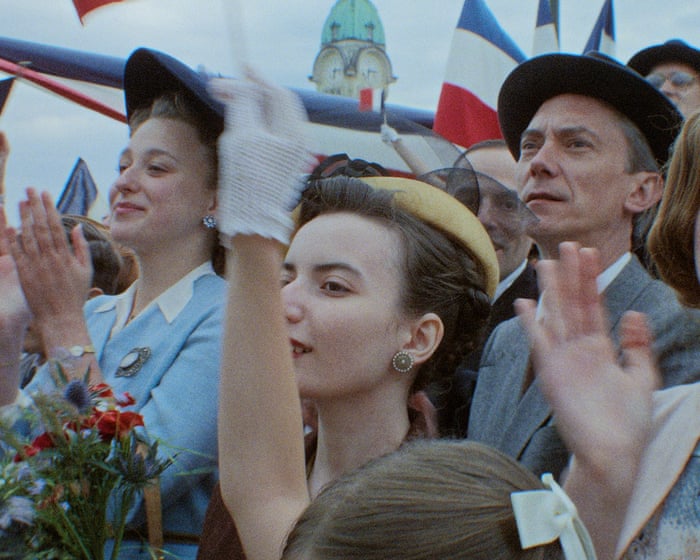
This is the story of how an ordinary state administrator unknowingly becomes part of an authoritarian regime’s machinery, embracing the bureaucracy and logistics of sending people to their deaths—and it is drawing audiences to French cinemas. The French film Notre Salut (Our Salvation), with its modern lighting, improvised scenes, and anachronistic 1980s Europop soundtrack, is far from a typical historical costume drama about World War II. But this award-winning film about the daily lives of ordinary people involved in the puppet Vichy regime that collaborated with the Nazis—and helped deport a quarter of France’s Jewish population to concentration camps—is set to become a box office hit.
The film, titled A Man of His Time in English, had a strong opening in French cinemas this week, especially among young audiences, at a time when the country is reflecting on its past ahead of next spring’s presidential election. Marine Le Pen of the far-right, anti-immigration National Rally (RN) continues to lead the polls for the presidential race despite political fallout from an investigation by Mediapart alleging that her party leader, Jordan Bardella, published antisemitic comments as a young party member, which he denies.
Notre Salut arrives amid a boom in films about France during World War II, including more than 5 million ticket sales for the two-part biopic of Charles de Gaulle, as well as the controversial Les Rayons et les Ombres about press baron and Nazi collaborator Jean Luchaire, and the upcoming Moulin, about the final days of French resistance leader Jean Moulin.
But rather than focusing on well-known heroes or monsters, Notre Salut highlights the role of ordinary people in the Vichy regime that, under Marshal Philippe Pétain, collaborated in the deportation of 76,000 Jewish people to Nazi concentration camps. The film was inspired by a stash of family letters found by its writer and director, Emmanuel Marre, that shed light on the life of his great-grandfather Henri Marre, who worked as an administrator under the authoritarian puppet regime.
“There are great figures who make history, but history is also made by the second-players, the grassroots who act on the ground, and that is what is interesting about this film,” said Marc Olivier Baruch, a historian and specialist on state administrators in the Vichy regime. For Baruch, the most chilling scene in the film is the bureaucratic nitpicking about the costs incurred by providing Jews on cattle trucks with straw and chamber pots. The central character, the administrator Henri Marre, “never chooses to reflect on things or look at what he’s doing, to wonder what his room for manoeuvre is.”
Baruch said the film’s sense of unease appeals to modern audiences because today France is “in a time of great uncertainty … There’s a strong lack of confidence among French people in their elites and in their state and that has been going on for a long time.” He said the Vichy regime resonates today as a period in history. “The PétainThe dictatorship was the only time the far right held power since 1820. For four years in the middle of the 20th century, the far right governed France, and for French people in 2026 and 2027, that is clearly significant. There has been a certain discomfort in modern France—a feeling that it would be better to stop talking about Vichy, to draw a line under it, to stop the masochism of looking back. That, of course, is foolish and impossible.
Film critics suggested that modern audiences were trying to better understand the rise of the far right across Europe and in France.
Henry Rousso, a historian who has studied how the Vichy regime is remembered collectively, wrote of the film in Le Monde: “The RN is not the fascism of the 1930s, nor a revival of the Pétain regime, but knowing this history helps us understand what the RN is the heir to, and how the gradual abandonment of democratic and republican values led to disaster.”
Emmanuel Marre won the screenplay prize for Notre Salut at the 2026 Cannes film festival. Photograph: SOPA Images Limited/Alamy
Emmanuel Marre, the film’s writer-director, who won the best screenplay prize at the Cannes film festival, began working on the story more than a decade ago after discovering letters from his great-grandfather that his family had kept in a drawer.
He told France Inter radio: “There are drawers like this everywhere in France… there is a phantom memory of the collaboration. With this film, we wanted to pry open those drawers and let all families look at that—not as self-flagellation, but because after the war France swept much of it under the carpet in order to survive.”
He said it was crucial to examine the nuances of what led people to collaborate or to take a stand. “Between resistance and collaboration, there is a whole range of human emotions, even the most ambiguous.”
Frequently Asked Questions
Here is a list of FAQs about the 2026 French film We Swept a Lot Under the Carpet covering its context themes and reception
Beginner Questions
What is We Swept a Lot Under the Carpet about
Its a French drama about a family in 1942 whose quiet life in Vichy France unravels when a hidden past involving collaboration with the Vichy regime comes to light
What was the Vichy regime
The French government based in Vichy from 1940 to 1944 that collaborated with Nazi Germany during World War II
Why is the film called that
The title refers to Frances habit of burying uncomfortable truths about the Vichy years instead of confronting them
Why did this film strike a chord in France in 2026
It premiered amid renewed public debate about memory collaboration and national identity and it became one of the years biggest boxoffice hits
Is it based on a true story
Its a fictional story but it draws on real historical events and the experiences of families who lived through the Occupation
Do I need to know French history to understand it
No The film explains what you need as it goes Some background helps but the family drama carries the story
Intermediate Questions
What themes does the film explore
Guilt silence inherited shame family secrets and how nations and individuals choose to remember or forget the past
Why did it spark debate in 2026 specifically
It arrived during a national reckoning over historical memory including new archival releases and political controversies about how Vichy is taught in schools
What was Frances carpet what was actually swept under it
The extent of French collaboration with the Nazis including the deportation of Jews by French police and the postwar myth that most of France resisted
How did the film perform at the box office
It was a major commercial success drawing millions of viewers in France and strong international attention
Did historians and critics agree on it
Most praised its emotional power though some historians said it simplified complex events Debate about the film became part of the story itself
What practical tips help when watching it
Pay attention