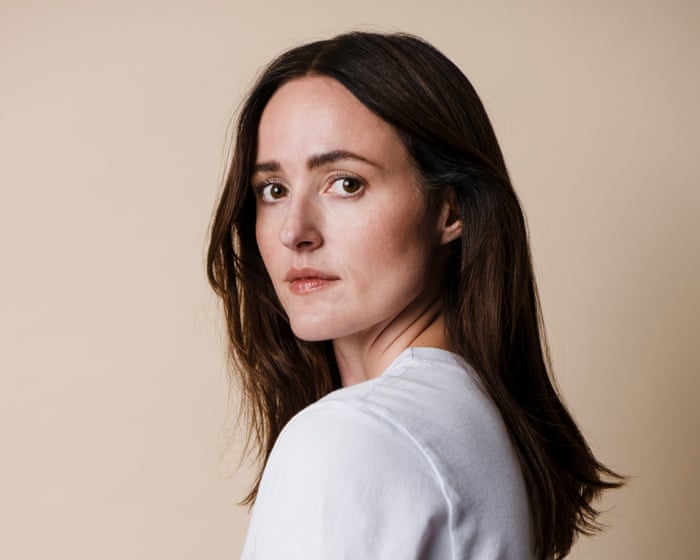
One day in July 2021, Renate Reinsve woke up, read the Guardian, and promptly vomited. It was—mostly—a happy kind of sickness. The Norwegian actor was at Cannes, where The Worst Person in the World had premiered the night before. Joachim Trier’s film, which follows Julie, a young woman on a whimsical yet determined search for meaning and happiness, was the first starring role of Reinsve’s career. During the screening, she thought, “This movie is great, but I am terrible!” Hours later, she was facing the possibility that she might be one of the finest actors of her generation. This newspaper’s headline—“A star is born”—was, she said, “too much to process, so I just started puking. My whole image of myself and what I could do changed instantly.”
Reinsve went on to win the best actress prize at the festival. Her performance would later be shortlisted for a BAFTA and a host of other awards (the film itself received two Oscar nominations). The recognition certainly helped her self-esteem, but the 38-year-old knew she shouldn’t let the praise go to her head. “I was very overwhelmed, and then I sat with it and thought: OK, I need to keep some distance from this somehow,” she recalls, sitting on a sofa in a spacious hotel suite in Soho, London. “You can’t take criticism too personally, and you can’t take praise too personally.” Such affirmation, I imagine, must become addictive. “Yes. And everything in life shall pass. So the aim was to keep everything a little bit even and keep the image I have of myself intact.”
Serene, meticulously humble, and aspirationally Scandi-chic in brown denim and black loafers, Reinsve is about as far from the archetypal fame monster as you could imagine. For fans of The Worst Person in the World, this will be welcome news. The film’s brilliance hinged on the rare relatability of its protagonist—a combination of the character’s frustrated search for fulfillment (too many professional epiphanies; initially euphoric but ultimately disappointing relationships) and the actor’s naturally vibrant and deeply layered performance. Her smile alone is a window into an entire inner world.
Reinsve quickly noticed how strongly people identified with Julie. During an early press tour, she met a journalist in her forties who “was a little bit agitated that someone in her 30s was telling her story. Like: how do you know how I feel? And then the next journalist was in his 20s, and he said, ‘I just want to say: This is me.’” The actor realized, “Oh, this is what the movie is to people—they really feel that it’s them.” Indeed, The Worst Person in the World isn’t just an astonishingly accurate portrayal of how it feels to be a young woman. Thanks to Reinsve, it’s also an astonishingly accurate portrayal of how it feels to live a life.
Following up this once-in-a-lifetime role was always going to be a challenge. Hollywood soon came calling: Reinsve’s next major (and first English-speaking) role was opposite Sebastian Stan in A Different Man, playing an actor whose facial disfigurement is miraculously cured. To calm her nerves, she decided to embrace failure, telling herself, “This will be my downfall—this is going to be crap, and that’s the way it is. And then it wasn’t that bad!”
Anticipating disaster clearly remains her go-to defense mechanism. In May, Trier and Reinsve returned to Cannes with Sentimental Value, a funny, sad, ambitious film about the tensions between family, art, and love. She plays Nora, a depressive actor whose estranged filmmaker father (Stellan Skarsgård) saunters back into her life brandishing a semi-autobiographical script he’s written as a vehicle for her talents. When an indignant Nora refuses the role, he casts…The up-and-coming American starlet Rachel (Elle Fanning) takes the role instead, while his eccentric presence continues to unsettle Nora and her sister Agnes.
During the shoot, Reinsve convinced herself the film could never live up to The Worst Person in the World. By Cannes, she was “very open to anything, because it’s really hard to tell if it’s good or not when you’re in the movie yourself.” Sentimental Value is admittedly a less immediately irresistible beast than the millennial coming-of-age story that made the pair famous. But it is also a beautiful, devastating, and richly thematic intergenerational tour de force. It ended up winning the Grand Prix, generating plenty of Oscar buzz for Reinsve—who has already received a Golden Globe best actress nomination—and reportedly received a 19-minute standing ovation, the third-longest in Cannes history. What was it like to sit through that? “You just feel that your face is really stiff from smiling for so long,” says Reinsve, fully aware of the absurdity.
Like Julie, Nora was written especially for Reinsve by Trier and his collaborator Eskil Vogt. Does that mean those characters are actually based on her? With Julie—whom the actor describes as “happy-go-lucky, melancholic but naive”—there was some overlap. Trier “writes something of what he has seen,” she explains. Then, during production, Julie became even “more my perspective, or the way I knew how to be a person in these situations.” For Nora, on the other hand, the director “wanted to challenge me to go even deeper into emotional weight.” Still, one parallel is especially clear: not only is Nora an actor, she’s a big fish in the small pond of Norwegian theatre, for whom a film is created by a director who believes she deserves success on a far greater scale.
Reinsve grew up in a remote part of Norway—not even a village, just “a road with some houses” in the forest—where she always felt out of place. She was “a quirky kid very interested in everything that had to do with existentialism” (she later bonded with Trier over both being “sentimental and melancholic way too early”). While her preteen peers were fawning over the Backstreet Boys, she was “listening to Pink Floyd in secret. So I knew that I was looking for something else.” She found hints of it in Hollywood icons like Diane Keaton, who “made it possible for quirky girls to feel accepted,” and David Lynch, whose embrace of the subconscious fascinated her. “Through movies, I really found my friends.”
Real life wasn’t making sense in quite the same way. The major theme of Reinsve’s youth is rejection: she was asked to leave, in roughly this order, the Girl Scouts (for “doing everything wrong”), the family construction business (“I never could follow the rules”), her childhood home (“I was, to put it mildly, too different from my mother”), and eventually school. By then she was 16 and living alone. “I was not finding a way to organize my life. I didn’t have the skills. So I would not show up if I was sleeping in, and I was just a little bit wild.”
Acting had long been a way to subconsciously process the “social dynamics” she struggled with. When she was nine, Reinsve joined a youth theatre half an hour’s drive away, where her talent was recognized. “When I was 14, someone came to the back room with a card and said, ‘You should apply for a theatre school.’” The prospect of acting for a living gave her “butterflies.”
But first, Reinsve “ran away from everything. I felt I didn’t fit in and was looking for something.”At 17, she ended up in Edinburgh. She had fallen in love with the city while performing to small audiences with her theatre group at the festival fringe—plus the flights were “really cheap,” and she had no money. To support herself, she worked double shifts at a hostel-restaurant-bar popular with international travelers. She loved being exposed to different cultures and enjoyed the “partying,” but her English wasn’t great, and she struggled to understand British humor (“the last thing you learn in a language”).
Back in Norway, Reinsve studied drama and spent the next decade building a name for herself on stage. Norwegian theatre, she says, is “really good”—high-brow, cutting-edge, and closely linked with avant-garde institutions in Berlin—but she soon felt she had reached a dead end. “I’d done it for so many years; it’s very hard physical work, and I had worked with so many great directors. I was like: OK, I think I’m done.” She wasn’t being offered any film projects that interested her either, so she decided to “do something else.” She even considered retraining as a carpenter, having enjoyed renovating a dilapidated house she had bought, and let go of being an actor.
Little did she know that director Joachim Trier had been busy writing something just for her. Trier had been convinced of her superstar potential ever since she appeared briefly in his acclaimed 2011 film Oslo, August 31st, and was baffled that almost a decade later she was still working in theatre. “One or two days” after she decided to quit acting, “Joachim called me for Julie.”
In Sentimental Value, Reinsve returns to her theatre days through the character Nora. She even got to realize a long-held dream of playing Hamlet (though those scenes didn’t make the final cut). While she is generally wary of improvisation—”because you can lose the layers: you want to say something, and you want the audience to hear something else and see something third”—she did make some alterations to the script. “When Nora explains what she loves about acting in the theatre, what [Trier] thought didn’t resonate with me. There were other things that were more important to me.” (In one scene, Nora tells Agnes that immersing herself in the perspectives of different characters “maybe provides me the security to connect to my own feelings.”)
Despite interest from the U.S.—last year she also starred in Apple TV’s Presumed Innocent alongside Jake Gyllenhaal—Reinsve seems to be staying in Scandinavia. Last year, she led the Caméra d’Or-winning Armand, directed by Halfdan Ullmann Tøndel, grandson of Ingmar Bergman and Liv Ullmann, and she recently reunited with director Henrik Martin Dahlsbakken for the upcoming film Fjord, about Romanian immigrants in Norway (she has also been cast in Alexander Payne’s Denmark-set film Somebody Out There). Is she loyal to the local scene? “Not really, because I started so late and I wasn’t let in!” she laughs. “It’s not loyalty; it’s actually that there are so many exciting things happening because of Joachim.”
It’s true that Trier and Reinsve’s success is putting modern Norwegian film on the map. Does she feel she’s actively contributing to the country’s cinematic identity? “Yes, absolutely. We all understand: Oh, something’s happening now.” As for what makes Norway’s output distinctive, “that’s so hard for me to see because I’m so in it.”
Crucially, after a childhood of alienation, Reinsve is now at the heart of things: a linchpin of her homeland’s film scene.”I don’t know what this feeling is…” she says, with genuine wonder and one of her famously complex smiles. “It’s a feeling of disbelief that you finally feel you belong.”
Sentimental Value opens in theaters on Boxing Day.
Frequently Asked Questions
FAQs About Renate Reinsve Reviews and Standing Ovations
BeginnerLevel Questions
Q1 Who is Renate Reinsve
A1 Renate Reinsve is a Norwegian actress who gained major international fame for her starring role in the 2021 film The Worst Person in the World Her performance won her the Best Actress award at the Cannes Film Festival
Q2 What does reviews that make you sick refer to
A2 This is a colorful way of describing overwhelmingly positive reviews It means the praise is so intense and universal that it can feel almost unbelievable or overwhelming to read
Q3 What is the 19minute standing ovation story about
A3 At the Cannes Film Festival premiere of The Worst Person in the World the audience was so moved that they gave the film a standing ovation for 19 minutes Renate Reinsve described the experience by saying Your face goes stiff from smiling for so long
Q4 Why would a standing ovation make your face stiff
A4 When you are the center of such prolonged intense admiration and applause you are constantly beaming reacting and expressing gratitude Holding a huge genuine smile for nearly 20 minutes straight can literally make your facial muscles ache and feel stiff
Advanced Practical Questions
Q5 How did the Cannes reception change Renate Reinsves career
A5 It catapulted her from a wellregarded actress in Norway to an international star The critical acclaim and viral moment of the ovation opened doors to global projects and established her as a leading talent in world cinema
Q6 Is there a downside to such rapturous reviews and reactions
A6 Potentially yes It can create enormous pressure for future projects lead to unrealistic audience expectations and make the intense public scrutiny feel burdensome The sickness from reviews can also be the dizziness of sudden fame
Q7 Can a long standing ovation ever be disingenuous
A7 In festival contexts like Cannes ovations are a tradition and can sometimes be influenced by industry politics However the genuine emotional reaction from critics and audiences to Reinsves performance was widely documented as being very authentic