So, I hear there’s a World Cup starting this week…
It is! Every four years, the best men’s teams from around the world come together to see who will be crowned world champions. This year’s tournament is co-hosted by Canada, Mexico, and the United States—countries that are friends and rivals at the same time. Matches will be held in 16 cities as diverse as Vancouver, Kansas City, and Guadalajara. The 48 teams are split into 12 groups of four, and each team plays the others in their group once. The top two from each group, plus the eight best third-place teams—32 in total—move on to the knockout rounds. From there, it’s single elimination: lose and you’re out. If the score is tied after extra time, the match is decided by a penalty shootout.
The final is on July 19 in “New York” (actually New Jersey, which FIFA calls New York/New Jersey), after 104 matches across three countries. The tournament kicks off this Thursday, June 11, at the Estadio Azteca, where co-host Mexico takes on South Africa.
Wait, 48 teams? I thought it was only 32?
That was the case for the last World Cup and the ones before it (the first tournament in 1930 had just 13 teams). Cynics say soccer’s governing body, FIFA, expanded the field to make more money—the 2022 World Cup brought in about $7.5 billion. But FIFA argues that the revenue goes toward developing grassroots soccer, and the larger field gives underdogs with little chance of winning—like Jordan, Curaçao, and England—a shot at competing with the big teams.
FIFA sounds like my kind of organization: helping the little guy and putting on a show for the whole world. Fans must love it, right?
Wellllllllllll… not everyone, no. FIFA has faced heavy criticism for the sky-high ticket prices this summer. A Guardian analysis in December found that the cheapest tickets for this year’s final are nearly 10 times more expensive than they were for the 2022 tournament. FIFA also takes a 30% fee on ticket sales through its resale site. Then there’s FIFA president Gianni Infantino’s decision to give a peace prize to Donald Trump. Yes, the same Donald Trump who is currently in a conflict with Iran and has threatened to make one of the tournament’s co-hosts the 51st US state.
High ticket prices, wars, and questionable prizes? Why should I even watch?
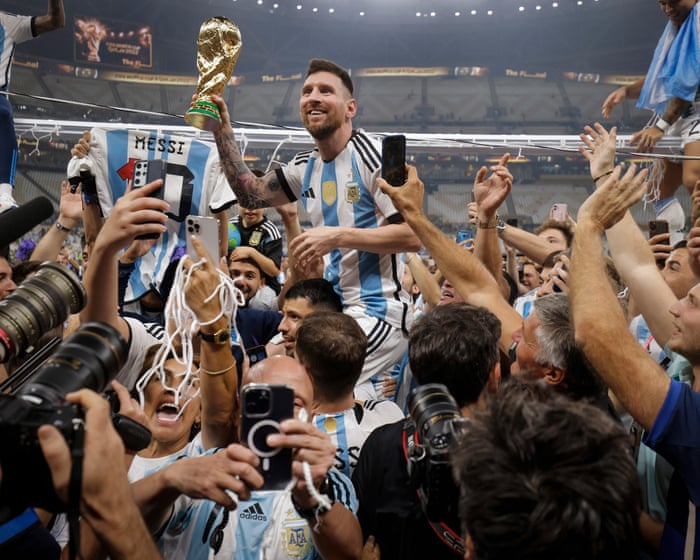
Because this is a gathering of some of the world’s finest athletes competing for one of the most coveted prizes in sports. There will be brilliant goals, shocking upsets (like when eventual champions Argentina lost to low-ranked Saudi Arabia in their opening match at the last World Cup), heartbreak for the losers, and pure joy for the champions.
And who will those champions be?
Spain is aiming to follow up their 2024 European title with the World Cup this time (they also won in 2010). They have excellent young players, excellent veterans, and an excellent coach—other than that, they’re a pushover. It’s a similar story for France, who reached the final in 2022. The reigning champions, Argentina, will be contenders but aren’t as strong as they were four years ago. Their old rivals England are among the betting favorites, though that’s partly because their often overly optimistic fans keep betting on them. Brazil and Germany have nine titles between them and shouldn’t be counted out, even though neither team is at their peak.
If you want to try making your own predictions, we recommend using our Bracketology game.
9:34
Zohran Mamdani plays the Guardian’s Bracketology to predict the World Cup winner – video
What about dark horses?
No less an authority than New York City mayor and democratic socialist Zohran Mamdani told the Guardian that Morocco will win the tournament. If they do, they’d be the first African team to do so.They have a shot at lifting the trophy, and they’ve got the track record—they made the semifinals in 2022. Norway, fresh off dominating the rest of the world at this year’s Winter Olympics, have the formidable goal-scorer Erling Haaland on their side. Mexico, Canada, and the US should all make it out of the group stage, but they’ll probably be hoping for a quarterfinal spot at best.
Who are the players to watch?
The most famous players at the tournament will be Cristiano Ronaldo and Lionel Messi, though at 41 and 38 respectively, they’re not at their peak anymore. Ousmane Dembélé, fresh off helping his club Paris St-Germain win the Champions League, is widely seen as the best player in the world, but Spain’s 18-year-old winger Lamine Yamal is the most exciting. Haaland, England’s Harry Kane, and France’s Kylian Mbappé are ruthless goal-scorers, while Vitinha’s cleverness and skill in Portugal’s midfield have earned him admiration from fellow players.
And where can I see all these players?
If you can’t make it to one of the 16 stadiums hosting matches (two in Canada, three in Mexico, and 11 in the US), you can settle into your couch and watch the whole thing on TV. In the US, Fox (English) and Telemundo (Spanish) are the broadcasters. In Australia, you can watch every match live on SBS and SBS Viceland. TSN and CTV will have the matches in English in Canada, while coverage in French will be on RDS. In the UK, the BBC and ITV will share the coverage during the tournament. Of course, if you want the best coverage, there will be live updates for every match on the Guardian website.
16 stadiums and three countries sounds like a lot. How far will fans and teams have to travel?
Canada, Mexico, and the US’s bid for the tournament emphasized that this would be a World Cup shared between the three countries. But the US actually ended up with 78 of the matches, while Canada and Mexico get 13 each, and every game from the quarterfinals onward will be hosted by the Americans. The 2026 bid book also talked about the co-hosts’ commitment to the environment, but this World Cup will involve a lot of travel. If they reach the final, most teams (and their diehard fans) will have traveled more than 8,000 km.
And how much will the players win for all this?
FIFA is paying out $727 million in prize money for the tournament, which is obviously a lot. But it’s worth noting that the organization’s vice-president, Victor Montagliani, expects this World Cup to bring in $13 billion. The winners alone will get $50 million, or enough for two tickets to the 2030 World Cup final.
Frequently Asked Questions
Here is a list of FAQs for a beginners guide to the World Cup
General How It Works
1 What exactly is the World Cup
Its a global soccer tournament where 32 national teams compete every four years to be crowned the world champion Think of it as the Super Bowl of international soccer but lasting a whole month
2 How does a team qualify for the World Cup
They dont just show up Over the three years before the tournament countries play hundreds of qualifier matches within their own continent The best teams from each continent earn a spot in the final tournament
3 How does the actual tournament work
It has two stages
Group Stage The 32 teams are split into 8 groups of 4 Each team plays the other 3 teams in its group once The top 2 teams from each group advance
Knockout Stage The 16 remaining teams play singleelimination matches Lose one game and you go home This continues until the final
4 What happens if teams tie in the group stage
In the group stage a tie is allowed Each team gets 1 point for a draw and 3 points for a win If teams have the same number of points tiebreakers like goal difference decide who advances
5 Why does the World Cup happen every four years and not every year
To keep it special It gives leagues and players time to rest allows a full cycle of qualifying matches and builds massive anticipation Its the biggest prize in the sport so the wait makes the victory sweeter
Players Teams to Watch
6 Who are the mustwatch players for a beginner
Lionel Messi Often called the greatest ever Hes small magical and won the 2022 World Cup
Kylian Mbappé Incredibly fast and powerful He scored a hattrick in the 2022 final
Erling Haaland A goalscoring machine but his team may not qualify every time