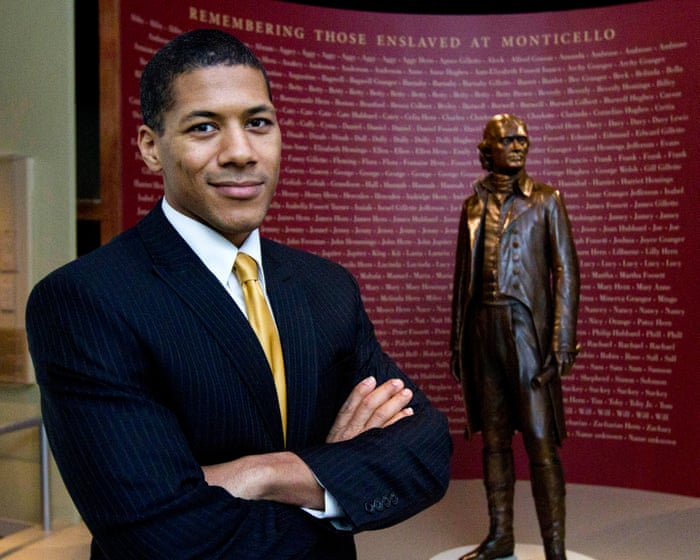
When the United States turns 250 years old on Saturday, Shannon LaNier will be grappling with a deep contradiction in the country’s founding story—and in his own.
LaNier is the sixth great-grandson of Thomas Jefferson, the Founding Father who wrote the Declaration of Independence and became the third president. He is also a direct descendant of Sally Hemings, a woman Jefferson enslaved and who bore several of his children. Their exploitative relationship began when she joined him in Paris at just 14 years old and lasted for decades.
There is no clearer example of the gap between the Founding Fathers’ noble ideals and their acceptance of the nation’s original sin. Jefferson wrote that “all men are created equal” with the right to pursue “Life, Liberty and the pursuit of Happiness,” yet he owned more than 600 people.
“I wish he would have done more to free the enslaved people and practice what he actually preached,” LaNier, 47, says by phone from New York. “I know he tried, but he was the most powerful man in the country and he could have done more. He was living a double life, so it’s unfortunate.”
“Sometimes I appreciate what he’s done for this country and how much of a genius he was,” LaNier continues. “Other times I hate what he did and that he didn’t do more, and the hypocritical aspects. Because we could have been so much further along as a society if he had done what was right instead of what was profitable.”
“A lot of people like to think of slavery as only a horrific experience, but it was also an experience that proves we come from a very powerful people.”
LaNier has built a career as a TV personality, actor, social media influencer, and public speaker. He is a co-author of Jefferson’s Children: The Story of One American Family.
He has known about his lineage since childhood, but he remembers a painful moment in second grade when his class was studying presidents. He proudly stood up and announced he was Jefferson’s great-great-great-great-great-great-grandson. “The class laughed and the teacher said, ‘Sit down and stop telling lies!’ That was a hurtful moment in my life.”
The next day, LaNier’s mother went to the school to correct the teacher about his family history. He adds, “That helped me understand the importance of knowing who I am, being strong in the belief of who I am, and not letting others define me.”
As LaNier grew up, he was aware of his famous ancestor’s name on mountain peaks, countless schools and streets, and a towering monument in Washington, D.C. It was equally clear that his sixth great-grandmother had been left out of the story.
But LaNier came to appreciate her strength and resourcefulness. Unlike most enslaved women, Hemings negotiated the freedom of her children with Jefferson. While she was with him in Paris—where she was legally free—she agreed to return to slavery in Virginia only after Jefferson promised to free their unborn children once they turned 21.
“We know more about Jefferson, but we have to give credit to Sally Hemings. It’s because of her that we know who we are today—that she didn’t hide the story from her children, that she was able to negotiate for her kids to have freedom at age 21, that she was able to tell her story and make sure we could tell ours.”
He adds, “I commend all those who were enslaved. A lot of people like to think of slavery as only a horrific experience, but it was also an experience that proves we come from a very powerful people—that we were able to survive the most horrible conditions on the planet, that we survived and we thrived.”We’re still surviving. Slavery was just a moment, but life is a journey.
The threat of forgetting history—or deliberately erasing it—looms large as the US approaches its 250th anniversary. LaNier is well aware of right-wing efforts to reshape the American story around heroic white Christian men, pushing aside the diverse realities of the nation’s beginnings.
But he points to Monticello, Thomas Jefferson’s sprawling Virginia estate where Sally Hemings lived and worked for nearly her entire life, as a positive example. For decades, it mostly served as a shrine to a founding father. However, in 2018, Monticello opened six exhibits that highlight the role Hemings and other enslaved families played in building and running the estate.
He reflects: “A lot of historical institutions can learn a lot from Monticello… they’re telling what happened: the good, the bad, and the ugly, because you can’t have one without the other. You need the full story and context.”
It’s just as important to celebrate July 4 because, if we didn’t, it would make all the blood, sweat, and tears of our ancestors meaningless.
Not everyone will be celebrating on July 4, especially since Donald Trump has inserted himself into the official events. For many African Americans, this date has long been a source of heated debate. The question Frederick Douglass asked in 1852—“What to the Slave is the Fourth of July?”—still echoes in the 21st century.
LaNier observes: “Some people in the Black community don’t want to celebrate July 4 because they say we have Juneteenth and we weren’t really free then. But it’s just as important to celebrate July 4 because, if we didn’t, it would make all the blood, sweat, and tears of our ancestors meaningless.
“It’s important that people know how involved people of color were in the founding of this country, that we wouldn’t have a 250-year anniversary without people of color slaving and laboring constantly.”
He adds: “Who do they think built the White House? Who do they think was helping Jefferson with everything when he was writing the Declaration of Independence? He had people running and managing his plantation. All these things are part of the foundation of this country, and they keep trying to whitewash or forget them.”
Saturday also marks the 200th anniversary of Jefferson’s death at age 83, at Monticello, just after noon on July 4, 1826. A few hours later, the second president, John Adams, died in Quincy, Massachusetts, at age 90. It was the 50th anniversary of independence.
For LaNier, the beauty of the Declaration of Independence isn’t in the narrow, hypocritical story of the man who wrote it, but in the broad power of those words to be claimed by every generation. Even though the US seems more anxious than hopeful right now, LaNier tries to stay optimistic about the future.
To understand the US’s complex history with slavery, look to Thomas Jefferson.
“Sometimes you take two steps forward, then you have to take two steps back,” he reflects. “Hopefully when this era is over, we can take several leaps forward and catch up.
“It’s going to take a while to recover from what has been done, but it’s not impossible. And if we keep focusing on the words Jefferson wrote—‘all men are created equal’—not just rich, land-owning white men, then we can get to a better place where this country can heal and reconcile.
“But we have to know our past, we have to know the mistakes that were made so we can move forward and not repeat them.”
Frequently Asked Questions
Here is a list of FAQs based on the quote I wish he had done more to free enslaved people says a descendant of Thomas Jefferson reflecting on his familys complicated legacy
BeginnerLevel Questions
Q Who is the descendant mentioned in the quote
A The quote is from a modernday descendant of Thomas Jefferson such as Shannon LaNier or others from the JeffersonHemings family They often speak publicly about their ancestors legacy
Q Why does the descendant say Jefferson should have done more
A Because Jefferson wrote that all men are created equal but owned over 600 enslaved people during his lifetime and only freed a handful mostly after his death
Q Did Thomas Jefferson ever free any enslaved people
A Yes but very few He freed only a small number in his willmostly members of the Hemings family including Sally Hemings children The vast majority were sold or passed on to his heirs
Q What is the complicated legacy the descendant is talking about
A It means Jefferson is both a hero for writing the Declaration of Independence and a figure of deep contradiction because he owned slaves and did not use his power to end slavery
Q Why didnt Jefferson free all his slaves
A Historians say he was deeply in debt feared economic collapse of his plantation and believed that freed Black people could not live peacefully in white society He also relied on enslaved labor for his wealth
AdvancedLevel Questions
Q What specific actions could Jefferson have taken to do more for enslaved people
A He could have publicly advocated for gradual emancipation in Virginia used his influence as President to push for federal antislavery laws freed his own slaves during his lifetime or funded colonization efforts for freed people
Q How does the descendants perspective differ from how Jefferson is traditionally taught in schools
A Schools often highlight Jeffersons ideals of liberty while descendants point out the painful reality that he lived a life of luxury built on slavery They call for a fuller more honest history
Q Why do some people defend Jeffersons inaction on slavery