This school in western Ukraine has around 400 cadets from all over the country. On paper, it looks like any other high school—students study math, physics, English, and history, and take the same national exams as everyone else. But daily life here is different.
As cadets wait to march out for the graduation parade, one straightens her classmate’s collar.
Military drills, tactical exercises, and drone training are part of the curriculum, taught alongside regular subjects by both civilian teachers and military officers. “They go from boys to men to warriors here,” says the deputy head, Taras Hrytsevych. Now, after years of discipline and routine, those rituals are coming to an end.
Cadets tackle infantry obstacles and learn how to operate FPV drones.
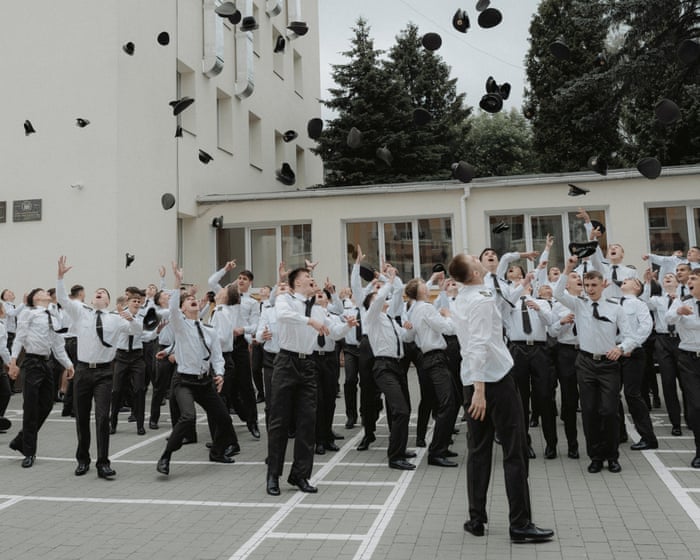
Heavy clouds hang over the schoolyard as 136 graduating cadets march in white uniforms. Parents, family members, and friends line the square, scanning the formation for familiar faces.
A cadet holds an anti-tank missile launcher.
Zakhar Yanov, 17, traveled nearly 560 miles (900 km) from his home in Dnipro to attend this school. After the summer, he will move to the southern port city of Odesa to start studying at a military academy. “It’s my duty to defend Ukraine,” he says. “I want to join the airborne forces.”
(Clockwise from top left): seventeen-year-old Zakhar Yanov; cadets dance and celebrate during their final evening together before graduation; the graduating company sergeant, the senior student leader responsible for the cadet sergeants, bows before the school flag as part of a tradition marking his farewell; and the graduating cadets march in formation as their families and friends watch the ceremony.
For years, many of the cadets have shared dormitories, classrooms, and early morning drills with the same group of classmates. Tomorrow, they will scatter across the country, following different paths but carrying lifelong memories with them.
Since 2024, the school has also admitted girls to study alongside the boys. Among the cadets in formation is Kateryna Sheremeta, 16, from the north-western Volyn region. After the summer holidays, she will move to Khmelnytskyi in western Ukraine, where she plans to attend the national academy of the state border guard service to become a border guard officer.
(L-R) Kateryna Sheremeta, 16, wants to become a border officer; cadets dance and sing around a bonfire on the evening before graduation, celebrating their last evening together at the school.
“Before the war [with Russia], I thought about doing something creative, like becoming an architect or a designer,” Sheremeta says. “But after the invasion, I realized this is where I belong.”
Her father served in the military during the early stages of the invasion, and both of her brothers have also served. One of them was only 25 when he was killed in January this year.
A family takes a selfie with a graduating cadet after the ceremony.
After the parade, the cadets hug parents they haven’t seen for weeks or months and pose for one last photo with their teachers and friends.
Within days, many will submit applications to military academies. Others will leave for universities or civilian careers. The dormitories that have been their home will stand empty until a new class arrives in September.
(Clockwise from top left): a band performs during the graduation ceremony; the cadets celebrate together; shirt signing; and a hug after the graduation ceremony.
The cadets throw their arms around lifelong friends and celebrate the end of a chapter that has shaped their adolescence. Tomorrow, they will go their separate ways.I’ll leave for different cities and different futures.
Frequently Asked Questions
Here is a list of FAQs based on the topic of a graduation ceremony at a Ukrainian military school as seen through a photo essay
BeginnerLevel Questions
1 What exactly is a graduation ceremony at a Ukrainian military school
Its a formal event where cadets officially complete their training and become junior officers Think of it like a university graduation but with a lot more military tradition uniforms and ceremony
2 Why is this ceremony happening now during the war
Ukraine needs new officers to lead its troops The war has made these graduations more frequent and urgent The cadets often go straight from the ceremony to the front lines
3 What do the graduates wear
They wear formal dress military uniforms Often they wear traditional embroidered shirts called vyshyvanky under their jackets Many also carry flowers
4 What happens at the ceremony
Typically there is a parade the national anthem is played diplomas are handed out and officers pin new rank insignia onto the graduates There are often speeches and moments of silence for fallen soldiers
5 Why are there so many flowers
Its a Ukrainian tradition to give flowers to graduates teachers and honored guests The flowers symbolize respect gratitude and celebration
IntermediateLevel Questions
6 How is this ceremony different from a peacetime graduation
The biggest difference is the emotional weight The war is not an abstract conceptits a reality Ceremonies are shorter more solemn and often include a roll call of graduates who have already been killed in action The sense of urgency and sacrifice is much higher
7 Who attends the ceremony
Family members senior military commanders government officials and sometimes foreign military attaches The most important attendees are often the mothers and wives of the graduates
8 What does the photo essay format tell us that text cant
Photos capture the raw emotion the pride in a mothers eyes the nervous smile of a young officer the solemnity of a salute and the stark contrast between the formal ceremony and the brutal reality of war they are about to enter It shows the human side of the conflict
9 Do the graduates immediately go to the front
Many do but not all Some may take on staff or training roles