At the core of this strange, perhaps even poignant, book lies a biblical question: “What must I do to be saved?” Not in a simplistic sense of securing a spot in heaven, but as a pressing challenge to the harmful assumptions and habits that mainstream culture promotes. Vance’s earlier book, Hillbilly Elegy, documented, among other things, how substance abuse has affected generations of the rural poor. It’s not a stretch to see this new book as a view of the modern West through the lens of addiction and its long-term effects. But this time, the norms and expectations of elite society are just as deadly for ambitious young professionals as fentanyl is for the less fortunate.
Vance offers a diagnosis that isn’t particularly original, but it gains power from the intense personal questioning he went through to reach it. The U.S. vice president clearly describes the widespread mechanisms in education, professional life, and politics that train us to want what others want—not what we truly find valuable. Most of us naturally crave emotional security, meaningful work, and, above all, hope and joy in raising the next generation, introducing them to a world of worth and possibility. One of the most striking moments in the book is when the highly successful young Vance feels painfully lost when faced with becoming a parent: “I knew exactly how to help my kid get into a good college but was woefully underprepared to make him a good man.”
Wanting what others want traps us in work patterns that are inhumanly frantic and wreak havoc on family life. It also corrupts our intellectual life, creating a hyper-anxious conformity in moral opinions. Vance recalls his time at Yale Law School, where, he says, progressive orthodoxies held an iron grip. To question the absolute moral certainty of a pro-choice stance meant instant exclusion from the inner circle. And this kind of ostracism came from both the left and the right: for both sides, the ultimate goal was to fit as fully as possible into an administrative elite that offered maximum personal freedom—understood as maximum income and status.
How can we take a book seriously that ignores the rampant corruption of the Trump-era ruling class?
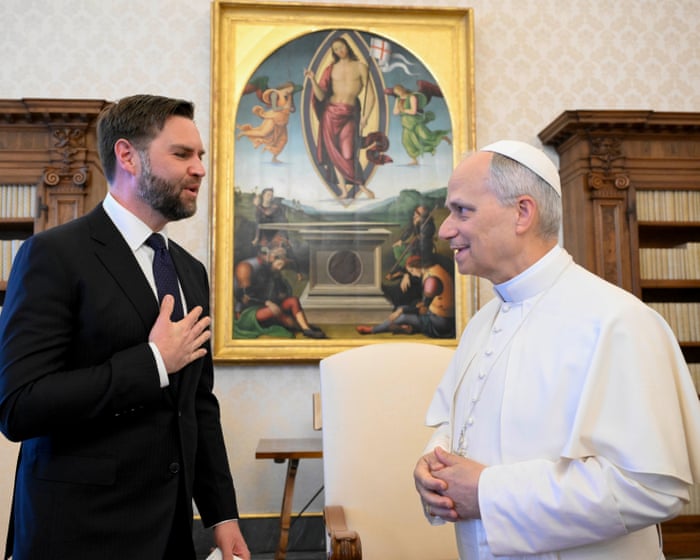
Vance’s return to Christian faith was shaped by two key insights. The first he provocatively states as, “I found liberation in guilt.” To be both honest and compassionate, we need a language (and a ritual) of repentance and renewal. What draws Vance toward a specifically Catholic identity is the need to see grace as something absorbed and internalized over and over again through a long history of learning and growth—unlike the quick spiritual fixes he saw in the evangelical world of his childhood. The beginning of Christian wisdom is only possible through honesty about your own failures and the resulting ability to respond to others’ failures not with enabling tolerance, but with mercy and hope.
The Catholic perspective is also compelling because of its history of social analysis that goes beyond the narrow divisions of modern politics. The social vision famously articulated in the late 19th century by Pope Leo XIII stresses that economic life should support, not undermine, the dignity of people and families, and the sense of meaningful ownership over one’s work and its conditions. This provides a strong foundation for union activism and the demand for fair wages. Vance gives a harsh account of a conversation with a critic of the U.S. administration’s immigration policy, who argues that abundant migrant labor lets employers avoid paying higher wages to American citizens, thus ensuring better profits. We are brought back to the emptiness and toxicity of the addictive cycle.The profit- and status-driven activity Vance has already described seems to be the thread running through this loosely structured book. In some ways, it echoes a view of modernity—especially American modernity—that has been more fully developed by scholars and commentators like Robert Bellah and David Brooks. This perspective focuses on the anxiety and isolation caused by individualistic hopes and desires, shows a renewed concern for “character,” and calls for rediscovering the resources that help us raise the next generation to live a good life. It’s not far from what “Blue Labour” and “Red Toryism” have highlighted on this side of the Atlantic. The Christian vision here matters less as a system of strict ethical rules—though those are certainly present—and more as an attitude that lets us face failure without despair, treat each other with generosity, and ultimately recognize that our deepest longings point us toward being at home with what is most real: the unconditional love that created us.
This brings us to the big question the book leaves us with: what does any of this have to do with the administration JD Vance is a leading member of? And maybe a related question: who is his audience? This book isn’t designed to appeal to the hardcore MAGA crowd, nor will it win praise from the tech-loving billionaires who control the digital world—Vance has harsh things to say about them, despite a somewhat grating tribute to Elon Musk as a job creator—or from traditional free-market capitalists. At the same time, it’s unlikely to win friends on the left. While his take on abortion is more nuanced and sensitive than much conservative writing on the topic, that alone will put him beyond the pale for most progressives.
What he doesn’t tell us—despite hinting a couple of times that he will—is why he was ready to tie his fortunes to Trump. He dismisses early criticism of Trump as just elite snobbery about the president’s “style,” and insists the first Trump administration was a “success,” without really connecting that to the values implied in these pages. But how can we take a book seriously that ignores the rampant corruption of the Trumpian ruling class, the disgraceful verbal bullying that has become normal in the president’s online and offline rants, the reckless foreign policies (Vance’s careful reservations about funding military support for Ukraine would apply even more to the Iran war disaster), and the murderous brutality of new immigration controls?
The book has been criticized more for its author than its content. That content isn’t as empty or nasty as some have assumed—though there are weak moments, like shaky arguments about traditional gender roles or claims that “rising racial conflict and gender division” are direct results of de-Christianization (a claim hard to square with America’s history of Christian nationalism). But it does nothing to solve the mystery of what makes the vice president tick. At one point, he approvingly quotes a pastor telling an addict in jail, “Show me your friends and I’ll show you your future.” Well, yes—back to the opening question about what you must do to be saved. “Look at the company you keep” might be a start.
Communion: Finding My Way Back to Faith by JD Vance is published by William Collins (£20). To support the Guardian, order your copy at guardianbookshop.com. Delivery charges may apply.
Frequently Asked Questions
Here is a list of FAQs about Communion by JD Vance written in a natural conversational tone
BeginnerLevel Questions
1 What is Communion actually about
Its a memoir about JD Vances journey back to the Catholic Church Its less about politics and more about his personal struggle with faith family and finding meaning in a chaotic modern world
2 Do I need to be religious to read it
Not at all Vance writes about doubt loneliness and the search for community Even if youre not religious the book explores universal human questions about belonging and purpose
3 Is this a sequel to Hillbilly Elegy
Sort of It picks up after Hillbilly Elegy While that book focused on his upbringing and poverty Communion focuses on his spiritual life and conversion to Catholicism You dont need to read the first one to understand this one
4 Why is the book called Communion
It has a double meaning First it refers to the Catholic sacrament of Holy Communion Second it refers to the idea of communion with other peoplefinding connection in a world that feels increasingly isolated
5 Is it a sad book
Parts of it are poignant and raw especially when Vance talks about family trauma and his own doubts But its also hopeful Its about finding peace after a long hard search
IntermediateLevel Questions
6 How does Vance describe his conversion to Catholicism
He doesnt present it as a sudden dramatic miracle Instead its a slow intellectual and emotional process He talks about reading ancient theologians going to Mass and wrestling with the Churchs difficult teachings Its very honest about the struggle
7 Does the book get political
Not really Vance is a politician now but this book is deeply personal He critiques modern consumerism loneliness and the breakdown of familythings that affect people across the political spectrum The focus is on faith not policy
8 What is the strange part of the book
Vance writes openly about suffering death and the weirdness of believing in miracles