A food truck in the Netherlands is offering a unique deal: trade in cigarette butts for buttery Dutch pancakes. The idea is to make people think twice about littering.
Cigarette butts are the most common type of plastic waste worldwide, with over 4.5 trillion produced every year. In the Netherlands alone, the number is estimated to be in the hundreds of millions.
To help tackle this problem, one company is accepting cigarette butts as payment for a plate of poffertjes—small Dutch pancakes usually served with lots of butter and sugar.
At the Het Vrije Westen liberation festival in Amsterdam’s Westerpark this month, the WasteBar’s yellow truck was covered in catchy slogans like “don’t waste waste!” A nearby sign read: “Betaal hier met zwerfafval” (pay here with litter).
At the WasteBar, cigarette butts are as good as cash. You can get poffertjes for 20 butts, drinks for 10, and fruit or candy for 15. They also accept plastic: 15 pieces for a plate of poffertjes.
Cigarette butts contain plastic, heavy metals, and other toxic substances, and they’re very hard to remove from the environment. Dutch municipalities reportedly spend around €36 million (£31 million) each year cleaning them up.
The problem has become so widespread that on the first Saturday of July, thousands of people take part in No Butts Day, an annual event that started in the Netherlands and has since grown internationally. Meanwhile, the WasteBar operates all year, showing up at festivals, children’s events, and business gatherings to help reduce the waste.
The creative idea began in Goa, India, as part of a 2019 campaign by Dutch entrepreneur Noreen van Holstein to tackle litter on the beaches. After living in Goa for 17 years, she returned to the Netherlands in 2020 and saw that the country could benefit from a similar approach. She combined the bar with a foundation she runs with fellow entrepreneur Lalita van Lamsweerde, and launched the WasteBar food truck in 2022.
“I wasn’t sure if people would be hesitant to pick things up from the ground,” Van Holstein said. “But right from the start, the response was just positive.”
The WasteBar has served more than 50 events, collecting over 500,000 cigarette butts. Some were used in an art exhibit last year. Others are waiting to be disposed of properly. “Right now I have about 100,000 in my garden in a drum,” Van Holstein said with a laugh. This year, she hopes to find a partner to help with recycling.
Reducing such a common source of litter is a big goal, but Van Holstein is hopeful. “I do believe that littering can be tackled,” she said, pointing to Singapore and the Nordic countries as examples of places that have kept their cities clean. She has also seen how the Netherlands has made progress with another type of litter: dog poop. But she admits that one truck can’t do it alone. “Even if we were at 500 events a year, we wouldn’t solve the problem,” she said.
Through the WasteBar, she hopes to spark a “mentality change” around litter and encourage children to adopt an anti-littering attitude. “We want to get people into action mode, and [hope] that by picking up litter, they won’t litter anymore, because we believe that once seen, it cannot be unseen,” Van Holstein said.
According to Reint Jan Renes, a behavioural scientist at the Amsterdam University of Applied Sciences who is not involved with the initiative, the WasteBar uses several methods known to be effective in reducing litter and promoting environmentally friendly behaviour. Its strength, he said, lies in the social dynamics and norms at play.
“It turns something abstract like littering into a visible, collective social activity,” he said. “People see others taking part, talking about waste, and it becomes a shared effort.”Picking up cigarette butts together and contributing to something real.
“If enough people start to see litter cleanup as a source of civic pride, creativity, or community involvement—rather than punishment or duty—this kind of initiative could help spark a broader cultural shift.”
Van Holstein also sees the WasteBar as a creative way to promote omdenken, a Dutch word that roughly means “rethinking.”
“People are used to paying with money. But when they have to pay with something else, it triggers something in their brain,” she said. “By giving value to something useless, like litter, it makes people see things differently.”
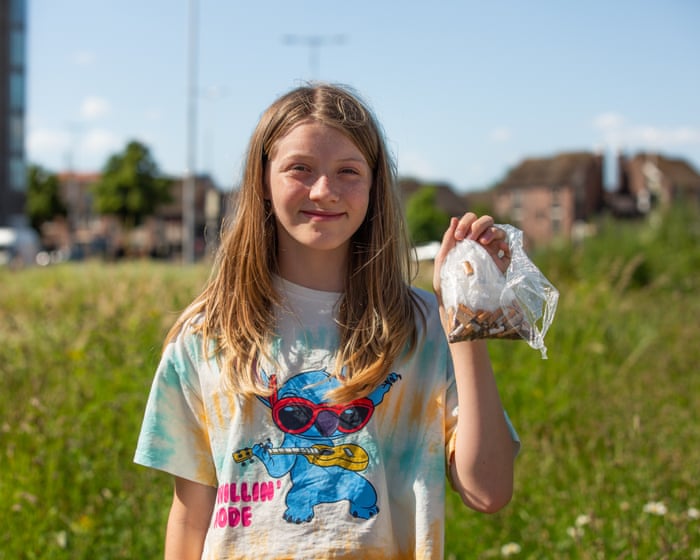
At the festival in Westerpark, the children inspecting the cigarette butts were doing exactly that. By the end of the day, they had collected 6,000 cigarette butts—the equivalent of several hundred servings of pancakes.
Frequently Asked Questions
Here is a list of FAQs about the initiative that encourages people to exchange cigarette butts for free food turning litter into an opportunity to rethink waste
BeginnerLevel Questions
Q What exactly is this program
A Its a campaign where people collect cigarette butts from the ground and bring them to a designated spot to receive a free meal or snack The goal is to reduce litter and show how waste can be valuable
Q Why would anyone want cigarette butts
A The butts are not reused for food They are collected to be recycled or properly disposed of The food is a reward for cleaning up the environment
Q How many butts do I need to get free food
A It varies Some programs ask for a handful while others might require a full container Check the specific event or restaurant rules
Q Is the food really free
A Yes the food is provided at no cost as a reward for your cleanup efforts Its a trade litter for a meal
Q Do I have to touch the cigarette butts with my hands
A No you can use gloves a grabber tool or a small container to pick them up Its best to avoid direct contact for hygiene
Advanced Practical Questions
Q What happens to the cigarette butts after I turn them in
A They are usually sent to a recycling facility that processes them into plastic pellets industrial products or they are incinerated safely They are not thrown back into the trash
Q Is this program legal and safe
A Yes its legal as long as you pick up litter from public spaces Safetywise wear gloves and wash your hands after handling butts
Q What if the butts are wet or moldy
A You can still collect them but wear gloves Some programs may accept them while others might prefer dry butts Check ahead
Q Can I participate if I dont smoke
A Absolutely In fact many participants are nonsmokers who just want to help the environment and get a free meal