As the judge read out the verdict in Marine Le Pen’s appeal trial for embezzlement, the same conversation was happening in living rooms and WhatsApp groups across France. What? Does this mean she can still run for the Élysée after all? But what about the prison sentence? And the electronic tag—which Le Pen had promised she wouldn’t wear while campaigning? And what about her protégé, Jordan Bardella?
For a few hours, it seemed like the court of appeal had unexpectedly played a clever hand by firmly upholding the far-right National Rally (RN) figurehead’s conviction for misusing public funds. She was fined €100,000 (£85,000) and given a reduced prison sentence, with the remaining year to be served under electronic tagging. The courts had been accused by the RN and its supporters of handing down politically motivated verdicts after her original conviction in March 2025. But now, crucially, they appeared to have found a way to confirm Le Pen’s guilt while protecting the judiciary from claims that they were blocking voters’ democratic rights. The court did this by shortening the original five-year ban on Le Pen running for office, which would have effectively removed her from next year’s presidential race.
The judges ruled that Le Pen was at the center of an elaborate fake jobs scheme and sentenced her to prison. Yet by clearing the way for her to run, they also protected voters’ right to elect a convicted criminal to the French presidency. The impartiality of the justice system and the rule of law were preserved; the ball was now back in the political court, and in Le Pen’s hands. But this verdict also forced her to face a deep dilemma: should she keep her promise not to campaign while under curfew with an ankle monitor (as her sentence requires), or step aside and let her young, poll-topping lieutenant Bardella run in her place in 2027?
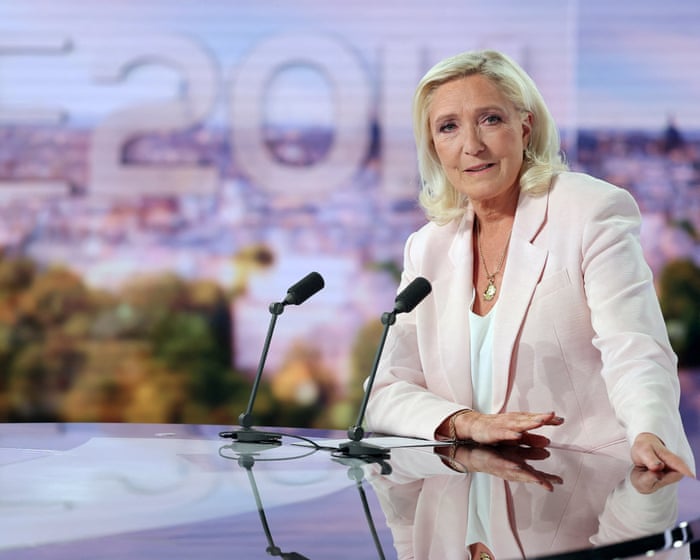
Le Pen wrestled with this deep moral dilemma for all of a couple of hours, then appeared—dressed in pink and looking fresh—on the evening news to announce that she would, after all, be the RN candidate in the presidential election. She would appeal to France’s highest court on a point of law, so she might not have to wear an electronic tag. Questions about the timing of this appeal were brushed aside. In a menacing performance that mixed cold political smiles with her trademark teeth-grinding, Le Pen was defiant: it would be up to French voters to decide.
It was somehow fitting that Nigel Farage had almost simultaneously made an (almost) equally grotesque statement in response to a UK parliamentary investigation into alleged financial misconduct. Farage lashed out against a system in which he claimed he was being hounded for doing well for himself. By forcing what he called a “people versus the establishment” election, he too was turning to the voters, the holders of “common sense.” In both France and the UK, “the people” would know better than any state institution. Notice how Le Pen and Farage, as populists, gain confidence by using democratic institutions (electoral systems, judiciaries, parliaments) as weapons against their opponents, or by bypassing them entirely.
That Le Pen will run for president instead of her presumed successor, Bardella, is a much bigger risk for both France and the rest of Europe for several reasons. First, her experience as a campaigner compared to the 30-year-old Bardella’s total inexperience is a key factor. She will be a much tougher opponent for other candidates to beat. And while Bardella has been riding high in the polls, he would struggle to survive the intense questioning of a French presidential campaign—let alone the infamous second-round TV debate that saw his boss trounced in the previous two elections. Second, if she wins and becomes the next French president, the consequences could be significant.If she becomes president, she will be ruthless in her efforts to undermine, challenge, or even dismantle France’s democratic institutions. Her decision to run for office despite her conviction clearly shows how little she respects them.
French democracy is mature, but it’s also stuck in its ways. More importantly, the presidential system concentrates too much power in the executive branch. That’s why comparing her to Giorgia Meloni in Italy is ridiculous—the French president is far more powerful than the Italian prime minister. And Le Pen would make full use of those powers. But most importantly, Le Pen is much more hostile toward the EU than Bardella is, just as her ties with Russia are much closer.
A Le Pen victory would be an earthquake at the heart of Europe.
Tuesday’s events raise at least two more immediate questions. One might seem like a side issue, but it’s still interesting: what about Bardella? Will he really fall in line and accept his role as a potential prime minister under Le Pen? Or is this verdict the start of another major succession battle or party split?
The second question is far more serious. In the 2017 presidential election, Le Pen was never close to winning—as I wrote in the Guardian. In 2022, she lost to Emmanuel Macron again, but the margin was narrower.
Ten years on, after a decade of Macron—a gifted but arrogant president—after waves of Russian disinformation and an increasingly divided and polarized public, she’s closer than ever.
Her defeat depends on whether a capable, credible candidate can make it to the second round to face her. For now, the left is nowhere near agreeing on a candidate—and neither is the mainstream right. The jockeying, bickering, and backstabbing (mostly egged on by radical left leader Jean-Luc Mélenchon) that have marked the political class since the 2024 crisis and Macron’s decision to call snap elections seem likely to undermine any serious challenge to Le Pen. Yet everything depends on the ability of other political parties to rise to the challenge.
Catherine Fieschi is a visiting scholar at Carnegie Europe and the author of Populocracy: The Tyranny of Authenticity and the Rise of Populism.
Frequently Asked Questions
Here is a list of FAQs about the article Populism brings Le Pen and Farage together But she is one step closer to power
BeginnerLevel Questions
1 Who are Marine Le Pen and Nigel Farage
Answer Marine Le Pen is a French farright politician who leads the National Rally party Nigel Farage is a British politician known for leading the UK Independence Party and for being a key figure in the Brexit campaign
2 What does populism mean in this context
Answer Here populism refers to a political approach that claims to represent ordinary people against a corrupt elite Both Le Pen and Farage use this message to gain support
3 Why are Le Pen and Farage working together
Answer They share a common goal to challenge the European Union and promote nationalist antiimmigration policies They see each other as allies in a global movement against the establishment
4 What does one step closer to power mean for Le Pen
Answer It means that Le Pens party has recently gained significant support in French elections making it very likely she could win the French presidency in the next election She is no longer a fringe candidate
5 Is this a new alliance
Answer Not entirely They have worked together in the European Parliament for years But the new attention is because Le Pen is now a serious contender for power in France making their partnership more significant
IntermediateLevel Questions
6 How does Le Pens current position differ from past attempts
Answer In the past Le Pen was seen as too extreme to win Now she has softened her image focused on economic issues and gained support from mainstream voters who are frustrated with the current government This makes her path to power much more realistic
7 What specific policies do Le Pen and Farage agree on
Answer They both strongly oppose immigration want to leave or weaken the European Union prioritize national sovereignty over international cooperation and promise to protect jobs and culture for nativeborn citizens
8 How does Farage help Le Pen