Russia hasn’t yet caused mass casualties in Europe outside Ukraine, but it’s edging closer. On the night of August 4-5, an airport bus driver found an armed drone near the runway at Leipzig-Halle airport, a key hub for Europe’s military support to Ukraine. A cargo plane may have hit a second drone shortly after takeoff, forcing an emergency landing, and investigators discovered a third drone packed with explosives nearby.
In 2024, incendiary devices hidden in parcels caught fire in DHL cargo at the same airport. If they had exploded mid-flight, it could have led to a major aviation disaster and heavy civilian casualties, possibly sparking a wider war.
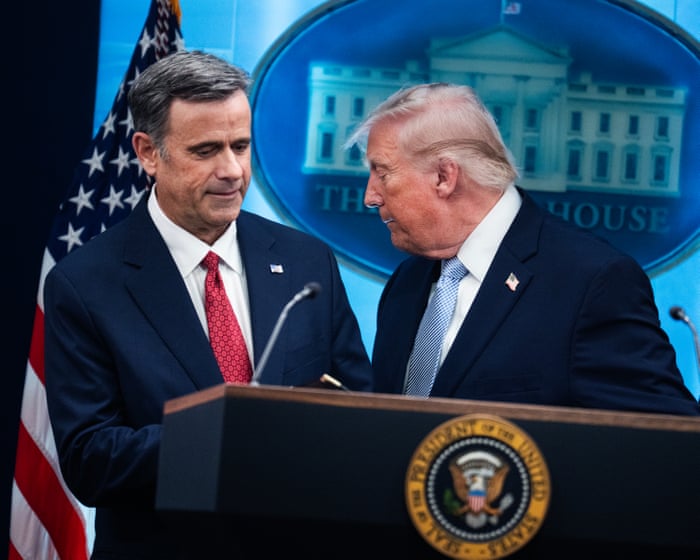
The latest incident may be why CIA Director John Ratcliffe flew to Moscow last week. According to reports, he warned Russian officials against attacking NATO territory, urged them to limit support for Iran, argued that escalating in Ukraine would backfire, and pushed for a deal to end the war.
Ratcliffe’s trip probably won’t change the Kremlin’s plans to escalate against Ukraine in the coming months, but it highlights how dangerously intertwined the Iran and Ukraine conflicts have become.
Sending Ratcliffe to Moscow makes sense for the White House, given how much influence intelligence agencies have in Putin’s government and the real worry that he’s getting overly optimistic reports from his own advisors. The diplomatic effort deserves praise. Still, the Trump administration’s refusal to end the war with Iran clashes with its goal of ending the war in Ukraine. They’re heading into the storm, not away from it.
One reason for Ratcliffe’s visit, according to the Washington Post, was to counter the Kremlin’s belief that the White House was too focused on Iran to pay attention to Ukraine. Good luck with that. Reports on how badly US missile stocks have been drained by the Iran conflict are so widespread that they’ve likely encouraged Putin to launch even more devastating strikes on Ukraine’s defenseless people.
Ukraine, for its part, has sent 228 specialists and truckloads of drones to help Gulf states defend against Iranian missile attacks, which led at least one Iranian lawmaker to declare Ukraine a legitimate target. Ukraine also struck an Iranian commercial ship in late July. Meanwhile, Russia has given Iran battlefield intelligence that makes its strikes more lethal. Moscow has also long used Iranian-designed drones to attack Ukraine.
Both conflicts are worsening and going nowhere. True, Putin is under pressure—his economy is hurting from Ukrainian strikes on oil refineries and supply lines—but that pressure could push him toward escalation just as easily as restraint, especially if he sees the US distracted in the Middle East and thinks he has a chance to deliver a knockout blow to Kyiv.
Putin, like Zelensky, Trump, and Iran’s leaders, faces the same sunk-cost trap that has led many wartime leaders in history to double down on doomed campaigns—from Alcibiades in Sicily to Napoleon in Russia to LBJ in Vietnam. If today’s leaders follow that path, the costs and risks of escalation will keep rising while the conflicts become even more entangled.
Meanwhile, Xi Jinping and Putin met on Monday and will join Iran’s leaders in Bishkek this week for the Shanghai Cooperation Organization’s annual summit. They’ll discuss closer ties between their energy markets and likely condemn the new “economic offensive” that US Treasury Secretary Scott Bessent announced last week to ramp up pressure on Iran. Beijing may noIt doesn’t want to see either war drag on, but it also doesn’t want Russia or Iran to suffer a clear defeat. It’s still well-positioned to prevent that by helping both countries cushion the worst economic and social impacts of the fighting.
Iran accuses US of ‘war crime’ after missile blast kills four people at wedding
Read more
Ratcliffe’s trip was important, especially given Russia’s reckless covert operations in Europe. But it won’t be enough. His predecessor, Bill Burns, once went to Moscow to warn Russia against attacking Ukraine. That effort was ignored, and Ratcliffe’s will likely be too.
What’s really needed are clearer plans to end both wars through more positive incentives.
To start, Washington should reach a deal with Iran by unfreezing its assets and offering sanctions relief in exchange for a genuine ceasefire and a framework for joint control of the Strait by the countries along its coast. Then it can work to soften the blow of losing that access by pushing hard to diversify energy supplies—through alternative routes out of the region, other sources like Venezuela, and a stronger focus on renewables.
Ukraine, meanwhile, needs to take neutrality more seriously. It also needs an honest debate about whether holding onto the parts of the Donbas it still controls is worth prolonging the war indefinitely.
In his recent book, The Coming Storm, historian Odd Arne Westad draws parallels between today’s world and the one just before World War I. He writes: “A key lesson of the world before 1914 is that regional conflicts, long left unresolved, can be the powder kegs that set off a global conflagration.” As the Iran and Ukraine conflicts become more intertwined with no end in sight, world leaders should take such warnings far more seriously. But without real pressure from their citizens, they may not.
History isn’t doomed to repeat itself. But you don’t need to be a renowned historian to see the dangers the world is facing, or to regret that our leaders aren’t doing more to calm these storms.
Christopher S. Chivvis is a senior fellow and director of the American Statecraft Program at the Carnegie Endowment for International Peace. He served as the U.S. national intelligence officer for Europe from 2018 to 2021.
Frequently Asked Questions
Here is a list of FAQs based on the premise of Christopher S Chivviss analysis regarding the intertwining of the Ukraine and Iran conflicts
General Overview Questions
Q What does it mean that the wars in Ukraine and Iran are intertwined
A It means they are no longer separate conflicts They are now connected in a way where events in one directly affect the other Specifically Russia and Iran are cooperating militarily and the Wests response to one war now impacts its strategy in the other
Q Why are these two conflicts becoming connected now
A Because Russia and Iran have formed a de facto military alliance out of necessity Russia needs drones and ammunition and Iran needs money defense technology and diplomatic cover Their mutual need to counter the West has pulled them together
Q Is this just about Russia buying weapons from Iran
A No that is just the surface Its about a deeper strategic alignment It involves intelligence sharing joint weapons production and coordinating their diplomatic efforts to undermine Western sanctions
BeginnerLevel Questions
Q What is Iran getting out of helping Russia in Ukraine
A Iran gets three main things 1 Cash and oil revenue to prop up its struggling economy 2 Advanced military technology from Russia that it couldnt get elsewhere and 3 A powerful ally to shield it from UN Security Council actions
Q How is Russia helping Iran in its conflicts
A Russia is providing Iran with advanced air defense systems and electronic warfare technology More importantly Russia is using its veto power in the UN to block resolutions that would punish Iran for its nuclear program or its actions in the Middle East
Q I hear about Shahed drones What are those and why are they important
A They are cheap explosive kamikaze drones made in Iran Russia uses them in swarms to overwhelm Ukrainian air defenses and attack critical infrastructure They are important because they show how Iran is directly fueling Russias war machine
Q Does this mean the war in Ukraine is now a World War