It’s a crisp afternoon in Haworth, West Yorkshire, and I’m drinking a pint of Emily Brontë beer in The Kings Arms. Other Brontës are on tap—Anne is a traditional ale, Charlotte an IPA, Branwell a porter—but the barman says Emily, an amber ale with a “malty biscuit flavour,” is the most popular. It’s the obvious choice today, anyway: in a few hours, Oscar-winning filmmaker Emerald Fennell will be at the Brontë women’s writing festival in a church just up the road, discussing her adaptation of Emily’s 19th-century gothic masterpiece, Wuthering Heights.
The film, set for release just before Valentine’s Day next year, is already mired in scandal. It started with Fennell’s casting of Hollywood stars Jacob Elordi and Margot Robbie—”Heathcliff, it’s me, it’s Barbie”—causing an uproar. An erotic teaser trailer full of tight bodices, cracking whips, and sweaty bodies had a similar effect. But heads were really sent spinning by reports of a scene featuring a public hanging and a nun who “fondles the corpse’s visible erection.”
Since my visit to Haworth, the full trailer has been released, showcasing Fennell’s signature anachronistic sets and costumes—think sugary, eye-popping interiors and red latex gowns—along with some suggestive licking and bread-kneading, and Elordi’s (admittedly quite good) Yorkshire accent: “So kiss me—and let us both be damned!”
Such a wild response was only to be expected. As I finish my drink and step out into the cobbled streets of this hillside village, the potency of Wuthering Heights is still palpable.
“I sometimes feel, in the morning, that I could just walk around the corner and the sisters would be there talking to each other,” Diane Park tells me over coffee in Wave of Nostalgia, her award-winning feminist bookshop. “They are still so alive here in this village.” Park’s shop sits near the top of the hill, on a road lined with terraced stone houses and quirky independent businesses. Just seconds away is a lane leading to the church where the Brontës’ father, Patrick, was reverend. Behind it lies a cluttered graveyard and the Brontë parsonage, where the family lived.
When Park moved here more than a decade ago, she had only read Charlotte’s Jane Eyre. Today, she reads one of Emily’s poems to me on the shop floor: “Hope, whose whisper would have given / Balm to all my frenzied pain …” How did she feel when she first read Wuthering Heights? “I was blown away by Emily’s insight into the soul.”
The world was scandalized when Emily published the novel under a male pseudonym in 1847. It tells the story of fiery Catherine Earnshaw and her relationship with the outcast orphan Heathcliff, whom she meets her match in as they roam the Yorkshire moors: “He’s more myself than I am. Whatever our souls are made of, his and mine are the same.”
When Catherine marries Edgar Linton and dies, it sets the haunted Heathcliff on a path of vengeance, as the second half of the novel becomes a tale of control, abuse, and grave-digging. While some critics admired its unique strangeness, many echoed one review that said: “The reader is shocked, disgusted, almost sickened by details of cruelty, inhumanity and the most diabolical hate.”
This didn’t stop Wuthering Heights from becoming a classic. It was made into a silent movie in 1920, with locals crowding around the shoot in Haworth and playing extras. The story later moved to a Hollywood studio and received the romanticized Golden Age treatment with Laurence Olivier and Merle Oberon, minus theThe more problematic second act has seen at least 15 big and small screen adaptations follow, from Yoshishige Yoshida’s 1988 retelling set in medieval Japan to Andrea Arnold’s 2011 version, which starred James Howson as the first Black actor to play Heathcliff. (A main criticism of Elordi’s casting is that Heathcliff is widely considered not white in the book.)
It was the BBC’s full-story 1967 series, starring Ian McShane as a brooding Heathcliff, that inspired Kate Bush to write her otherworldly hit, bringing Wuthering Heights into every home. “I just managed to catch the very last few minutes, where there was a hand coming through the window and blood everywhere and glass,” she has said, admitting she wrote the song before reading the book.
So why does this story of passion-ravaged lovers on rain-ravaged moors have such a hold? “I think Wuthering Heights endures because the relationships between Cathy, Heathcliff, and Edgar aren’t easy to quantify,” says author Juno Dawson, who grew up in Bingley and calls the Brontës “the pride of Yorkshire.” Dawson was inspired by Wuthering Heights to write a short story for an anthology called I Am Heathcliff. “They don’t fit into traditional notions of a romance novel or a ghost story,” she continues. “And each character is frustrating, unfathomable. If there’s something I take from it, it’s that ambiguity can be as satisfying as neat resolution.”
I stroll over to where the Brontës lived, mingling with fellow visitors—mostly solo women whom I later spot at Fennell’s talk. “People have always come to make a pilgrimage,” says Rebecca Yorke, director of the parsonage and the Brontë Society, which opened in 1928. “If you look at the visitors book, there’ll be a mixture of UK, USA, Australia, Japan, and Europe. About a third of our visitors are from overseas.” There are famous signatures too, from Sylvia Plath to Patti Smith.
This is actually my third visit, or pilgrimage, to the parsonage with my mum. It just keeps pulling us back. Today we learn that the trees in the garden separating it from the graveyard only grew after the Brontës’ time here. So the family would have had views of death on one side and endless moors on the other. The rooms are quite claustrophobic, and downstairs is where they wrote their novels, on a table that has an “E” etched on it. In the corner is the sofa on which Emily died, most likely of tuberculosis, aged just 30. The life expectancy in Haworth was a mere 24, partly due to the overcrowded graveyard contaminating the drinking water. Such details from this place’s past still feel compelling in the present, especially when it comes to the author of Wuthering Heights.
“Emily is quite enigmatic,” says Yorke. “We don’t know as much about her as we do about Charlotte. And Wuthering Heights was her only novel—but it’s one of the best-known in the English language.” How, then, to square this woman described as peculiar, introverted, and nonconformist with the literary genius who created a novel so haunting, dark, and poetic that it still fires people up today? As Charlotte said of her sister: “An interpreter ought always to have stood between her and the world.” So much so that Charlotte made efforts to “correct” Emily’s reputation after her death, further adding to the mystery.
Top Withens, thought to be the inspiration for the fictional farmhouse that gives the novel its name, is now endangered.
The siblings have proven almost as popular as subjects for drama as their works, from Christopher Fry’s 1973 ITV series The Brontës of Haworth to Sally Wainwright’s 2016 To Walk Invisible for the BBC. In 2022, Emily got a somewhat reimagined biopic, with a passionate portrayal by Emma Mackey and a raunchy affair with a curate. With each new film or TV series, fresh hordes of tourists have flocked to Haworth.
Down the hill, a record shop with…A “Never Mind the Brontës” poster is just one of many nods to the local celebrities. Other shop windows display a lampshade made from book pages and paintings of the moors. Authors either live locally or come to stay for writing retreats, says Park: “There’s that creative feeling in Haworth.” But does the Brontë influence affect local culture in ways beyond the obvious? It runs deeper, according to Park, pointing to things like the nature sculptures at nearby Penistone Hill Country Park, part of Bradford’s year as the City of Culture. “It feels like Emily is in the heather and the trees. You just breathe the air. ‘Wuthering’ refers to weather, and I feel she’s left her mark here.”
It’s not just about tourism. Take last month’s Wandering Imaginations project, which brought together two young authors from Bradford and two from Ghana to write stories inspired by the Brontë siblings’ fictitious African kingdom, Angria. “We’re here for the people who live here,” says Yorke. The Brontë Society has just acquired a new building on the main street, where it will focus on “opportunities for local people to get closer to their heritage.” She hopes to further “instill that sense of pride in something on your doorstep, something people across the world think is worth visiting.”
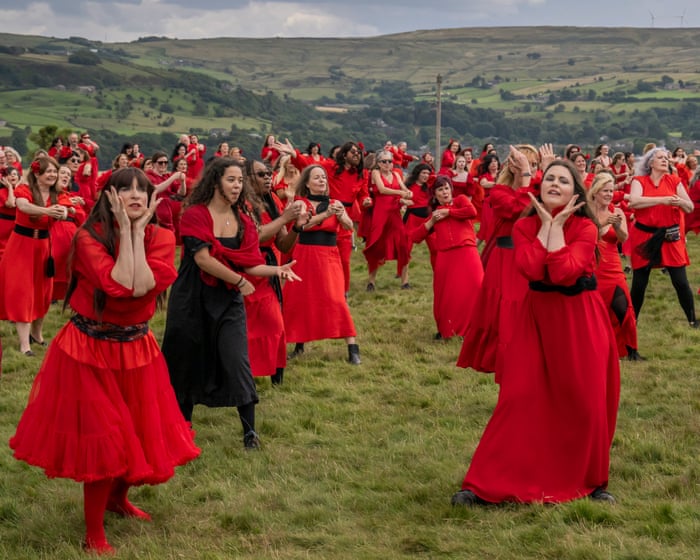
The event that ticks all the Brontë boxes, though, is the Most Wuthering Heights Day Ever, held each year on July 27th. Hundreds of people dressed in floaty red dresses gather in locations around the country to sing and dance to the Kate Bush song. This summer, at Penistone Hill, it also served as a campaign to protect Top Withens—believed to be the inspiration for the fictional windswept farmhouse that gives the novel its name—from a planned wind farm development.
Of course, the beautiful Brontë country isn’t just for literary enthusiasts. It has always been a rugged paradise for hikers and fell runners. The Tour de France pedaled through here in 2014, inspiring the Tour de Yorkshire. A moody walkway behind the parsonage leads to a waterfall named after the sisters, as they were said to spend time there. That magical feeling only grows stronger as you walk around, retracing their footsteps. “These heather-laden moors,” says Park, “call to you as much as they did to Emily, who roamed as free as Cathy.”
Night falls in Haworth, and I head to the packed church. The young woman sitting next to me is visiting from New York, staying at an inn for the entire festival weekend, which includes a writing workshop out on the moors the next day. Fennell walks out wearing a T-shirt with “The Brontë Sisters” stamped on it in gothic, heavy-metal-style lettering.
She says the book “cracked me open” after she first read it at age 14. She drew on that “primal, sexual” initial reaction for her film. What resonates most in the room, though, is how Fennell talks about Wuthering Heights speaking to her differently at various stages of her life. I recently read it again for the first time in 15 years and could not believe that I ever considered it sexy.
Many others agree. “If you read it as a teenager,” says Yorke, “you might just think, ‘Oh my goodness, to experience a love and passion like that would be amazing.’ And then, as you get older, you might think, ‘Actually, this isn’t very… healthy.'” Fennell goes further: “It’s so bonkers.”
Perhaps that’s why she also “did the dirty” with the book’s secondThe adaptation cuts the story in half, focusing solely on the love story and dropping the rest. This might have been a missed opportunity to explore Heathcliff with greater nuance—though it’s impossible to say for sure now. However, there is a clear desire for more exploration of the novel’s highly debated and complicated relationship with race.
Emerald Fennell, defending her adaptation of Wuthering Heights, remarked, “There’s an enormous amount of sado-masochism in this book.” Emily Brontë, who was well-read, wrote the novel in the years following the abolition of slavery in the UK, and Heathcliff is found without an “owner” in Liverpool. Still, this film is Fennell’s own interpretation. “It’s very personal for everyone,” she says. “But I can’t make something for everyone: no one agrees on any element of it.”
Fennell certainly isn’t afraid to shock, but author Dawson isn’t concerned. “If anyone’s going to do it, I’m glad it’s Fennell,” Dawson says. “She’s a director who isn’t afraid to actually adapt, rather than just photocopy the book to the screen.”
As I walk to my car in the dark, with silence now enveloping the village and the moors, I recall something Park told me about Emily. “Her poetry gets so deep into your soul, into your heart,” she said. “I can’t express how alive it makes me feel.” Wuthering Heights will be released on February 13.
Frequently Asked Questions
Of course Here is a list of FAQs about your unique crash course in Brontmania designed to answer questions from the curious newcomer to the seasoned enthusiast
The Basics What Is This All About
Q What exactly is Brontmania
A Its a playful modern term for passionate fandom and scholarly interest in the Bront sistersCharlotte Emily and Anneand their iconic 19thcentury novels like Jane Eyre and Wuthering Heights
Q How do Margot Robbie in red latex a Kate Bush lookalike and a pint of Emily ale relate to the Bronts
A They represent a fun popculture approach to engaging with the Bronts enduring legacy Its about connecting their themes of passion rebellion and wild landscapes through modern film music and social ritualslike watching a bold actress hearing Wuthering Heights performed or toasting with a themed ale
Q Is this a real event or course I can sign up for
A Not an official one but its a fantastic blueprint for creating your own immersive experience You can easily recreate this crash course by planning a themed movie night listening to music and visiting a pub with local ales
Deep Dive The Three Elements Explained
1 Margot Robbie in Red Latex
Q Why Margot Robbie as a symbol for the Bronts
A Margot Robbie often plays complex determined and sometimes rebellious characters This mirrors the defiant spirit of Bront heroines who challenge social norms The red latex adds a modern bold and visually striking edge to that classic spirit
Q Which Bront character does she best represent
A She could channel the fierce independence of Jane Eyre the wild passion of Catherine Earnshaw or the quiet resolve of Anne Bronts heroines Its more about embodying their shared energy than a direct portrayal
Q Isnt the red latex a bit too modern and flashy for the Victorian Bronts