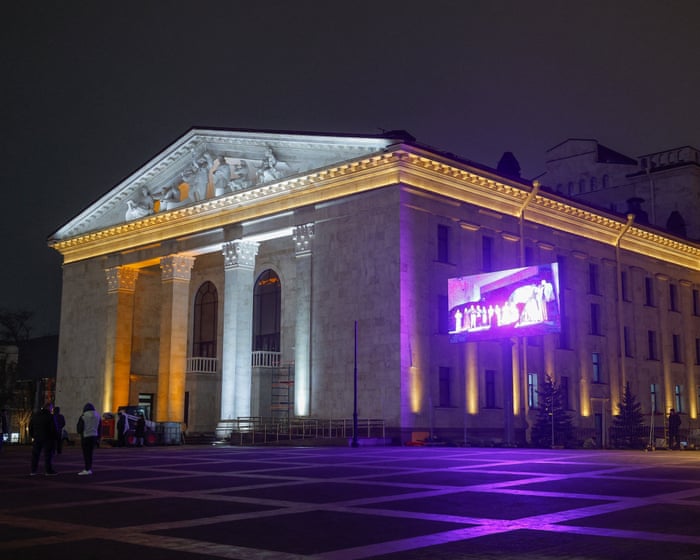
The Mariupol Drama Theatre, which was destroyed in a Russian airstrike in 2022 while hundreds of civilians sheltered in its basement, is set to reopen. Russian occupation authorities have presented the reconstruction as a symbol of renewal, but former actors from the theatre have condemned the reopening as “dancing on bones.”
The Kremlin has made rebuilding Mariupol a showcase of its control in occupied Ukraine. However, Moscow’s oversight has been accompanied by arrests, exile of critics, and property seizures that have deprived thousands of Ukrainians of their legally owned apartments.
After being almost completely rebuilt over the past two years, the theatre is scheduled to reopen by the end of the month with a performance of The Scarlet Flower, a Russian fairy tale. “The theatre is being reborn together with Mariupol. Russian and Soviet classics have returned to the stage,” the theatre said in a statement.
Evgeny Sosnovsky, a photographer from Mariupol who worked extensively with the theatre before moving to Kyiv after the Russian takeover, said, “I can’t think of any other word for it than cynicism. There should be a memorial at the site in memory of the Mariupol residents who died during Russia’s capture of the city, not an entertainment venue.”
The strike on the theatre remains one of the most notorious incidents of Russia’s war in Ukraine. The building was targeted despite the word “CHILDREN” being painted in large block letters on the square in front of it. At least a dozen people were confirmed killed, though the actual death toll is believed to be much higher.
Russia has denied hitting the theatre, claiming instead that the damage was caused by an explosion inside the building. However, multiple independent investigations have pointed to Russian air bombs as the cause. Amnesty International concluded that the destruction was “likely caused by Russian forces deliberately targeting Ukrainian civilians” and called for the attack to be investigated as a war crime.
“Having entertainment, songs, and dances on top of all the bones? I have the feeling that the souls of the people who died there won’t let them perform well,” said Vira Lebedynska, a former actor at the theatre.
Lebedynska now lives in the western Ukrainian city of Uzhhorod with a small group of former Mariupol actors. Their theatre-in-exile has performed a play called Mariupol Drama, based on events at the theatre in February and March 2022, which has toured across Europe over the past year.
“At the beginning, it was really difficult to perform in this, and I wondered why I have to remember all of this,” Lebedynska said. “But I carried on, and I realized it was my mission to tell the world about what happened there in the theatre.”
Meanwhile, many other actors have remained in Mariupol and are collaborating with the new theatre. “For them, the main thing is acting on stage, and everything else is irrelevant. ‘We are outside of politics’ is their principle. They don’t care where they are, in Russia or Ukraine,” said Sosnovsky.
The theatre’s former director stayed in Mariupol but has been demoted to running the orchestra. Russian authorities have appointed Igor Solonin, previously the deputy director of the Donetsk Circus, as the new head.
In an interview earlier this year with a Russian journalist, Solonin repeated claims that the building was blown up from inside. “It was an internal explosion. It was a bomb or an explosive device inside the building, or maybe careless handling of ammunition,” he said.People who were in the theater at the time of the explosion have told the Guardian there were no soldiers or military equipment present.
Russia has launched a massive reconstruction effort in Mariupol, a city largely reduced to rubble during its invasion. Earlier this month, Russian President Vladimir Putin signed a decree allowing officials in occupied areas of Ukraine to seize homes left empty after their owners fled or were killed. Under this policy, dwellings showing signs of being “ownerless” will become property of regional authorities. Compensation is only possible for those who obtain Russian citizenship. Public records from the Russian-installed authorities in Mariupol now list over 12,000 apartments as ownerless.
The Guardian spoke with several former Mariupol residents who said their property had been or was about to be confiscated. One, Volodymyr, owned an apartment in a building destroyed in the fighting and later rebuilt by Russian authorities. “They posted a notice at the entrance saying they were waiting for the owners to urgently confirm ownership, or their apartments would be ‘nationalized,'” he said. The only way to confirm ownership would be to travel to Mariupol and take Russian citizenship.
Another resident, Sosnovsky, found his Mariupol apartment on the “ownerless” list and has accepted the loss. “I know I will never return to Mariupol. In my lifetime, it is unlikely to return to Ukraine,” he said. “My wife and I are already over 60, so it’s unlikely. We are trying to start our lives from scratch in Kyiv. But there is absolutely no help or support from the state.”
One woman from Mariupol, who asked not to be named, had managed to buy “the apartment of my dreams”—a modest flat in a Soviet-era building—and planned to begin renovations just days before Russia’s full-scale invasion in 2022. The building was damaged but has since been repaired. She asked her father, who still lives in the occupied territory, to take possession but was told that even with a power of attorney, she could not transfer ownership to him. “As far as I can tell, there is no possibility unless you go there and take Russian citizenship,” she said, a step she is unwilling to take.
Establishing property rights is also difficult for those who remain in Mariupol. Earlier this month, a resident named Anna Guzevskaya, a mother of three, recorded a video appeal to Putin saying her house had been destroyed. Although this should have made her eligible for a new apartment, she was only offered cash compensation far too low to buy one. “How should I explain to my children that in the newly built apartment block there is no longer our apartment, where they have lived since their birth?” she asked.
Actor Lebedynska said her apartment in Mariupol survived relatively unscathed, with only a few broken windows. She learned in 2022 that others had moved in and has not tried to contact them since. “I’m not interested in who is there. Even if there was a theoretical chance, I wouldn’t want to sell it. I have closed that place in my life, I have built a wall. The place is dead to me. Let them enjoy their ‘Russian World,'” she said.
Frequently Asked Questions
FAQs Mariupol Theater Reopening with Russian Fairytale Performance
1 What is the basic news story here
The Mariupol Drama Theater which was famously destroyed during the siege of Mariupol in 2022 is being rebuilt by Russian authorities Its planned reopening will feature a Russian fairytale ballet The Little Humpbacked Horse
2 Why is this reopening so controversial
The theater is a powerful symbol of civilian suffering In March 2022 it was bombed while being used as a shelter with an estimated 600 civilians killed Many see its reopening with a Russian cultural performance as an attempt to erase that tragic history and impose Russian culture on a Ukrainian city
3 What was the original significance of the Mariupol Drama Theater
Before the war it was a major Ukrainian cultural institution in the city During the siege it became a crucial refuge for hundreds of civilians with the word CHILDREN written in large letters outside to deter attack
4 What is The Little Humpbacked Horse and why was it chosen
Its a classic 19thcentury Russian fairytale ballet Russian officials likely chose it to symbolize a rebirth of the theater with traditional Russian culture framing it as a positive cultural restoration Critics see it as a blatant political statement of Russification
5 Who is criticizing this and what are they saying
Ukrainian officials survivors international human rights groups and cultural observers are criticizing it They call it a deeply insensitive act of memory washing that disrespects the victims and is part of a broader campaign to suppress Ukrainian identity in occupied territories
6 Isnt rebuilding a destroyed theater a good thing
Physically rebuilding a structure can be neutral but the context matters The controversy stems from who is doing it how they are narrating the past and what cultural content they are introducing
7 What is memory washing or cultural erasure
These terms describe the process where an occupying power deliberately destroys or repurposes cultural symbols of a conquered people to replace them with its own narratives and identity effectively erasing the historical memory of the local population