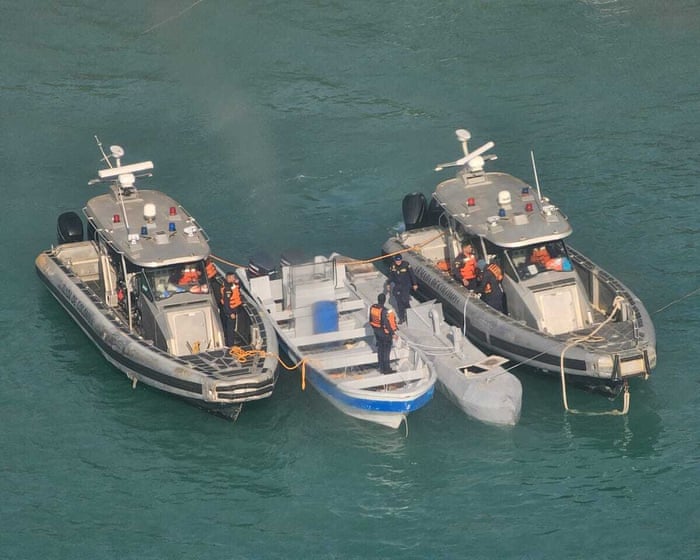
A senior Spanish police officer reports that the falling price of cocaine is compelling drug traffickers to reuse “narco-submarines” they once scuttled after single trips from South America to Europe.
While semi-submersible vessels have been common in Colombia and other parts of South and Central America since the 1980s, they were not seen in European waters until 2006, when an abandoned sub was discovered in an estuary in Galicia, northwestern Spain.
Since then, Spanish police have spotted or seized 10 such vessels. Until recently, these custom-built boats, costing around €600,000, were used for one-way journeys.
However, massive cocaine production has saturated the market, causing wholesale prices to halve to about €15,000 per kilo in recent years. This drop means traffickers can no longer afford to send their vessels to a “narco-sub graveyard” in the Atlantic between the Azores and the Canary Islands.
“These semi-submersibles used to make one-way voyages to the area around the Canaries and then be sunk,” said Alberto Morales, head of the Spanish Policía Nacional’s central narcotics brigade. “Back then, the value of the cargo compared to the cost of the vessel made that worthwhile—they carried at least three or four tonnes, so it was very profitable. But now the price of the merchandise is very, very low, so the organizations have logically had to rethink. Instead of sinking them, they now unload the drugs and set up refueling platforms at sea so the subs can return to their origin and make as many trips as possible.”
Spanish police and customs seized 123 tonnes of cocaine last year, up from 118 tonnes in 2023 and 58 tonnes in 2022. In September this year, the Policía Nacional arrested 14 people and seized 3.65 tonnes of cocaine allegedly brought to Galicia by a narco-sub.
Morales noted an increase in narco-sub activity over the past two years and a decrease in the use of sailboats for smuggling drugs into Spain. “Right now, the organizations have two basic methods: merchant ships and semi-submersibles, which allow them to transport drugs year-round,” he said.
He added that while 10 narco-subs have been recorded over the last 20 years, the actual number in operation is likely higher. “Obviously there will have been more than 10. Logically, we can’t detect everything that reaches the Spanish coast, as we have 8,000km of coastline.”
Morales also mentioned that while multiple sources confirm the existence of the “narco-sub graveyard” in the eastern Atlantic, details are limited. “We don’t have a location; we don’t even have any numbers. And even if we did, recovering the subs would be nearly impossible due to the water depth. It’s something for the fish to enjoy.”
The growing use and reuse of narco-subs is not the only recent trend Morales and his team have observed. Officers from the brigade’s synthetic drugs and precursors department report dismantling more amphetamine, methamphetamine, and…Spanish authorities have dismantled more MDMA laboratories in the past two years than in the previous 18. In 2023, two labs were raided and shut down, followed by six in 2024 and another three so far this year. Seizures from these operations have included over five tonnes of MDMA, 450kg of amphetamine sulphate, and 27kg of methamphetamine.
While the Netherlands has historically been the center of synthetic drug production—with police dismantling around 100 clandestine labs there each year—criminal gangs are increasingly expanding across Europe. Officers believe production has moved beyond the Netherlands’ limited space to countries like Spain, France, and Germany, where there is more room to manufacture drugs and dispose of waste, and where ingredients and finished products are easier to transport.
“There are laboratories all over the place, especially in rural areas with few people, which offers better security,” said one senior officer. He added that drug gangs not only pay locals to watch for strangers and police but also use drones to monitor their operations.
“We’ve been pretty surprised by the synthetic drugs phenomenon, both by the number of labs we’re dismantling and by the scale of some of these facilities,” he said. “These are large-scale production laboratories.”
Frequently Asked Questions
Of course Here is a list of FAQs about the falling price of cocaine and the reuse of narcosubmarines based on the report from Spanish police
BeginnerLevel Questions
1 What is a narcosubmarine
A narcosubmarine is a custombuilt lowprofile vessel designed to smuggle large quantities of drugs primarily cocaine across the ocean They are usually semisubmersible and are hard to detect by radar
2 Why is the price of cocaine falling
According to police increased production in South America has created a massive oversupply More cocaine is being produced than the market can absorb at previous high prices forcing traffickers to lower prices to move their product
3 How does a lower price force traffickers to reuse submarines
Building a new narcosubmarine is extremely expensive When cocaine prices are high traffickers can afford to use a submarine for a single trip and abandon it With lower profits they can no longer afford this onetime use model and must reuse the same vessels to cut costs and maintain their profit margins
4 Where is this happening
This specific report comes from Spanish police who are intercepting these vessels on transatlantic routes from South America to Europe often arriving via the coast of Galicia in northwest Spain
5 Is reusing these submarines dangerous
Yes These vessels are often built hastily with lowquality materials for a single journey Reusing them increases the risk of structural failure sinking and drowning for the crew who are usually lowpaid laborers with little training
Advanced Practical Questions
6 What are the operational risks for traffickers when reusing submarines
Reuse increases the chance of detection Each voyage adds wear and tear making mechanical failures and leaks more likely Furthermore a vessel used multiple times has a higher chance of being spotted identified and tracked by law enforcement across different trips
7 How does this trend affect law enforcement efforts
Its a doubleedged sword On one hand reused vessels might be easier to identify if they are already in a database On the other hand it indicates traffickers are becoming more efficient and desperate potentially leading to riskier behavior and more attempts to flood the market with cheaper drugs