At first glance, British culture seems doomed. The music industry is on shaky ground, with grassroots venues closing rapidly—125 in 2023 alone—and artists struggling to afford the few that remain. Touring has become a money-losing venture, forcing even established acts to subsidize it with other work. Meanwhile, streaming has drastically reduced the value of recorded music, leading to a contraction at the highest levels of the industry. Earlier this year, the UK divisions of major labels like Warner and Atlantic were effectively absorbed into their US counterparts.
In comedy, the Edinburgh Fringe—the breeding ground for modern British stand-up, sketch shows, and sitcoms—faces an existential crisis due to a lack of sponsorship and prohibitively high costs for performers. The film industry is now almost entirely reliant on dwindling US investment. While Britain remains a popular filming location thanks to tax breaks and scenic spots, most productions made here ultimately generate profits for American companies.
The BBC, a cornerstone of British cultural life, lurches from one crisis to another, while the broader TV industry suffers from broadcasters’ inability to fund programming due to advertising cuts and rising costs. Like film, it has become dependent on international investment, raising concerns that the UK has lost the ability to produce shows solely for domestic audiences. Programs that can’t attract foreign funding rely on goodwill, with directors, writers, and stars of major dramas taking significant pay cuts to get them made—as seen with the second installment of the award-winning Wolf Hall. Unlike US-based streamers, British broadcasters struggle to turn viewership into profit. For instance, the hit drama Mr Bates vs The Post Office drew over 13 million viewers but still lost around £1 million, which ITV’s boss attributed to its lack of international sales.
So how can an uncompromising, idiosyncratic arts sector survive under these conditions? One effect of entertainment globalization is that success is now measured by attracting a vast, often indistinct, global audience. As a small island, Britain seems destined to matter less and less.
Yet something unexpected has happened. Amid this turmoil, British culture is thriving. Not only is it dominating the global conversation, but it’s doing so with art that explores British heritage and sensibility in thrillingly nuanced ways. Look at it all—from viral trends capturing the British psyche like never before, to music, TV, and films grappling with the complex, often contradictory nature of British identity—and it’s hard not to feel we’re in a golden age.
Take I Used to Live in England, a very British love letter to Britain, written by an American. Released in June by musician Frankie Beanie under his Supermodel alias, the track drawls about shopping at Tesco, saying “Go Tesco’s” instead of “Go to Tesco’s,” and references Wetherspoons, UK garage music, and £65 train fares. Beanie isn’t the only American bypassing tired clichés like afternoon tea or bad teeth to celebrate the real hallmarks of British life. Following 2024’s “Britishcore” trend on TikTok, where users worldwide embraced quintessential British texts (Trainspotting), institutions (Greggs), and figures (Gemma Collins), this year has seen a surge in Anglophilia from across the Atlantic. This is driven in part by a romanticized view of the UK as a refuge from Trump’s America and unprecedented exposure to the nuances of British life.British sensibility is thriving on social media. Olivia Rodrigo expressed her love for England during her Glastonbury headline set, mentioning Colin the Caterpillar cakes, enjoying a pint at noon without judgment, and English men—a nod to her current boyfriend, actor Louis Partridge. Their cross-Atlantic relationship is part of the “British boyfriend” trend, driven by the abundance of young British actors in Hollywood, which has turned UK men into a desirable accessory.
Elsewhere, British content creators have gained global popularity with their chaotic, provocative humor, described by Clive Martin in a Vice article as a mix of Benny Hill, You’ve Been Framed, and Nil By Mouth. Genuine familiarity with UK culture has become a form of cultural capital: when New York mayor-elect Zohran Mamdani was asked about his listening habits, he praised the Arseblog Arsecast podcast and an extended version of “One Pound Fish,” a viral 2012 song by an east London market trader who later appeared on The X Factor.
This online revival of “Cool Britannia” has a novelty factor, but there’s substance too: the British fondness for mundane, slightly underwhelming pleasures is now appreciated worldwide. Meanwhile, in the arts, a deeper reflection of Britishness is trending.
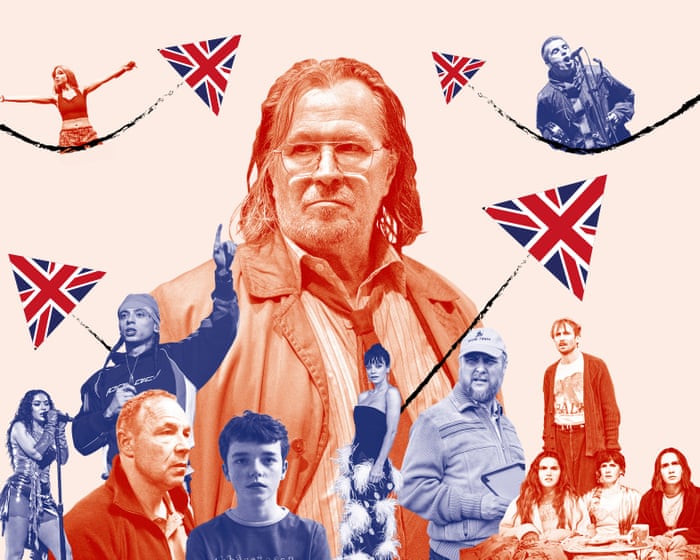
In pop music, the 2010s saw global stars like Adele, Ed Sheeran, and Coldplay offering fairly neutral music with little connection to British identity. Now, British artists are shaping the transatlantic musical zeitgeist: this year with the Oasis reunion, and last year with Charli XCX’s Brat (whose influence extended into 2025, partly due to a misguided diss track by Taylor Swift). Both are quintessentially British. Oasis has been a national symbol for over 30 years, blending rowdy banter, sharp Mancunian wit, playful bravado, and Beatles nostalgia—capturing a romanticized view of everyday life and having a laugh.
Brat, on the other hand, connects through contemporary British references like happy hardcore, UK garage, and dubstep. At its core is an ironic, art-school sensibility, embodied by Charli’s collaborator AG Cook, a Goldsmiths graduate who helped create hyperpop—a genuinely new subgenre—through his satire of artifice, consumerism, technology, and good taste. Like Oasis, Brat channels blunt honesty and sardonic megalomania, this time through the persona of a privately educated party girl.
This chaotic, outspoken yet witty side of British character is evident across pop music: from Lily Allen’s brutally honest and funny “West End Girl,” to Lola Young’s expletive-filled “Messy” (which topped the charts in January), to ex-Little Mix member Jade Thirlwall’s debut album That’s Showbiz Baby! (with lyrics like “I am the it girl / I am the shit girl”). They share a vibe with Amelia Dimoldenberg, whose YouTube series Chicken Shop Date blends social awkwardness, dry wit, and UK high street culture into a vision of Britishness embraced in the US; she now serves as an Oscars red carpet correspondent.
If Charli XCX’s RP-accented electropop felt distinctly British, then Kent-raised PinkPantheress’s melancholic version…Her rise might be even more remarkable. Since debuting on TikTok in 2020, the 24-year-old’s ascent has been swift—aided by the platform’s knack for pushing niche UK content to global audiences, creating a viral feedback loop (see also: #Britishcore). This year, she earned a Mercury Prize nomination and two Grammy nods. She too leans into overtly British nostalgia, layering drum ‘n’ bass, jungle, and big beat samples with evocatively bleak vocals that convey rain-soaked melancholy. While PinkPantheress’s unique appeal in the U.S. may stem from mining this lesser-known musical history in a charming accent, she’s also tapping into something deeper: the feeling of Britishness. Her creative moodboard, as she once told Rolling Stone, includes “hope and lost hope,” the color grey, the TV show Skins, “having a dirty kind of feeling,” and the Streets—especially Mike Skinner’s talent for capturing the sense that “life is so shit.” The interviewer noted her take was delivered in that “distinctly British way we have of delighting in our own misery.”
This was also the year distinctively British rap truly broke through in the U.S., thanks to Central Cee. His debut, Can’t Rush Greatness, became the first UK rap album ever to enter the Billboard Top 10, rooted in UK drill and packed with references to Sports Direct, the Uxbridge Road, and the Vauxhall Astra. Meanwhile, after previously aligning his sound with U.S. R&B, Blood Orange’s Devonté Hynes released Essex Honey in August—an album steeped in pained nostalgia for his childhood in Ilford. The Guardian’s Alexis Petridis described its “primary mood” as “a very British kind of late summer-into-autumn melancholy.”
In cinema, Tim Key and Tom Basden’s exquisitely sad The Ballad of Wallis Island—hailed by Richard Curtis as one of the greatest films this country has ever produced—became an unlikely international hit while remaining, in Basden’s view, “very British.” Set against a windswept Welsh coastline, its emotional tone was dominated by repressed grief channeled into awkward banter and a longing for the past, peppered with references to Monster Munch, Gideon Coe, and Harold Shipman. When met with acclaim on the U.S. festival circuit, Key upheld the national tradition of self-deprecation, questioning whether he’d accidentally made a film that only resonated in America.
Another quintessentially British film, Danny Boyle’s 28 Years Later, grossed over $150 million worldwide. Boyle’s film was a kitchen-sink drama—fry-ups and family dysfunction in a terraced house—disguised as a zombie flick. It opened with an old VHS tape of the Teletubbies and built to a climax featuring a Clockwork Orange-style gang dressed in homage to Jimmy Savile. It also served as an allegory for post-Brexit Britain, centering on a community of isolationists who find nostalgic comfort in a vision of England blending Arthurian romance, postwar village halls, and pub humor.
If 28 Years Later was a sour, surreal, yet beautiful ode to Britain’s past, Adolescence—the second-most-watched series in Netflix history—was its nightmarish, future-facing counterpart. Jack Thorne and Stephen Graham’s six-time Emmy-winning story of a 13-year-old accused of murder was the kind of provocative social-issues drama that used to be a British specialty—except none had ever amassed 142 million views before. Painstakingly realistic (the police station scenes felt eerily reminiscent of Channel 4’s observational documentary 24 Hours in Police Custody, a series Graham admits to being “obsessed” with), it ultimately spiraled into a chillingly ordinary domestic drama, evoking Mike Leigh at his most devastating.
Elsewhere,Apple TV’s hit series Slow Horses – built on a foundation of failure and flatulence, set in a recognizably dreary version of London – has returned for a fifth season. Also back for a second season is Such Brave Girls, which blends stifling suburbia with extreme gallows humor, deeply rooted in a dark British comic tradition (the New York Times compared it to Peep Show, Pulling, and Fleabag), despite being backed by the influential U.S. production company A24. Both shows capture the spirit of UK life far more accurately than The Crown, The Great British Bake Off, or Ted Lasso – but not every on-screen portrayal of Britain is so bleak. Industry, an HBO-BBC co-production most popular in the U.S., might be the coolest and most sophisticated drama ever made about Britain. Moving seamlessly from trading floors to shady pubs, gentlemen’s clubs, and country cottages, creators Mickey Down and Konrad Kay have infused their exploration of the opaque power structures at the heart of UK society with gripping drama and sharp satire.
Perhaps fears about the decline of British culture are premature. Or maybe the worst effects are still to come. Either way, what’s most striking about this new era, in which we feel compelled to perform Britishness for the world, is how creatively and authentically it’s being done – and how well it’s being received. So why can’t we use this current momentum to help lift our creative industries out of crisis? In January, David Lammy announced a “soft power” taskforce aimed at turning cultural achievements into national benefits, noting that despite our successes, “we have not taken a sufficiently strategic approach to these huge assets.” There has never been a better time to monetize the global appetite for British culture, yet a year later, we’re still waiting for an action plan.
Some people do have concrete ideas: Wolf Alice guitarist Joff Oddie has been among those pushing for a £1 ticket levy on arena concerts, with proceeds going to smaller venues (the policy was adopted earlier this year, though only on a voluntary basis). Even if we’ve shortsightedly allowed U.S. tech companies to dominate our TV industry, it’s not too late to reclaim some revenue: director Peter Kosminsky (Wolf Hall, The Undeclared War) advocates for a 5% levy on UK subscription streaming revenues, with the funds directed toward a British cultural fund.
In September, prolific screenwriter Steven Knight (Peaky Blinders, A Thousand Blows, the first film in the newly Amazon-owned James Bond franchise) told the Times that the answer to our current struggles might be “creative nationalism.” The phrase might make you cringe – especially after a summer in which the St George’s Cross, long weaponized by the far-right, was displayed across the country as part of a vague patriotic campaign. Yet some form of nationalism – in the sense of autonomy and independence – may be necessary if we don’t want our popular culture to remain permanently dependent on the whims of foreign conglomerates. (Disney’s decision to discard its underperforming Doctor Who reboot like an old tissue should serve as a warning.) Knight’s vision didn’t seem particularly exclusionary or aggressive: his version of Britishness – “a cross between Dad’s Army and SAS Rogue Heroes” – was built around rain, cold, and our awareness “of our own absurdities.”
The problem with creative nationalism might be just that: we’re so enamored with our failures and flaws that capitalizing on success doesn’t feel very British. If our cultural sensibility is anti-boosterish – rooted in self-deprecation, repression, chaos, irreverence, and disappointment – then actively promoting our achievements goes against the grain.Perhaps we perform best when we’re on the defensive. The future is unclear, but one thing is certain: as 2025 draws to a close, British culture finds itself in a very familiar position.
Frequently Asked Questions
Of course Here is a list of FAQs about the topic From Central Cee to teenage trends British culture had a global moment in 2025but can it last
Beginner Definition Questions
1 What does British culture had a global moment in 2025 mean
It means that in 2025 elements of British music slang fashion and online trends became massively popular with young people worldwide not just in the UK
2 Who is Central Cee and why is he mentioned
Central Cee is a hugely popular British rapper from London Hes mentioned as a key example because his music and style were a major driver of this global trend especially on platforms like TikTok
3 What are some examples of these teenage trends
Examples include UK drill music and slang going global the popularity of specific London streetwear brands and viral UKbased TikTok dances or phrases being used internationally
Analysis Why Questions
4 Why did this happen specifically in 2025
A perfect storm the global reach of TikTok and YouTube Shorts amplified UK creators artists like Central Cee released hit songs with global appeal and a postpandemic desire for new gritty and authentic subcultures made UK street culture feel fresh
5 Was it just about music
No it was a full vibe The music was the engine but it carried UK slang accent trends fashion and even attitudes into global teen culture
6 Hasnt British culture been popular before How is this different
Yes but those were often more polished and industrydriven This 2025 moment was seen as more organic grassroots and rooted in street culture spread directly by teens online rather than traditional media
Critical FutureOriented Questions
7 What are the main challenges to this trend lasting
Oversaturation Global trends burn out fast The slang and sounds can become overused and feel inauthentic
The Next Big Thing Another countrys scene could easily capture the next wave of attention