At the turn of the century, a modest debate played out mainly in newspaper letters pages—the prime forum for public discussion at the time—over when exactly the new millennium and the 21st century began. Most assumed the start date was January 1, 2000, but dissenters, quickly labeled pedants, insisted the correct date came a year later. As it turned out, both were wrong.
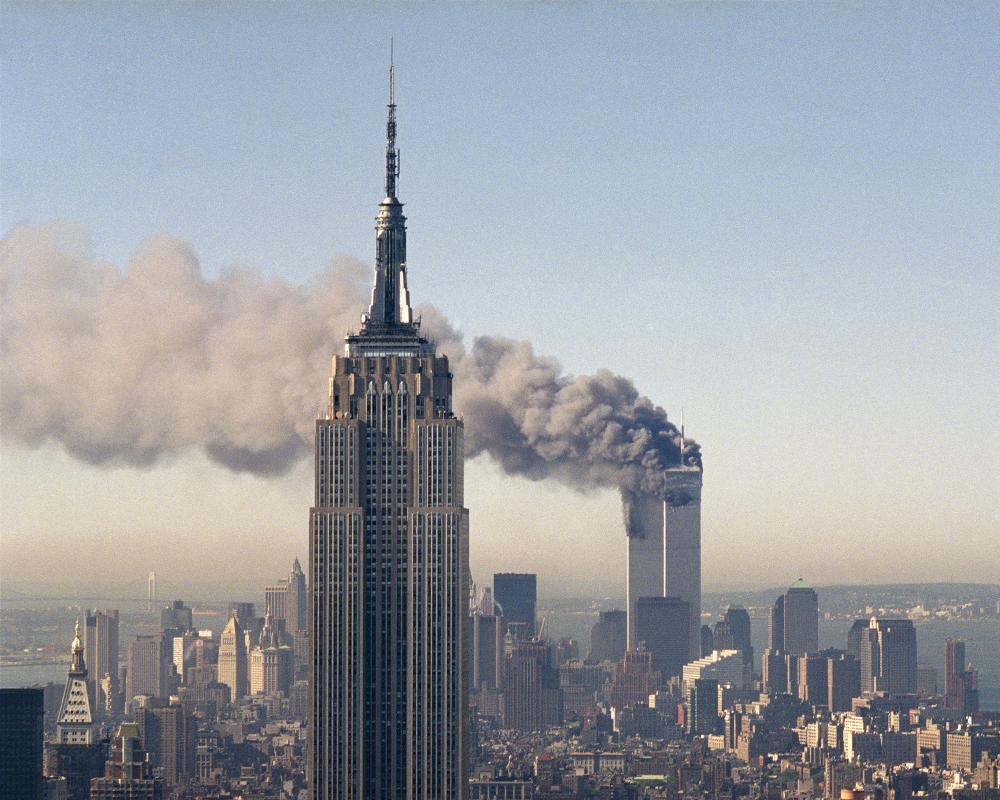
The 21st century truly began, at least in the Western mind, on a day no one had marked in their diaries. Out of a clear blue sky on September 11, 2001, two passenger jets flew into the twin towers of the World Trade Center, inaugurating a new age of anxiety—a period we have lived in ever since.
Historian Eric Hobsbawm had already spoken of the short 20th century, spanning from the start of World War I in 1914 to the fall of the Berlin Wall in 1989. It was followed by the long decade of the 1990s, which came to resemble a contented pause, a holiday from history, until it was abruptly ended on that bright New York morning.
The sight remains shocking. Nearly 25 years later, the image of an ash-covered sculpture depicting a businessman with his briefcase is as unsettling now as when it first appeared. Never mind that it was always a statue. The frozen Manhattan figure, intact while everything around him lies in ruins, could be one of the petrified bodies of Pompeii—a preserved emissary from the world before 9/11.
For a while, it seemed the new era would be entirely defined by the September 11 attacks and the response to them. George W. Bush’s declared “war on terror” threatened to remake the globe according to the preferences of the United States, which, after the Soviet Union’s collapse, stood as the sole global hegemon. Following the invasion of Afghanistan—which would keep U.S. troops there for two decades—came the U.S.-led conquest of Iraq and the toppling of Saddam Hussein and his statue. This brought death and devastation to Iraq, roiling the Middle East and politics across much of the democratic world, including Britain.
The slogan of the hour was “the clash of civilizations,” and many believed that struggle would overshadow all others in the new century. The reverberations of Iraq were felt for years, whether in the Arab Spring, the rise of Islamic State, or the persistent threat of violent jihadism. But that struggle has had to share space in the 21st century with others.
Not that this was obvious right away. At first, it seemed hope might edge out fear—that the new millennium could bring change for the better. Barack Obama won a Nobel Peace Prize before he had really done anything, in recognition of the optimism stirred by his winning 2008 campaign. That optimism is captured in an image of the politician who, as he liked to remark, didn’t look like any other U.S. president.
These have been turbulent years, roiled by culture wars, a long-delayed reckoning over race, and vast movements of people. Easy as it was to dismiss that feel-good sentiment as merely “hopey-changey”—more vibe than reality—there was a lot of it around. Science and technology, especially, were seen as full of promise. For some, that meant the excitement of the Large Hadron Collider, the biggest machine ever built. For others, it was the prospect of instant social connection delivered by a new breed of young, nerdy men who could turn ones and zeros into magic. Just look at the image here of Mark Zuckerberg and fellow Facebook founder Chris Hughes, delightfully unaware that they had opened not just the computer on Zuckerberg’s lap, but Pandora’s box.
For a while, the optimism held. Technology and the birth of social media were celebrated as a remedy for all manner of ills—even the one that had announced the century’s arrival. Violent men had brought 9/11, but a decade later, Facebook and Twitter seemed like harbingers of democracy, enabling those Arab Spring uprisings.The uprisings and other movements against oppressive regimes did not unfold as expected, and not just because of the lingering effects of the war on terror. On another September day, in another steel-and-glass financial fortress, another collapse occurred—one whose consequences are still with us. The fall of Lehman Brothers was at the heart of a global crash that ended an economic respite dating back to the 1990s.
The stagnation that followed, with wages frozen or declining in real terms, set the stage for the political turmoil of the next two decades. But it was far from the only shock the world faced.
The climate crisis has been a constant throughout this period, as it is in this collection, making itself known through fires and floods, from Pakistan to New Orleans. (George W. Bush’s disastrous response to Hurricane Katrina is another reason he has been fortunate in his latest successor: if not for the current president, Bush’s place as the most despised U.S. leader of the early 21st century would be secure.)
In 2020, a global pandemic struck, an event that still feels like a collective nightmare. Looking at a photo like the one here of an elderly Spanish couple, separated for a hundred days by a plastic barrier, makes you wonder: did that really happen?
Other images now seem like early warnings of troubles to come. The “separation wall” around the West Bank is a reminder that, after the failure of peace talks at Camp David in 2000, another 25 years of Israeli-Palestinian conflict followed, culminating in the Israel-Hamas war that erupted in October 2023 and has only recently paused. Similarly, the 2014 image from Ukraine now feels like a premonition of Russia’s 2022 invasion.
These have been turbulent years, marked by culture wars, a long-overdue reckoning with race—it’s striking to recall that taking the knee began with a single athlete’s gesture—and massive movements of people. The anguish of today’s refugee crisis is captured in the image of two-year-old Alan Kurdi, face down on a beach. These simmering discontentments were further fueled by tech platforms that shifted from reconnecting old friends to dividing strangers, filtering information along partisan lines until people could be persuaded to believe almost anything, usually the worst.
All these currents fed into the movement that has defined the last decade or so, embodied by Boris Johnson and his infamous Brexit bus—a lie on wheels—and, of course, by the man who symbolizes these times: Donald Trump. That movement is nationalist populism, and it thrives on the many plagues of the 21st century, from stagnant living standards to social media, skillfully channeling unease and fear into hostility toward migrants, minorities, and one another. Watching tech titans pay homage to Trump as he returned to the White House in January, you see we are living through what the Italian writer Giuliano da Empoli calls “the hour of the predator.”
Yet there are also images of wonder here that suggest the rest of the 21st century could be different: look at the selfie taken by the Mars rover and remember what we are capable of. The next 25 years are no more predetermined than the last. Like the cameras that captured these extraordinary moments, they are in our hands.Desperately fleeing with no sense of the scale of what had happened, this image stands out to her as a rare moment of stillness amid the chaos. It shows a life-size statue of a businessman, Double Check (1982) by John Seward Johnson II, surrounded by debris in Liberty Plaza Park across from the World Trade Center. Initially, Meiselas couldn’t tell if it was a real person.
Today, she sees the statue as a symbol of the attempt to make sense of the enormity of 9/11 and its terrible aftermath: George W. Bush’s “war on terror.” “A lot has happened as a consequence. Even the endless lines of security at the airport—these are small reminders of our distrust of each other.”
An Iraqi man comforts his son, 2003
By Jean-Marc Bouju
On March 31, 2003, an Iraqi man and his four-year-old child were arrested by American forces and taken to a prisoner of war camp near the southern Iraqi city of Najaf. French photojournalist Jean-Marc Bouju captured the moment just after the man’s handcuffs were removed so he could comfort his distressed son.
The image won the World Press Photo of the Year award and, for many, captured the cruelty of the U.S. invasion of Iraq. The hooded figure, attempting to preserve some humanity in an overwhelmingly hostile situation, foreshadows the infamous images of abused prisoners taken by American soldiers at Abu Ghraib prison, which would make headlines not long after.
Toppling of Saddam Hussein’s statue, 2003
By Sean Smith
The image of Saddam Hussein’s statue being pulled down in Baghdad as American forces entered the city on April 9, 2003, became one of the iconic images of the war. It was promoted by the Pentagon as a symbol of Iraqis joyously greeting the overthrow of their hated dictator.
“I’m happy with the picture,” photographer Sean Smith says, “but not with things that may be ascribed to it—as a defining moment, say, because it wasn’t.” Even at the time, Smith felt uneasy about becoming part of a false narrative. He had been in Baghdad for months as war approached and got to know many Iraqis. He knew the situation was more complex: “This wasn’t the liberation of Paris.” Most of the crowd that day, he remembers, were journalists staying in an overlooking hotel. “It was getting to their deadline time,” he recalls, “and they wanted a headline.”
Looking back, Smith is also saddened by the illusion of finality the photograph represents. When he returned to Iraq for work years later, one conversation about the invasion stuck with him. When an American soldier argued it had been necessary for the freedom of Iraqis, an Iraqi interpreter replied, “All I know is that everyone knows someone who’s died.”
Separation Wall, West Bank, 2004
By Alessandra Sanguinetti
It is a symbol of one of the most enduring conflicts of the century. In 2002, during the second intifada, the Israeli government began building what is known as the Separation Wall: a barrier between Israel and the West Bank, which it has occupied illegally since 1967. This image shows children dwarfed by an eight-meter-high section of the wall at Abu Dis, a Palestinian village in the suburbs of Jerusalem cut off from the rest of the city. The permits Palestinians need to cross the wall are hard to obtain, severely restricting movement.
The barrier, deemed illegal by the International Court of Justice, was “presented as a security measure,” explains Emma Graham-Harrison, the Guardian’s Middle East correspondent, following a spate of suicide bombings targeting Israeli civilians. “However, it also functioned as both a land grab and a key step in enforcing separation. In some ways, it was a template…”The text describes a metaphor for Israel’s approach with the Gaza fence: the notion that Palestinians could be physically contained without acknowledging their humanity or political aspirations.
In 2004, Boston photographer Rick Friedman was called by an editor to photograph “two kids with their computers” at Harvard. The subjects were Facebook founders Mark Zuckerberg and Chris Hughes, just months after launching their site, which initially involved rating female classmates’ attractiveness. Friedman found them agreeable but wondered if it was just “some kid trying to get a date with his computer.”
Edward Burtynsky’s 2005 photo captures a massive chicken processing plant in Dehui city, China, part of his work documenting global industrialization. As China became an economic powerhouse, accounting for up to 30% of global manufacturing, Burtynsky sought to capture the immense scale of its industries, like this facility preparing poultry for export to Japan.
The “Disaster Girl” meme, from a 2005 photo by Dave Roth, shows his daughter Zoë smiling mischievously during a fire department training exercise. The image, later dubbed one of history’s most famous memes, was widely photoshopped into other disaster scenes, symbolizing the rise of internet memes.
During Hurricane Katrina in 2005, which devastated New Orleans and exposed deep racial inequalities, Kanye West famously declared, “George Bush does not care about Black people.” The disaster highlighted stark societal divisions, with former MP Oona King noting how it “clearly and unavoidably illuminated the chilling impact of race.”
A 2006 paparazzi photo of Paris Hilton, Lindsay Lohan, and Britney Spears crammed into a car became an iconic image of 2000s celebrity culture. Hilton later called it “the moment that defined an era,” though it was controversially headlined “Bimbo Summit” by the New York Post at the time.Men have since spoken out about their treatment by the media: the misogynistic scrutiny and judgment that extended far beyond celebrity circles. “They loved pitting women against each other,” Hilton has said. “It was so vicious.”
Rangers taking away a mountain gorilla, 2007
By Brent Stirton
The Democratic Republic of Congo’s Virunga National Park, Africa’s oldest conservation area, is exceptionally biodiverse—and one of the most dangerous places to work. Since 1996, more than 200 rangers have been killed in a series of conflicts. Photographer Brent Stirton took this picture after seven rare mountain gorillas were killed by hostile gunmen wanting to warn rangers not to disrupt illegal charcoal manufacturing in the area. Locals and park workers carried the bodies to a burial site. “Everyone was silent,” Stirton recalled later. “It was very reverent.” Not all is lost. Last year, analysis published in the journal Science found conservation efforts around the world were helping stem the decline of biodiversity. “Our results clearly show there is room for hope,” one co-author said.
Large Hadron Collider, 2007
By Simon Norfolk
One of this century’s biggest scientific discoveries took place in the Large Hadron Collider, the world’s most powerful particle accelerator, which opened at CERN in Geneva in 2008. This photo was taken during construction. Still the largest machine ever built, it consists of a 27km ring of superconducting magnets in a tunnel 100 metres underground. The magnets, chilled to a temperature lower than in outer space, are used to propel high-energy particle beams into collisions. By studying the results, particle physicists hope to answer questions about the essential workings of the universe. In 2012, they made a major breakthrough: the discovery of the Higgs boson, the so-called “God particle.”
Steve Jobs with the first iPhone, 2007
By Kimberly White
In January 2007, Steve Jobs unveiled the first iPhone. “We are all born with the ultimate pointing device—our fingers—and iPhone uses them to create the most revolutionary user interface since the mouse,” the Apple CEO said. (For his demo, seen here, he had to follow a carefully planned “golden path” to avoid glitches; the software wasn’t yet finished.) The touchscreen smartphone was released six months later, totally transforming the way we communicate. Today more than 1.4 billion iPhones are in use globally.
Lehman Brothers staff, 2008
By Kevin Coombs
This photo of staff at the Lehman Brothers offices in London’s Canary Wharf was taken on 11 September 2008. Over the past year, the global financial system had been showing cracks. Now Lehman was in trouble, with its share price plummeting and rumours of a buyout. “This meeting was called just before lunch,” said Gwion Moore (back left, minus the grey-suit banker trousers because his work clothes were at the cleaner’s). “A couple of senior bankers made a speech, saying, ‘We’re not going bankrupt, get back to work.’” Four days later, Lehman did go bankrupt. “Trust evaporated and funds stopped flowing around the world,” says economic historian Catherine Schenk. What followed was the worst financial crisis since the Great Depression. “It reminded us that, as in 1930, failures in the richest countries could spark a financial crisis that had repercussions in markets everywhere.”
Construction of the Burj Khalifa Tower, Dubai, 2008
By Philippe Chancel
Shown here in the last stages of its construction—and already towering over everything thatSurrounding it – the Burj Khalifa in Dubai has held the record for the world’s tallest building since opening in January 2010. This neofuturist mega-scraper, with its 163 floors reaching 828 meters high, is not just a dizzying feat of engineering; it’s a symbol of the equally dizzying, oil-fueled rise of the Gulf states in the 21st century.
In this era of expansion, flashy development projects have become a major tool of soft power—what critic Rowan Moore has called a “cultural and architectural arms race.” The race continues: the Burj Khalifa will soon be eclipsed by the Jeddah Tower in neighboring Saudi Arabia, scheduled for completion at 1,000 meters by 2028.
Barack Obama on the campaign trail, 2008
By Damon Winter
“It was one of those moments that gets stuck in your head,” Damon Winter recalls. “Part of it was the irony that a memorable photo could come from such a banal setting—a podium in front of an American flag.” Yet everything lined up, from the shaft of light to Obama’s smile, and today the image captures something of the optimism and dynamism of his 2008 campaign—qualities absent from many other campaigns of the century. “It was a very optimistic time,” Winter says. “The country was experiencing this momentous change.”
Unlike other politicians Winter had covered, Obama “seemed like the same person on stage as he was when interacting with people. It seemed to me that he was really interested in people.”
Northern lights over the Eyjafjallajökull volcano, 2010
By Lucas Jackson
In spring 2010, after 187 years of silence, the Eyjafjallajökull volcano on the south coast of Iceland began a powerful eruption. It spewed fine volcanic ash high into the atmosphere, which blew toward the UK and western Europe. Almost all flights in the region were grounded due to fears that the ash would clog and stall jet engines.
Stranded in Iceland, photographer Lucas Jackson captured this spectacular image of the northern lights over the erupting volcano. “When you’re a photographer,” he told the Guardian in 2010, “it’s really rare to actually be exactly where you want to be to take the shot. We were laughing about how crazy it all was.”
Pakistan floods, 2010
By Daniel Berehulak
In the summer of 2010, record-breaking rains led to extreme flooding in Pakistan. At its peak, one-fifth of the country was submerged. Nearly 2,000 people died and more than 20 million were affected, with homes and crops lost. Though unprecedented at the time, such severe flooding has since become a recurring event, including this summer.
As temperatures rise worldwide, floods are becoming more frequent and intense. Unsurprisingly, poorer nations and communities are most affected. But, as UN Secretary-General António Guterres warned earlier this year, “No country is safe.”
Fukushima disaster, 2011
Photographer unknown
On March 11, 2011, a massive 9.0 undersea earthquake off the northeast coast of Japan triggered a tsunami that killed an estimated 20,000 people. More than a million buildings were damaged, including the Fukushima Daiichi nuclear plant, where three reactors went into meltdown after flooding disabled the cooling systems. It was the worst nuclear accident in history after Chernobyl.
Several workers were injured in explosions at the facility, and more than 100,000 people in the wider region were evacuated to avoid radiation exposure. It’s estimated that 2,313 “indirect deaths” resulted from physical and mental stress, and that 29,000 people remain displaced.
Tahrir Square,In 2011, Tahrir Square in central Cairo became the symbolic heart of the Arab Spring, though the movement had actually begun the previous year in Tunisia. It started after Mohamed Bouazizi, a market seller who faced government harassment and corruption, set himself on fire outside a governor’s office. Saudi journalist Jamal Khashoggi wrote in 2018, “The Arab world was ripe with hope,” but “these expectations were quickly shattered.” Khashoggi’s assassination that year, ordered by Saudi Crown Prince Mohammed bin Salman, reflected a broader descent into violence. Since then, Syria, Libya, and Yemen have endured years of brutal civil war, while Egypt remains under the iron-fisted rule of President Abdel Fattah al-Sisi, who came to power after the protests.
From late 2013 to 2016, the worst Ebola outbreak in history killed over 11,000 people in Sierra Leone, Liberia, and Guinea. The fatality rate for recorded cases was 40%, due to poor healthcare, mistrust of medical authorities, and an international response focused more on containment than treatment. In September 2014, photographer Daniel Berehulak captured eight-year-old James Dorbor being carried into a clinic in Monrovia, Liberia, after his health worsened during a three-hour wait for admission. Berehulak noted that when staff finally took him in, his father was not allowed to embrace him, and they carried the boy “like he was a bag of garbage.”
In 2014, Melilla—a small Spanish territory in Morocco—became a symbol of “Fortress Europe” policies. Activist José Palazón photographed a group of men stuck on a razor wire fence for hours while trying to cross the border, as Spanish golfers played below. Eight years later, Melilla would be the site of a massacre where at least 37 people attempting to enter Spain were killed by border guards. Palazón shared the photo on Twitter with the caption: “Immigrants on the fence, expulsions and a game of golf. Only in Melilla.” The surreal image of inequality quickly went viral. He later said, “It seemed like a good moment to take a photo that was a bit more symbolic.”
Russia’s devastating war on Ukraine traces back to the “Euromaidan” protests in Kyiv, which began in November 2013 after then-President Viktor Yanukovych bowed to Russian pressure and abandoned an agreement to move closer to the EU. On the bloodiest day of the uprising, February 20, 2014, photographer Jérôme Sessini documented the scene, including an Orthodox priest blessing protesters at a barricade. More than 50 protesters were shot dead that day.
The term “selfie” has humble origins: an Australian man posting a blurry photo of his bruised lip to an online forum in 2002, apologizing, “Sorry about the focus. It was a selfie.” The following year, sales of phones with front-facing cameras began to rise, and by 2013, “selfie” was named Oxford Dictionaries’ word of the year. The selfie organized by Ellen DeGeneres at the Oscars in 2014 broke the internet. Eleven years later, it might…Kevin Spacey faced damning sexual abuse allegations, and Brangelina broke up.
Italian rescue, 2014
By Massimo Sestini
The number of people risking the Mediterranean crossing to Europe, fleeing wars and persecution in the Middle East and Africa, rose dramatically in the mid-2010s. In 2013, Italy launched its search-and-rescue operation Mare Nostrum after hundreds died in two shipwrecks near Lampedusa.
Shot from a helicopter, Massimo Sestini’s image shows 500 people on a boat 25km from Libya’s coast, just before their rescue by the Italian navy. The operation was controversially halted that year. At least 20,000 people have died or disappeared in the Mediterranean since.
The death of Alan Kurdi, 2015
By Nilüfer Demir
On 2 September 2015, photojournalist Nilüfer Demir saw the body of a toddler, Alan Kurdi, on a beach near Bodrum, Turkey. “There was nothing left to do for him,” she said later, “except take his photograph. And that’s exactly what I did.”
Alan was born in Syria in 2012. His family had been trying to reach Greece, but their boat overturned soon after launching, and Alan and his mother drowned. “I was holding my wife’s hand,” his grief-stricken father later told the media, “but my children slipped through my hands. It was dark and everyone was screaming.”
Demir’s shocking image spread quickly. Despite protests, a spike in donations to charities, and promises from Western governments to do more, the Mediterranean remains the world’s deadliest border.
Caitlyn Jenner, 2015
By Annie Leibovitz
This was a high point for trans visibility. In June 2015, Caitlyn Jenner made her public debut in a portrait by Annie Leibovitz on the cover of Vanity Fair. It instantly received positive support, and Jenner became the fastest person to reach 1 million Twitter followers, before facing backlash when she revealed she voted for Trump.
Since then, trans rights have been rolled back in the US and UK, but support remains strong. Earlier this year, the world’s largest trans pride march took place in London, with a crowd of 100,000.
Usain Bolt’s Olympics “triple triple”, 2016
By Cameron Spencer
“There you go, I’m the greatest,” said Usain Bolt after achieving an unprecedented three consecutive Olympic golds (in 2008, 2012, and 2016) across three events. Here, in the Rio 100m semi-final, “Lightning Bolt” seems to have time to smile at the camera. He was actually checking if the runner to his left was catching up: “I saw I had him covered, and I smiled.”
The Brexit bus, 2016
By Jack Taylor
For many, Brexit marks the beginning of what Marina Hyde called “an age of gathering chaos and rising disbelief” in the UK.
The “Brexit bus,” reportedly masterminded by Dominic Cummings but closely linked to Boris Johnson, became a subject of bitter arguments and a symbol of the chaos that has engulfed the UK since. Its slogan, claiming the UK sent £350 million a week to the EU, was disputed, with the UK Statistics Authority calling it “a clear misuse of official statistics.” Research by the Nuffield Trust shows Brexit has actually put unprecedented strain on the NHS.
Colin Kaepernick taking the knee, 2016
By Marcio José Sánchez
On 1 September 2016, during a San Francisco 49ers pre-season game, quarterback Colin Kaepernick kneeled during the US national anthem to protest police violence against Black people. His gesture was adopted by teammates—this photo shows him with Eli Harold.Colin Kaepernick’s protest, which began in 2016 with teammate Eric Reid, spread worldwide and became linked to the Black Lives Matter protests that erupted in the spring of 2020. The gesture was highly controversial: Kaepernick was ousted from the league a year later and has never played for an NFL team again.
An assassination in Turkey, 2016
By Burhan Ozbilic
“We die in Aleppo, you die here,” shouted Turkish off-duty riot squad officer Mevlüt Mert Altıntaş after killing the Russian ambassador to Turkey, Andrei Karlov, at a gallery in Ankara, in protest at the actions of the Russian military in Syria. Photographer Burhan Ozbilic soon snapped this unsettling image. Altıntaş was later shot and killed by police.
Women’s March, 2017
By Bryan Woolston
In January 2017, the day after Donald Trump’s first inauguration as president, millions of women gathered across the world—including 500,000 in Washington—mobilized by his misogyny and sexual assault allegations. It was one of the largest single-day protests in U.S. history, and nine months later its energy fed into the #MeToo movement, which began as a disturbing story of one Hollywood producer’s abuse of women and soon turned into a global reckoning.
Amazone, 2017
By Andreas Gursky
In 2017, the eminent German photographer Andreas Gursky, known for his vast, detailed, era-defining landscapes, trained his camera on an Amazon warehouse in Arizona packed full of goods destined for customers. This century has seen internet shopping go from a niche experiment—in 2000, the Guardian reported that anxieties about postage time had led to a “collapse” of online pre-Christmas book sales—to one of the most common ways to make a purchase.
Sophia the Robot, 2017
By Giulio Di Sturco
“It was super weird,” recalls Giulio Di Sturco of his visit to a Hong Kong lab to photograph Sophia the Robot. “Pieces of robots everywhere, five guys working like mechanics—to think the future might be built in this kind of space.”
The idea that Sophia represented a major leap in AI was big news: the next year, she became a citizen of Saudi Arabia—the first robot to be granted legal personhood anywhere. There were skeptics, however, and ChatGPT’s arrival in 2022 might suggest the future of AI is in chatbots and data centers instead. But Di Sturco believes the humanoid robot’s time is still to come. “They were on the edge of something interesting,” he says.
Megan Rapinoe, 2019
By Franck Fife
After decades in which their game was dwarfed by men’s, women are winning fans for their playing and inclusivity. Megan Rapinoe’s victory pose after scoring for the U.S. in the 2019 World Cup went viral: a symbol of both her athleticism and her advocacy on issues including LGBTQ+ rights and mental health.
Stormzy headlining Glastonbury, 2019
By Samir Hussein
“This is the best night of my entire life,” a 25-year-old Stormzy told the crowd during his historic set at Glastonbury in 2019, as the first Black British solo act to headline the festival. Wearing a Banksy-designed Union Jack stab vest, Stormzy crafted a set that both celebrated Black British culture—with guest performances from Ballet Black, WAR collective, and Dave—and critiqued racism in the UK. Praised by everyone from David Lammy, Zadie Smith, and Jeremy Corbyn to Adele and Ghetts, the performance went out of its way to educate its audience and reference the many acts that had come before to make it possible. “This was about arrival,” Smith wrote in the New Yorker, “of a king and his court and the many, many people who have hoped for this day.”The image captures the emotional reunion of Agustina Cañamero and Pascual Pérez, an elderly couple in their 80s, at a nursing home in Barcelona in June 2020. Separated for 102 days during the first lockdown—the longest they had ever been apart in 59 years of marriage—the photo has come to symbolise how Covid-19 upended lives across the globe.
Although the global health emergency was declared over in May 2023 and may now feel like a distant memory, the pandemic’s impact endures. To date, more than seven million people have died, and many others are grappling with grief or long-term health issues. “Most of my generation have been affected in deep, developmental ways, and that’s going to affect us forever,” said 21-year-old student Eoin O’Loughlin in a 2023 Guardian series on the “Covid Generation.”
On 6 January 2021, following Joe Biden’s election victory, a crowd broke away from Donald Trump’s fiery speech in which he accused Democrats of stealing the election. Photographer Victor J. Blue followed them as they stormed the U.S. Capitol. This photo was taken after they had been expelled; police officers, having run out of pepper spray, were discharging fire extinguishers to deter protesters from re-entering, creating the “smoke” visible at the centre of the image.
Has there ever been life on Mars? And could the planet, as Elon Musk believes, become a future home for humanity if Earth becomes uninhabitable? It’s no surprise that Mars exploration has been a dominant theme in the 21st-century space race. NASA’s Perseverance rover landed in February 2021, tasked with searching for signs of past life to better understand the planet’s habitability.
This selfie, taken in 2024, is “such a nice encapsulation of what NASA’s mission is all about,” says project scientist Katie Stack Morgan. Composed of 62 stitched-together images—which is why the rover’s arm is missing—it shows Perseverance alongside the helicopter Ingenuity, the first aircraft to achieve powered, controlled flight on another planet. As for colonising Mars, Stack Morgan suggests we might first “ask whether we have been good stewards of our own planet.”
“At that moment,” recalled 81-year-old Panayiota Kritsiopi, “I was shouting not only for myself, but for the whole village.” She was photographed as a massive wildfire on the Greek island of Evia forced thousands to flee, eventually burning more than half the island. Miraculously, Kritsiopi’s home was spared; the fire reportedly stopped just a metre from her house.
The year 2021 was quickly surpassed by 2022, and then 2024, as Europe’s hottest on record, while this summer saw the worst wildfire season in European history.
“It was surreal,” recalls Just Stop Oil activist Anna Holland (right) of the day she and Phoebe Plummer approached a Van Gogh painting at the National Gallery in London, can in hand. “Almost before I knew it, we were throwing the soup.”
The stunt was part of a wave of climate activism that has gained momentum this century, often targeting symbolic objects like this painting (which was safely protected behind glass). Although the pair were sentenced to prison under Britain’s increasingly strict protest laws, they inspired similar acts of protest around the world.
Queen Elizabeth II died on 8 September 2022.In 2022, at the age of 96, she passed away, ending a 70-year reign—the longest of any British monarch. Around 250,000 people joined the characteristically British queue to see her lying in state before the funeral, which was watched by 29 million television viewers in the UK. In this image, her son, Charles III—who at 73 became the oldest person to ascend the throne—walks beside her coffin in Westminster Abbey. His grief is clear, but beyond the loss lies uncertainty: what comes next?
GS
Northern White Rhino Foetus, 2023
By Jon A Juárez
In March 2018, tragedy struck when Sudan, the last male northern white rhino, died. With only two females remaining, the species was functionally extinct. Then came a glimmer of hope: a foetus created using sperm collected from males before they died.
Sadly, the mother died from an unrelated infection. However, tests indicated the small foetus would likely have survived. Photographer Jon A Juárez said, “Though the story is bittersweet, the foetus proves the science works. If we support scientists’ efforts, we can still change course and make the planet a better place.”
GS
Taylor Swift’s Eras Tour, 2024
By Emma McIntyre
For a time, Taylor Swift’s Eras tour—149 shows across 51 cities over 21 months—seemed like it would never end. The enthusiasm of her global fans never waned either, as they filled stadium after stadium for 3.5-hour performances of Swift’s greatest hits. When the international juggernaut finally concluded in December 2024, it became the highest-grossing concert tour of all time, with over $2 billion in ticket sales, cementing her dominance.
The tour’s success also reflected the post-pandemic surge in major live music events, fueled by fans seeking joy and connection, as well as artists looking to supplement their income in the streaming era. It’s often said that our century has seen the end of a shared popular culture. Swift, it seems, is one of the last remaining superstars.
GS
Trump Assassination Attempt, 2024
By Evan Vucci
“Let me get my shoes,” were Donald Trump’s first words to the Secret Service agents rushing him to safety after a sniper’s bullet grazed his ear. But it was what he said next, fist raised, that etched the moment into history: “Fight!” The image energized his supporters and injected new momentum into his campaign. Coming just weeks after Joe Biden’s disastrous debate performance, this pivotal moment led commentators across the political spectrum to believe a second presidency was within his reach.
FB
…and Tech Leaders at His Inauguration, 2025
By Saul Loeb
This is a defining image of power in 2025: Mark Zuckerberg, Lauren Sanchez, Jeff Bezos, Sundar Pichai, and Elon Musk in the front row at Trump’s inauguration (Apple CEO Tim Cook is out of frame).
These tech leaders—from Meta, Amazon, Google, and Tesla—have a combined net worth of nearly $1 trillion, reflecting the sharp rise in global inequality this century. The image also captures the political shift of the U.S. tech sector, from being a darling of the left to aligning with the MAGA right.
FB
These 46 images capture moments that tell the story of the first quarter of the 21st century. Which other moments come to mind for you? Email saturday@theguardian.com.
Frequently Asked Questions
Of course Here is a list of FAQs about The sight of it is still shocking 46 photos that capture the story of our century so far designed to sound like questions from a real audience
General Beginner Questions
1 What is this collection of 46 photos about
Its a curated selection of iconic photographs from the year 2000 onward that have defined the major events emotions and turning points of the 21st century so far from wars and disasters to social movements and technological leaps
2 Where can I view these photos
The collection was originally published by The Guardian newspaper You can find it by searching the articles title on their website or through major news archives
3 Why 46 photos Why not 50 or 100
The number isnt arbitrary it represents the years from 2000 to 2023 Each photo is meant to symbolize the story of one year though some years might be represented by more than one pivotal image
4 Are the photos graphic or disturbing
Some are as they document realworld events like war terrorism and climate disasters The title itself warns that many images are emotionally powerful and difficult to view but they are historically important
5 Who chose these photos
They were selected by editors and picture researchers at The Guardian likely with input from historians and photojournalists to create a narrative of the centurys defining moments
Content Context Questions
6 What kinds of events do the photos cover
They cover a wide range 911 the Iraq War the Arab Spring the Syrian refugee crisis the Black Lives Matter movement the COVID19 pandemic the war in Ukraine and major climate events like wildfires and floods
7 Are there any positive or hopeful images included
Yes While many capture conflict and tragedy the collection also includes moments of human triumph solidarity and cultural shift such as the election of Barack Obama marriage equality victories or the global response to disasters
8 I dont recognize some of the events Is there context provided
Yes in the original article each photo is accompanied by a caption explaining the event the date the photographer and why it was significant