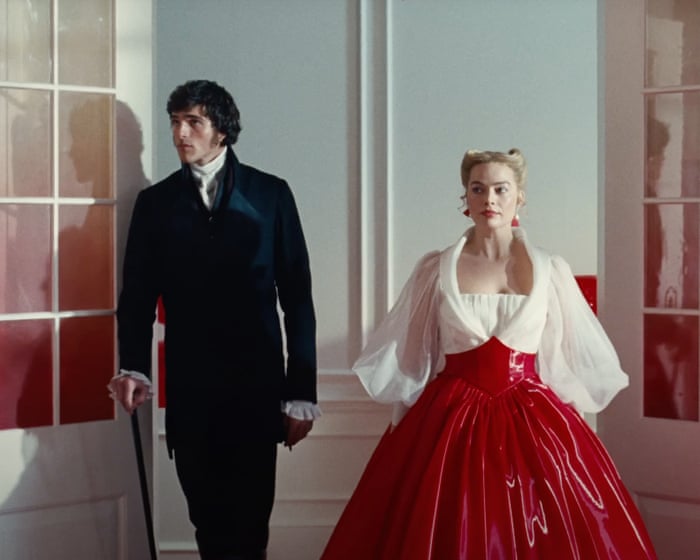
The most surprising aspect of the first trailer for Emerald Fennell’s Wuthering Heights isn’t the extreme close-up of dough being forcefully kneaded. It’s not that Margot Robbie, who is blonde and 35, and Jacob Elordi, who is white, are playing the leads, despite Emily Brontë describing Cathy as a teenage brunette and Heathcliff as “a dark-skinned gypsy.” It’s not the gaudy interiors—silver walls, plaster Greek gods spewing pearls, blood-red floors, or a flesh-pink wall for clutching and licking. It’s not Robbie’s enormous diamonds, her scarlet sunglasses, her mouth stuffed with grass, the loud snip of her corset laces being cut, or her elaborately—erotically—bound hair as she eyes towering fruit puddings on silver stands. It’s not any of her outfits—the red latex dress or the perfectly ’80s off-the-shoulder wedding gown with yards of veil half-blown from her head. Nor is it any of the scenes where Elordi removes his shirt.
The most astonishing thing is that the trailer calls Wuthering Heights “the greatest love story of all time.” That’s almost exactly how the 1939 film starring Laurence Olivier and Merle Oberon was promoted—as “the greatest love story of our time … or any time!” Have we learned nothing? I’m not referring to Robbie’s white wedding dress, which isn’t historically accurate—a detail that has bothered many online. I’m more concerned that nearly a century after Olivier’s film, we’re still labeling it a love story—a great one, the greatest! It’s even being released the day before Valentine’s Day, when in reality, Cathy rejects Heathcliff out of snobbery, and he becomes a psychopath.
This is why the novel is nearly impossible to film—unless you stop halfway through. The 1939 version cuts from Cathy’s death to her ghost walking hand-in-hand with Heathcliff’s as the housekeeper Nelly Dean sighs, “They’ve only just begun to live!” Most adaptations have followed suit, with a rare exception being Peter Kosminsky’s 1992 version, which covered the entire book and even featured Emily Brontë herself, played by Sinéad O’Connor in a large blue cloak, warning the audience “not to smile at any part of it.”
It’s certainly not a comedy. Instead of a charming meet-cute, Cathy’s father brings home a ragged orphan he found starving on the streets of Liverpool. The “boy-loses-girl” part is there, but the “boy-gets-girl” ending never really happens. The real question is whether the story is too brutal for the screen—Andrea Arnold’s raw, stripped-down 2011 version comes closest to the book’s dark energy, and even she stuck to the first half.
There’s so much cruelty. Heathcliff is abused by Cathy’s brother Hindley, then goads Hindley into drinking himself to death, takes his house, and abuses Hindley’s son. He tricks Cathy’s sister-in-law into marriage, beats her, calls her a slut, hangs her dog, and gaslights her, insisting this is what she wants. Cathy is too self-absorbed to care. So even ignoring her death and the second half of the novel, it’s a lot. If Fennell continues to the bittersweet end, she’ll have to address Heathcliff abusing his own son and Cathy’s daughter, forcing them to marry, and renting Cathy’s marital home to a middle-aged fop who slashes a ghost girl’s wrists with broken glass. (This is part of a frame narrative—the plot’s complexity is another reason it’s a nightmare to adapt.)
When the novel was published in 1847, critics didn’t consider it a love story.”How a human being could have attempted such a book… without committing suicide… is a mystery,” wrote Graham’s Magazine, shuddering at its “vulgar depravity and unnatural horrors” and speculating that its author’s nightmare vision must have come from eating “toasted cheese.” The Spectator found it “coarse and disagreeable”; Atlas called the characters “utterly hateful or thoroughly contemptible”; and the North American Review shrank from the novel’s “coarseness,” “stupid blasphemy,” and “morbid imagination.”
So, in a way, it’s a good sign that a viewer at a test screening of Fennell’s film found it “aggressively provocative and tonally abrasive”—rumored to be because of a scene where a man is publicly hanged, ejaculates, and is fondled by a nun. None of that is in the book, but Wuthering Heights has always shocked. It has always been depraved and unhinged.
Heathcliff literally begs Cathy to “drive me mad.” She feels obliterated by love, crying: “I am Heathcliff!” Love sends her into a brain fever and makes him gnash his teeth and dash his head against a tree until he bleeds, and he digs up her grave. All this is in the book. And we want it. Brontë surrounds Cathy and Heathcliff with characters who are so petty, hypocritical, small-minded, and smug that their uncompromising love seems like a breath of fresh air. She also gives Cathy a brother who bullies her and a husband who stultifies her, so that you can even argue, as critics Sandra Gilbert and Susan Gubar did, that Heathcliff is a feminist force who helps her smash the patriarchy and run wild in nature.
Perhaps, anyway, the love isn’t supposed to be real. Some say it’s, as Elizabeth Hardwick rather unkindly put it, “a virgin’s story,” a book about impossible, abstract love that can only work when it becomes ethereal or, to put it less romantically, when both lovers are dead. Perhaps that’s why it appeals so much to teenagers—Kate Bush wrote her soaring song at 18, and Fennell has explicitly said she wants her film to reflect the book as she read it at 14. Perhaps it’s not the greatest love story of all time, our time, or any time, but is the greatest story about what we think love is like when we haven’t experienced it.
But I am not sure that’s entirely the novel Brontë wrote, at 27, intellectually brilliant and canny too (she managed the sisters’ investments), physically strong (she walked miles, she could handle a gun), and an avid reader of newspapers as well as all the newest books. Her novel is absolutely bursting with ideas. In its intricate structure, it holds a tension between love and nihilism. She wanted to confound us, to perplex us, to startle us, so perhaps it’s absolutely right that the trailer should do the same.
It will be a shame, though, if the adaptation doesn’t take in any of the novel’s tricky second half, where, having conjured our darkest desires, I think Brontë is asking us whether we really want to indulge them. Heathcliff tells Nelly he started digging up Cathy’s corpse but stopped at the last moment. Repulsed, she asks what he’d have done if he’d found her, “dissolved into earth, or worse,” and he says he would have dreamed “of dissolving with her…!” Is this what we want love to cost? Do we really want love that is so toxic that it can only end in death and damage everyone around us? Is this love or a macabre will to suicide? And while we might enjoy this kind of love in fantasy, wouldn’t we be better off going for the kind of love Brontë actually ends the novel with, as Cathy’s daughter gently, intimately, teaches Hindley’s son to read—a scene that has hardly ever, yet, made it to the screen.
Samantha Ellis is the author of Take Courage: Anne Brontë and the Art of Life (Vintage). Wuthering Heights is released in cinemas on the 13th.February is the second month of the year, known for its short span of 28 days, or 29 in a leap year. It’s a time when winter’s chill begins to soften in many places, hinting at the coming spring.
Frequently Asked Questions
Of course Here is a list of FAQs about why the true story of Wuthering Heights is considered too intense for a faithful film adaptation
General Beginner Questions
Q What does Its no romantic comedy mean in relation to Wuthering Heights
A It means the core story is not a sweet lighthearted love story Its a dark obsessive and often cruel tale about revenge social class and psychological torment which is the opposite of a typical romcom
Q What is the true story of Wuthering Heights
A The true story refers to Emily Bronts original 1847 novel Its a multigenerational saga where the passionate bond between Heathcliff and Catherine Earnshaw leads to decades of misery abuse and revenge that destroys nearly everyone around them
Q Why is it considered too intense for film
A The novel contains deeply unsettling themeschild abuse psychological cruelty animal cruelty grave desecration and a love that is more about possession and shared darkness than happiness A fully faithful adaptation would be a brutal almost horrorlike experience
Q Havent there been lots of Wuthering Heights movies How are they different
A Yes but most adaptations significantly soften the story They often focus only on the first half cut the second generations story entirely make Heathcliff more sympathetically brooding and downplay the most vicious acts of cruelty
Advanced Thematic Questions
Q What specific elements from the book are usually left out or softened in films
A Films often omit Heathcliffs abuse of his sickly son Linton his psychological torture of Isabella Linton the hanging of Isabellas dog his forcing the marriage between young Catherine and Linton and the graphic gothic imagery of him digging up Catherines grave
Q Is the problem just the dark content or is it something about the books structure
A Its both The content is dark but the novels complex nested narrative is very hard to translate to screen without losing its eerie recounted quality