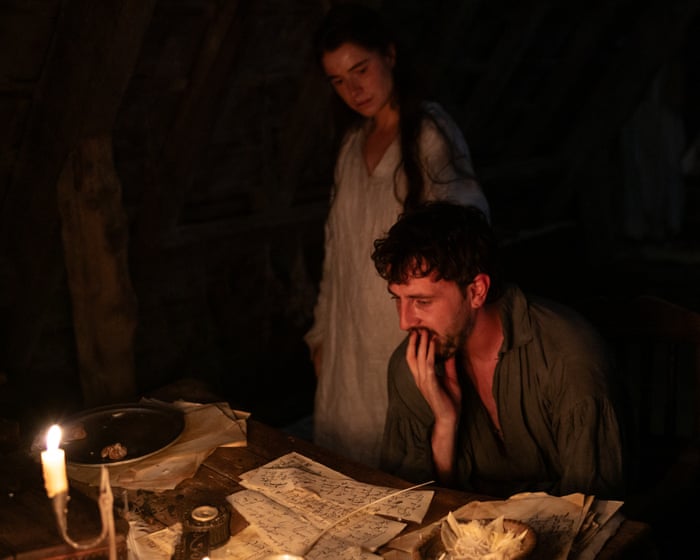
“The joys of parents are secret, and so are their griefs and fears…” This line comes from Francis Bacon’s essay Of Parents and Children; perhaps such feelings were more hidden in his time than in ours. This interplay of secrecy and revelation lies at the heart of Chloé Zhao’s deeply moving romantic fantasy about the origins of William Shakespeare’s tragedy Hamlet. The film suggests the play began in the imagined sorrow of Shakespeare and his wife, Agnes (or Anne) Hathaway, following the death of their 11-year-old son, Hamnet, in 1596—just a few years before Hamlet was first performed.
The similarity of the names Hamnet and Hamlet is not presented as some grand Freudian slip; there is historical evidence that the two names could be used interchangeably. The movie draws inspiration from Maggie O’Farrell’s 2020 novel of the same name—Zhao co-wrote the screenplay with O’Farrell—as well as from literary scholar Stephen Greenblatt’s 2004 essay, “The Death of Hamnet and the Making of Hamlet.” The film succeeds not by solving the mystery, but by deepening it further. It is speculative and even contrived, yet also ingenious and deeply heartfelt.
On one level, the story could be seen as a flawed interpretation, treating Shakespeare like a modern novelist with contemporary views on expressing grief—relying heavily on a name coincidence that may be just that, a coincidence. Moreover, one could apply this “Hamnetisation” of tragedy to almost any of Shakespeare’s plays. (His grief over Hamnet’s death might have lain dormant for years, only to resurface later in Macbeth, with the murder of Macduff’s wife and son.) You might remain unconvinced. Yet there is something thrillingly daring in Zhao and O’Farrell’s imaginative leap—a bold creative act that reaches across centuries to embrace Shakespeare and Agnes as fully human.
Zhao begins her film at a walking pace, following Agnes as she wanders endlessly through a forest—a habit that has earned her a witch-like reputation, much like her late mother. She moves dreamily, watching the sky through the branches and a hawk that swoops down to her hand. Agnes is in a trance of rapture in the folk-horror woods outside Stratford-upon-Avon, sensing a creative inspiration born from despair. Jessie Buckley delivers an unselfconsciously captivating performance, giving every glance and smile a piercing significance. Her beauty enchants young William Shakespeare, a would-be poet chafing at having to join his abusive father in the glove-making trade, played with intelligent intensity by Paul Mescal.
They marry, much to the discomfort of William’s mother, Mary (Emily Watson). The film imagines Agnes giving birth to her first child, Susanna, right in the forest. But when she reaches the end of her second pregnancy, she is forced to deliver indoors—a bad omen. These are the twins, Judith and Hamnet. While William is away in London, pursuing his dream of becoming a playwright, illness and tragedy strike.
Hamnet’s death can be compared to the loss of Thomas Cromwell’s wife and daughters to sickness at the start of Hilary Mantel’s Wolf Hall—an inciting event, a terrible loss that in some way explains everything that follows. Cromwell channeled his agony ruthlessly into his career, without dwelling on those he lost. Here, Zhao and O’Farrell suggest Shakespeare transformed and displaced his grief into every line of his play: the agony, the futility of carrying on, the dazed inability to find meaning in anything. In a sense, Shakespeare himself becomes the ghost—an undead phantom condemned to wander miserably through the world, while Hamnet remains alive in spirit. The boy’s soul has not been murdered; the father’s has.
It could all be true—though in the end, it comes down to…There’s a line in Romeo and Juliet about what’s in a name. The cinematography by Łukasz Żal is beautiful and clear, while Max Richter’s score swarms around the action. It is a moving film, carried by utterly absorbing performances.
Decades ago, Tom Stoppard’s play Rosencrantz and Guildenstern Are Dead offered a whole new way into Hamlet. Perhaps Zhao and O’Farrell will do the same with this tender and moving new creation myth. Hamnet is out now in the US, on 9 January in the UK, and on 15 January in Australia.
Frequently Asked Questions
FAQs Hamnet Review Paul Mescal and Jessie Buckley
General Beginner Questions
Q What is this Hamnet production about
A Its a stage play adaptation of Maggie OFarrells bestselling novel It imagines the emotional story of Agnes William Shakespeares wife and the devastating impact of the death of their young son Hamnet on their family and his work
Q Who stars in it
A The production features acclaimed actors Paul Mescal as William Shakespeare and Jessie Buckley as Agnes Hathaway
Q Is this a direct adaptation of a Shakespeare play
A No Its an adaptation of a modern novel about Shakespeares family life While it deals with themes found in his works it is not one of his plays
Q Where and when is it showing
A This specific production starring Mescal and Buckley premiered at the Royal Shakespeare Company in StratforduponAvon in 2023 Check official theatre websites for any future runs transfers or touring information
Q Do I need to know the book or Shakespeares plays to enjoy it
A Not at all The play is a powerful standalone family drama about love loss and creativity Familiarity might add layers but its not required
Performance Reviews
Q What are the critics saying about Paul Mescal and Jessie Buckleys performances
A Reviews have been overwhelmingly positive praising them as enchanting electrifying and heartbreaking They are celebrated for bringing deep emotional truth and raw vulnerability to these historical figures
Q Is the play sad
A Yes at its core its a profound tragedy about the loss of a child However its also a celebration of love resilience and the mysterious wellspring of art Its emotionally intense but deeply rewarding
Q How does the play connect Hamnets death to Shakespeares play Hamlet
A The play explores the idea that Shakespeares greatest tragedy