It is just before dawn, with the December temperature hovering a few degrees above freezing. Across Ukraine’s 750-mile front line, troop rotations are about to begin.
At a secret location, a four-man crew from the Da Vinci Wolves battalion loads into an M113 armored personnel carrier. They will be driven to a safe drop-off point, then continue on foot to their position, where they will remain for the next 10 to 12 days.
Space inside the vehicle is tight, but spirits are high—perhaps with a touch of nervous excitement. Asked how they’re doing, the reply comes back: “Wonderful, wonderful.”
For now, the only light comes from inside the armored carrier. The goal isn’t to reach their positions under cover of darkness. While moving at night used to be safest, the growing number of Russian drones equipped with thermal cameras can now easily spot a person from above. These days, it’s often safer to move during “grey weather”—the gloomy, sometimes wet or foggy winter mornings along the Novopavlisky axis, a stretch of Ukraine’s eastern front southwest of Pokrovsk.
By the time the Da Vinci crew reaches their drop-off point, there will be enough daylight to give them the best chance of reaching their dugout or basement position safely.
It’s still early enough in December to ask whether the outgoing crew—ranging in age from 20 to 32—will be back before Christmas. “We’ll be back before Christmas, yes,” says 30-year-old Dark, using his military call sign. “But then there’ll be another rotation. So we’ll be out again at Christmas. The work never stops.”
A shortage of personnel, and especially the threat from drones, means soldiers are spending longer and longer stretches on the front line. Just over a year ago, the Guardian spent time with a drone crew from the Khyzhak brigade, who rotated in and out every three days. Today, that sounds like a distant memory.
Once the troops are sealed inside the armored vehicle, they wait for those coming off duty to return—the survivors of the moment. First to arrive is an infantry squad that has spent 38 days on the front, followed by a drone crew returning after two weeks.
Two hours later, daylight has begun to break. For a while, there is only silence and a tense, pensive wait. Then the unmistakable rumble of the tracked armored personnel carrier grows closer. When it stops, three soldiers emerge from the rear doors, stretching as they step out of their metal cocoon.
The vehicle is wrapped in an exoskeleton of netting—a last hopeful layer of protection to keep drones from detonating directly against the armor.
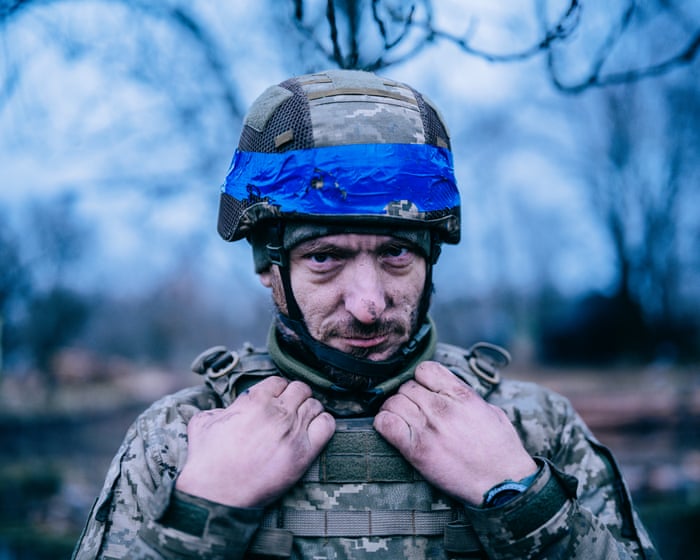
The faces of soldiers returning from the front are unmistakable: eyes wide, skin smudged with dirt. Rough strips of blue tape are wound around their helmets, marking them as Ukrainian to prevent friendly fire. For now, at least, they are safe.
Oleksandr, 37, is the most talkative of the group. He’s glad to be smoking what he calls proper cigarettes, complaining that the ones dropped in by drone were an inferior brand. What he’s looking forward to most, he says, is “a shower and rest—we’ll take as much rest as they give us.”
Solodenkyi’s call sign means…He is sweet, though his strong features at 42 suggest a more serious demeanor. He looks exhausted, but also relieved—enjoying his first moments of freedom from the front. Their walk to the early morning pickup point began at 10 p.m. the night before.
Infantry and drone crews have opposite tasks. A drone squad is constantly busy, either on reconnaissance or attack, searching for Russian infiltrators. They theoretically work in pairs, but sometimes stay on duty around the clock if their area is under threat.
The infantry’s job is simply to hold a position—to hide and avoid being spotted by drones. Over 38 days, Oleksandr says they had “no contact” with any Russians—a success not only in terms of survival, but in holding their point on the frontline, which stretches from the Kharkiv region in the north to the Dnipro River in the west.
The faces of soldiers returning from a position are unmistakable: eyes wide open, skin caked in dirt.
Next, a drone crew returns from a two-week stint. The receiving team was told one soldier was injured, and medics stood ready to take him to a nearby stabilization point for treatment.
But it turns out the soldier—call sign “Estonian,” age 34—is only lightly wounded. He limps out of the armored vehicle that brought them back at a reasonable speed, eager to get into a car with his buddies and recover at his own pace.
A Russian drone struck when Estonian was heading toward his position—“it was 700 meters away,” he says before moving on. Meanwhile, the waiting medics congratulate themselves on making someone better without having to do anything.
The drone crew, operators of Chinese-made Mavic quadcopters, is less keen to stop and linger—except for Jesus, 22, who stands to be photographed, taking deep drags from what seems like the best cigarette of his life.
There is little to no respite in the cramped bunker—they only venture out for drone-dropped food and supplies—and it’s critical they aren’t spotted, as they are high-value targets for the Russians. Now, he can finally feel the cool air and relax.
Was it busy? “There was enough work,” Jesus replies with a smile between drags, not offering many words. How does it feel to be back? “I feel amazing,” he says, full of life on the grayest of mornings. How long is your break? “Also two weeks.”
Frequently Asked Questions
Of course Here is a list of FAQs about the photo essay Back to the front Ukrainian soldiers return to the battlefield
General Beginner Questions
1 What is this photo essay about
Its a visual and written story documenting Ukrainian soldiers who were wounded in the war received medical treatment and rehabilitation and have made the difficult decision to return to the front lines to rejoin their units
2 Who created it
It was created by photographers and journalists typically from a major news organization like The Guardian who were granted access to soldiers and rehabilitation centers
3 Where can I see it
You can find it on the website of the news publication that produced it such as The Guardians website Searching the exact title Back to the front Ukrainian soldiers return to the battlefield a photo essay online should bring it up
4 Why is it called Back to the Front
Back to the Front is a phrase meaning to return to the battlefront or the most active area of conflict It highlights the central theme soldiers going back to the war after recovering from injuries
5 Is it just pictures or is there writing too
It is primarily a photo essay meaning powerful photographs are the main storytelling tool However it is almost always accompanied by captions short interviews and an introductory article that provides context and the soldiers stories in their own words
Deeper Questions About the Content Themes
6 What kind of injuries do the soldiers shown have
The essay typically shows soldiers with a range of serious injuries including lost limbs shrapnel wounds burns and traumatic brain injuries illustrating the brutal nature of modern warfare
7 Why would someone go back to fight after being so badly injured
The essay explores complex motivations a deep sense of duty and commitment to defending their country powerful bonds with their comrades still in the field and a feeling that their fight is not yet over For some its also about reclaiming a sense of purpose
8 What does the essay show about rehabilitation
It shows glimpses of the challenging physical and psychological rehabilitation processprosthetic fittings physiotherapy and psychological supportnecessary to make returning even a possibility