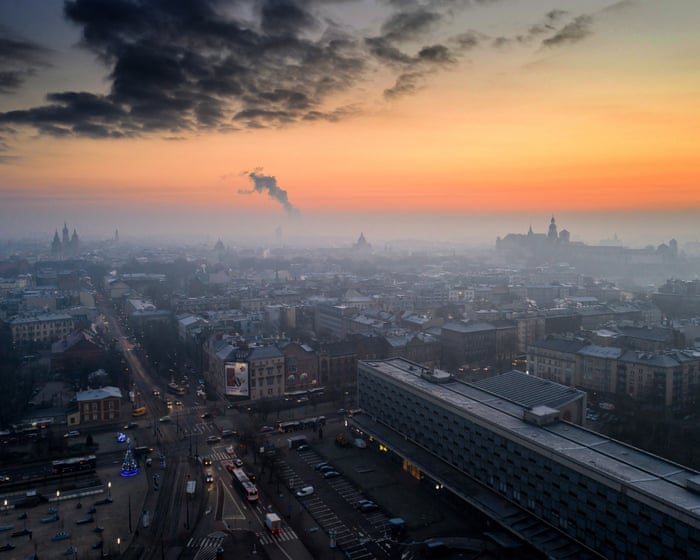
As a child, Marcel Mazur had to hold his breath in parts of Kraków thick with “so much smoke you could see and smell it.” Now, as an allergy specialist at Jagiellonian University Medical College who treats patients struggling to breathe, he understands all too well the damage those toxic gases do inside the human body.
“It’s not that we feel nothing can be done. But it’s difficult,” Mazur said.
Kraków, long known as the smog capital of Poland, shows that politicians have the power to save lives by cleaning the air. Since 2013, when the city announced it would ban coal and wood in home heating, a drop in soot levels has prevented nearly 6,000 premature deaths over a decade, according to an expert assessment shared exclusively with the Guardian.
Mazur’s own research has separately shown that in 2018 there were 17% fewer cases of asthma and 28% fewer cases of allergic rhinitis in children compared to 2008.
Anna Dworakowska, a co-founder and director of Polish Smog Alert, said: “It’s a huge improvement.” Polish Smog Alert is a network of campaign groups that started in Kraków and led a nationwide push to improve Poland’s air quality. “Little more than 10 years ago, we had about 150 days a year with dangerously high concentrations of particulates in Kraków. Now it’s down to 30,” she added.
Kraków’s ban on burning solid fuels took effect in 2019, by which time most of the tens of thousands of dirty stoves and boilers had been replaced. The local government subsidized the switch to cleaner heating systems, sometimes covering the full cost, and restricted which fuels could be burned in the years leading up to the ban.
According to the European Clean Air Centre, the reduction in soot—known as black carbon—saved 5,897 lives over a decade. Researchers used established methods to calculate the death toll and relied on a special station in Wrocław to estimate the proportion of black carbon in the fine particulate matter (PM2.5) measured in Kraków.
Łukasz Adamkiewicz, president of the European Clean Air Centre, said the progress resulted from a rare consensus across political lines. “Green, red, black, right, left, up, down—everyone said, ‘OK, this is a problem we need to tackle.'”
Black carbon is a superpollutant more potent than carbon dioxide, released during the incomplete burning of fossil fuels and biomass. At the UN climate summit in November, nine countries announced unprecedented plans to cut black carbon emissions as part of efforts to curb global warming and protect local populations from harmful air.
Rachel Huxley, head of mitigation at the health charity Wellcome, said: “It’s a big deal. If we take action to tackle superpollutants, we can have a huge impact on global warming and also on all of these premature health impacts.”
Latest data shows that early deaths from fine particulates in Poland fell by 18% between 2005 and 2022, and across the EU they dropped by 45%.
Kraków, the capital of the coal-rich Małopolska region, has seen perhaps the most dramatic improvement in air quality in Poland. According to Polish Smog Alert, 2024 was the first year since measurements began that the city recorded no breaches of daily limits for benzo(a)pyrene, another cancer-causing pollutant from burning wood and coal.
Pollution is expected to decline further with the introduction of a low-emissions zone at the start of the year, which restricts the types of vehicles allowed to drive in about 60% of the city.
Experts say more needs to be done.In late January, Kraków briefly ranked as the world’s most polluted major city, surpassing Lahore in Pakistan and Kolkata in India, according to an IQAir survey of 120 global cities. Smog drifts into Kraków from surrounding towns and villages, where coal and wood remain the primary sources of home heating—and the city has little control over policies in those areas.
Mazur, who also owns a house in the southern Polish town of Szczawnica, noted that progress elsewhere in Poland has been slower. Before replacing his coal boiler, he had to refuel it three times a day in winter and clear out ash just as often. Switching to a heat pump and a gas boiler has been, in his words, “incomparably more convenient and much more eco-friendly.”
“What happens in the towns and villages surrounding Kraków has a direct impact on the air quality in our city,” Mazur said.
The influence may also flow the other way. Kraków’s ban has inspired similar policies across Poland, where pressure from citizens and campaign groups has fueled political momentum to adopt anti-smog measures and restrict the most polluting fuels.
Experts believe Kraków’s success could serve as a model for polluted cities across Eastern Europe and beyond, where air pollution claims many lives but public discontent seldom escalates into protests or organized campaigns.
Huxley observed, “My experience working with cities is that you can’t succeed without public support. That support either drives change, or without it, you’re hamstrung.”
Frequently Asked Questions
Of course Here is a list of FAQs about how Polands smog capital saved lives by reducing soot pollution based on the welldocumented case of Kraków and surrounding regions
Beginner General Questions
1 What is Polands smog capital
This usually refers to Kraków a historic city in southern Poland For years it had some of the worst air quality in Europe especially during winter
2 What is soot pollution
Soot also called black carbon or PM25 is tiny black particles that come from burning things like coal wood and diesel fuel Its a major part of what makes up smog and is extremely harmful when inhaled
3 How did they save 6000 lives
By implementing strict antismog laws that banned burning coal and wood in home furnaces air quality dramatically improved Researchers estimate this reduction in soot pollution prevented approximately 6000 premature deaths over a decade in the region by reducing heart attacks strokes and lung diseases
4 What was the main cause of the smog in Poland
The primary cause was the widespread burning of lowquality coal and sometimes garbage in millions of old inefficient home furnaces for heating known as lowstack emissions
5 What specific action did they take
The key action was a regional ban on burning coal and wood in Kraków which came into full effect in 2019 It was the first major city in Poland to implement such a strict ban
Advanced Detailed Questions
6 Was it just Kraków or a wider effort
While Kraków was the pioneer and gets the most attention the ban was enacted by the Maopolska region Krakóws success created pressure and a model for other municipalities and regions to follow with their own cleanair resolutions
7 How did they enforce the ban and help people comply
Enforcement included inspections and fines Crucially it was paired with substantial subsidy programs to help residents cover the cost of switching to gas heating heat pumps or connecting to district heating networks
8 What has been the measurable result
Air quality monitoring shows a significant drop in concentrations of PM25 and PM10 so