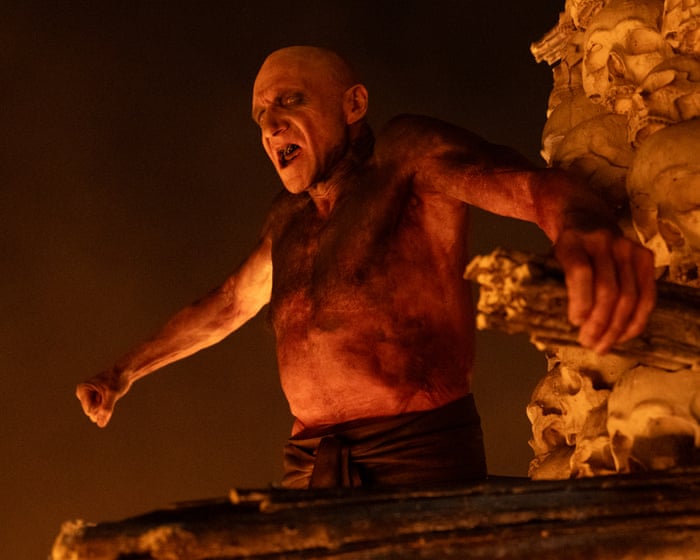
Laughter of surprise rippled through screen three at the Everyman in Muswell Hill, north London, as 28 Years Later: The Bone Temple reached its conclusion. Without spoiling too much for those who haven’t seen it, watching Ralph Fiennes dance semi-naked among piles of human bones to Iron Maiden’s “The Number of the Beast” is not how you’d expect one of our greatest actors to conduct himself on screen.
“Alex Garland chose that song,” says the film’s director, Nia DaCosta. “He wrote it into the script. And you can’t get better than that in a film about satanists.”
Indeed, you can’t. From the track’s spoken intro by actor Barry Clayton to Bruce Dickinson’s concluding lines, it’s a shade under five minutes dedicated entirely to the dark lord.
The song was the title track of Maiden’s 1982 album, their third and first with singer Bruce Dickinson, propelling them to new heights in the metal world. Released as a single, the track reached No. 3 in the UK in 1990, which remains the highest-ever UK chart position for a song about Satan.
It’s an unconventional track: Clive Burr’s drum patterns judder awkwardly, and, as Maiden often do, they incorporate multiple sections. “That makes it so fun,” DaCosta says, “and gives you so many options in terms of when and how to cut.” The scene aimed to contrast the world of the Jimmys—a Satanist gang—with that of Fiennes’s warm, humanist character. “We wanted it to feel as erratic and crazy as the Jimmys’ violent scenes, but also capture the romance of Ralph’s character’s world—which is why there is fire and warm tones. That song gave us a lot to work with.”
Iron Maiden seldom licenses their music for film and TV. “The biggest thing to consider,” says Dave Shack, one of the trio who run the band’s management team, Phantom Music Management, “is: are we going to be made fun of?” Given popular culture’s tendency to mock metalheads, that rules out many proposals from the start. He still regrets allowing a character in Hot Tub Time Machine to wear an Iron Maiden shirt throughout. “That was a litmus test of what happens if you grant the license and take the fee. We’re not bloody Spinal Tap or Steel Panther.”
Even with a great script, fantastic cast and crew, and an amazing director, things can go wrong, he says. “What happens on the day can completely kibosh it—we all accept that risk.” This time, however, everything went perfectly. After the BFI Imax screening, DaCosta approached Shack and asked if he was happy. “Am I happy? Are you kidding me? People stood up in the cinema and clapped for it!” The scene itself might be startling, but Maiden don’t come out of it looking silly at all.
It’s the second time in weeks that Maiden has been at the center of a pop-culture moment on screen. Their 1983 track “The Trooper” featured in the Stranger Things finale, and within seven days, its streaming numbers across all platforms rose by 252%.
It’s worth noting that both 28 Years Later: The Bone Temple and Stranger Things are big-budget, prestige productions that use music as an integral part of their plotting and character development. Maiden, a band that has long refused to do things “for the exposure,” has always maintained a strong sense of its own worth.”Historically, Maiden has usually said no because licensing often feels like an afterthought,” says Shack. “If you’re making a $10 million film, why not set aside a budget for the music? They’ll tell you a song is crucial for a scene, that it’s the only one the director wants. Well, then pay for it.”
DaCosta knew immediately that this scene would be powerful. Shot over three nights, her editor had a cut ready within days. “It was amazing. Right then, I thought, ‘We did it.’ I never expected people to cheer or dance in the aisles, but I felt its impact from that first edit. A needle drop has to be great—sometimes it’s used to mask a weak scene. But when it works, it’s incredible.”
This marks another showstopping, snake-hipped moment for Fiennes, following his dance to the Rolling Stones’ “Emotional Rescue” in Luca Guadagnino’s A Bigger Splash. It has also worked out well for Iron Maiden, if unintentionally. The band is currently on their 50th-anniversary world tour, while both Stranger Things and 28 Years Later were in motion long before. Shack acknowledges it was chance, but adds, “Maybe these moments felt like vindication. But the bigger picture is that you’re always seeking to connect with a new audience. Iron Maiden is no different.”
Frequently Asked Questions
Of course Here is a list of FAQs about the topic Unleash the beast How Iron Maiden and a nude Ralph Fiennes crafted the perfect cinematic needle drop
General Beginner Questions
Q What is this article or video about
A Its about a specific memorable moment in the 1999 film The Avengers where the song The Number of the Beast by Iron Maiden is perfectly synced to a scene of Ralph Fiennes character transforming
Q What is a needle drop in movies
A Its a filmmaking term for the precise moment a preexisting song starts playing in a scene to heighten the emotion humor or impact
Q Why is this particular needle drop considered perfect
A Because the aggressive theatrical energy of the Iron Maiden song perfectly matches the overthetop bizarre moment of Ralph Fiennes character John Steed unleashing his inner beast while standing nude in a fountain
Q Wait Ralph Fiennes is nude in this scene
A Yes His character John Steed is standing in a fountain and the transformation happens as the song kicks in making the juxtaposition of classical British imagery nudity and heavy metal both absurd and brilliant
Deeper Advanced Questions
Q What makes this needle drop different from just using a cool song
A Its the specific ironic contrast Using a legendary heavy metal anthem about Satanic panic in a famously stuffy failed British spy comedy creates a hilarious and unexpected layer of meaning that comments on the characters repressed nature
Q How does the scene use the song technically
A The scene famously uses the songs iconic introthe rain sounds bells and Bruce Dickinsons first screamto time the visual transformation exactly The music doesnt just play over the action it drives it
Q The Avengers was a critical and commercial flop Why do people remember this one moment
A Because its a rare example of a genuinely inspired creative choice within a messy film Its so audacious specific and tonally wild that it transcends the movies overall quality and becomes a standout piece of