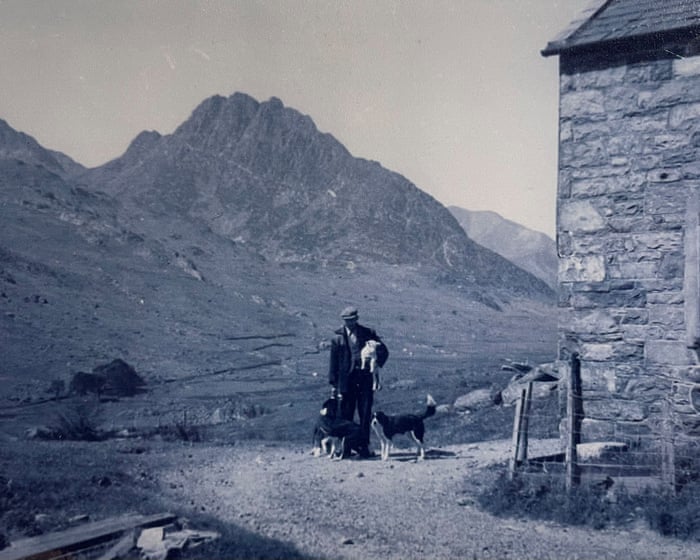
My maternal grandmother passed away twenty years ago. Her funeral took place in a small Methodist chapel nestled in the lush Conwy valley of north Wales. She had lived her entire life—nearly a century—in those hills. That morning, a light drizzle had left the trees glistening and turned the chapel’s slate roof a deep black. Our family gathered under umbrellas and entered in order of seniority: my mother, now the family elder, with my father on her arm, followed by my six aunts and uncles and their spouses, and finally the cousins, led by my brother Mark and me.
The chapel was austere—white walls, sturdy wooden furniture, a plain cross on the wall. We squeezed into box pews in the center. A few older men in the congregation reminded me of my grandfather, who had died decades earlier: the same thick black hair, dark weathered faces, expressions that seemed etched with history.
The service was conducted in Welsh, my grandmother’s first language and my mother’s as well. I didn’t understand a word. I stood when the congregation stood to sing and sat when they prayed, but my grief felt isolated, wrapped in English and the quiet sounds of sniffles and creaking pews. Near the end, a hymn began. I recognized the melody—Cwm Rhondda—so stirring and anthemic that Welsh rugby fans often sing it from the stands before big matches. With each verse, the lines repeated, climbing higher and splitting into harmonies—tenors rising over baritones, sopranos above altos—until the melody slowed dramatically at its peak, voices swelling with power before descending gracefully to the final chord.
I knew the tune well enough to hum along. The air in that small, intimate room seemed to tremble. I could hear my own voice woven into the chorus, yet still outside the language. In the hymn’s final soaring bars, I looked at my grandmother’s small coffin resting in the aisle, and a feeling—something between a thought and a sensation—washed over me: I am part of her language. I must not let it go.
I called her Nain—pronounced like “nine”—the Welsh word for grandma. I must have been one or two when I first said it. A little older, when I began to scribble my name on drawings and Christmas cards, I spelled it with a capital N, believing it was her given name. Taid, for grandad, sounds like “tide.” These were my first Welsh words, and for a long time, my only ones.
I didn’t need more. My grandparents spoke English, and I grew up in southern England, where almost no one knew Welsh. My mother was born in the late 1930s in Llanrwst, a pretty market town just two miles north of where Nain’s funeral was held. She left Wales in the 1960s, shortly after my brothers were born, moving first to Canada and then back to Britain after a brief marriage ended. Looking for work, she settled in Oxford, where she met my father, who came from an Irish Catholic family in northern England. They married, moved to a nearby village, and had me. When I was a baby, Mum sang Welsh lullabies—“Heno, heno, hen blant bach” (tonight, tonight, little children). Occasionally Welsh words slipped into our family slang—“I’m going to the cyfleusterau” (the bathroom)—but we always spoke English at home. My father, who knew Italian, French, Latin, Greek, and German, never picked up much Welsh.
I often heard English people dismiss Welsh as a jumble of consonants, a nuisance to tourists, a dying language. I took those remarks personally, feeling protective of my mother and my family—like a guard posted outside castle walls, loyal to the life within. Growing up in England with a southern accent, I felt different from my Welsh cousins, but I rarely stopped to wonder why I couldn’t speak their language.
The Welsh call their country Cymru, a word that comes from an early Brittonic term meaning “compatriots.” Welsh—Cymraeg to its speakers—belongs to the Celtic family of languages, related to Cornish and Breton. These were spoken across Britain and Brittany long before what we now call English arrived.In 1536, the Act of Union brought Wales under English law. Officials tried to limit the use of Welsh in legal and government matters, but people continued to speak it in their daily lives. A few decades later, new translations of the Bible helped standardize the language into its modern form.
The decline of Welsh began during the Industrial Revolution. English-speaking workers flooded into Welsh coalmines, while many Welsh-speaking families moved away seeking better opportunities. This era of new wealth and growing inequality sparked civil unrest. In 1847, a notorious government report on education in Wales blamed the Welsh language for what it called the “evil effects” of laziness, illiteracy, and violence. As a result, English was aggressively promoted in schools, setting Wales on a widespread path toward bilingualism.
When my grandmother, Nain, was a girl, children at her school caught speaking Welsh were forced to wear a wooden paddle around their necks, known as the “Welsh Not.” The last child wearing it at the end of the week was beaten. Welsh was portrayed as inferior and a barrier to success, while English became the language of modernity and opportunity, spread through laws, business, and quiet acceptance. By 1911, when Nain was two years old, only 43% of the population spoke Welsh. By my mother’s childhood in the late 1930s, that number had fallen to nearly 30%, and by the 1960s, when she left Wales, it was down to just a quarter. The Welsh that remained was mostly concentrated in the rural north.
This is where Nain and my grandfather, Taid, lived. When I was little, we would visit their cottage in the Conwy valley three or four times a year during school holidays. I remember endless hours in the car, navigating narrow Welsh roads that wound like loose shoelaces. Taid was a shepherd, and Nain was a mother with all the additional duties of a shepherd’s wife. England was less than 50 miles to the east, but they used English only when necessary or polite. My grandparents’ entire life together was conducted in Welsh: at the dinner table, on the radio, in the fields, for gossip, and for poetry. Welsh was the language of the chapel, where the Bible was Y Beibl.
Their home, called Siambr Wen (pronounced “shamber when,” meaning “white chamber”), felt timeless, like an illustration from a children’s book written before television and plastic toys. It had thick stone walls, dazzling whitewashed barns, and an orchard in the back garden. Every morning, Nain would take me with her to feed the chickens and collect eggs. I wasn’t much taller than the birds, and I remember liking it when the color of the feed bucket matched the blue of Nain’s work coat. At teatime, she served wafer-thin slices of fruitcake glazed with butter, called bara brith (pronounced “ba-ra breeth,” meaning “speckled bread”). I slept under thick Welsh blankets so heavy they pinned me to the bed.
Taid died shortly after I learned what to call him, too soon for me to form clear memories of how we spoke to each other. I have silent images of him: watching him asleep on the couch, curled on his side with sunlight outlining his body. After his death, Nain moved to the coast. In her kitchen, the radio was always tuned to Welsh-language stations for news and choral music. She always spoke to me in English, but if I behaved well, she’d call me hogyn da (pronounced “hog-in dah,” meaning “good boy”). Llyncu mul (pronounced “thl-unky mil,” meaning “swallow a mule”) if I sulked. If I made a mess, I was a mochyn (pronounced “moch-in”), which means “pig.” If she was surprised, she’d exclaim, Bobol bach! (pronounced “Bob-ol” then “bach,” like the composer)—a Welsh “oy vey” that literally translates to “little people.”
I understood diolch (pronounced “dee-olch”) for “thank you,” dim diolch for “no thanks,” and I gathered from birthday cards that cariad (pronounced “carry-ad”) meant “love.” Context gave me the feeling, if not the exact definition, of basic words. I couldn’t have told you how anything was spelled or whether I was hearing one word or ten. Instead, I heard my family’s phrases as little melodies and familiar refrains—big, round sounds.The vowels were drummed by rolled r’s and split syllables that spliced new beats into the middle of words. My aunts and uncles were bilingual, but they had never lived outside Wales, and they carried strong Welsh rhythms into their English. Only my mother’s accent was softened by faraway places, by a husband and three boys who did not sound like her.
Conversation at Nain’s house was filled with quiet pauses, marked by the steady tick of the grandfather clock in the living room. Love among the family was strong and unconditional, yet shaped by a deep emotional privacy that could seem like reserve to outsiders. Disagreements were rare, but without Welsh, my busy imagination filled the silences with drama. I’d wonder if a lull meant that “something had been said,” as the family euphemism went. “Is everything okay?” I’d ask my mother, only to learn I’d overheard a debate about where to take Nain for a day out.
In these gaps, the Welsh of my childhood became intertwined with the weather. I would sit at the window and watch snowflakes form intricate patterns against Nain’s lace curtains. I tried to name the feeling stirred by moments of delicate sunshine, a certain quality of light reflecting off the nearby sea. Something like melancholy. I came to associate Welsh with voices close to my ear, in small rooms warmed by gas fires. I rarely heard Welsh on TV or saw it in print; it was only ever alive in the room with me.
By 17 or 18, I visited Wales less often. Modern art was my new discovery. My compass turned toward London, where I believed that over a cappuccino at Bar Italia, or behind the sooty facade of what was then the Tate Gallery, I might find the life I wanted. I dreamed of making movies like the avant-garde films I’d read about but never seen, and of going to art school—not of learning Welsh. Llyncu mul, as Nain would say.
In my twenties, I worked as an art critic, in a world with its own minority language. Work took me to New York, where I lived among immigrants who spoke two or four languages, while I remained a monoglot. Americans, I noticed, liked to trace their ancestry. I would explain that my mother spoke Welsh and wish I had a phrase to share; no one I met in New York had ever heard it spoken.
After Nain died, the memory of her funeral would surface now and then, sparked by a bit of music or a passing remark. Over time, it distilled into an image of the coffin and a fragment of a hymn’s refrain, tugging at my conscience: I had a vague sense I was neglecting something. That “something” couldn’t be satisfied by bara brith or heavy Welsh blankets. It was inside the Welsh language itself. One day I’ll learn it, I told myself, and I’ll understand the message carried in that memory. I’ll start tomorrow, or maybe next week.
The pandemic arrived during my tenth year in New York, leaving me an ocean away from my parents. They were in their eighties, isolated in their Oxford village. On my last visit, only months before, I had watched my mother shuffle old photos from a wrinkled envelope, her fingers stiff with arthritis, and lay them out on the cheerful oilcloth covering the kitchen table. We often spoke through pictures. There she was at four, in a little pixie hat, sandwiched between bigger kids at Sunday school in Llanrwst. “My goodness, they were rough,” she said. Then in her late teens, in a trench coat with short, modern hair. In her early twenties, posed on the doorstep of the family farmhouse, now a mother.
There were things I knew about that house. It was called Tal-y-Braich Uchaf, perched on a remote ridge in the Eryri mountains, better known in English as Snowdonia. Tal-y-Braich means “high spur,” or “arm.” Uchaf means “upper.” Nine of them lived in three bedrooms. The house was lit by oil lamps. They kept food cold in the stream outside. Taid tended his sheep on the slopes, and sometimes the children would sum…They called him in for meals with blasts from a conch shell. To draw out more stories of Tal-y-Braich, we needed more slow afternoons at the kitchen table. Phone calls and emails felt too impersonal. Unable to travel, I wanted another kind of sympathetic magic to bridge the ocean between us. One afternoon during those early months of sourdough and dread, I sank into the couch and opened an email from Auntie Gwenda. She had sent the family a YouTube clip showing dozens of shaggy wild goats roaming the deserted streets of Llandudno on the north Wales coast. Freed by the lockdown, they had wandered into town, nibbling garden hedges and lounging in parking lots. Taid used to drive his sheep to Llandudno to graze on those headlands. I had run along the beach below as a boy. After closing the video, I opened another browser window. With a few swipes of my thumb, I downloaded Duolingo, selected “Welsh,” and started the first quiz.
The pleasure was immediate. Familiar sounds crystallized into verbs and nouns, as if some essential layer of Welsh was already inside me. How slow I had been—embarrassingly slow for a writer—to realize that my mother’s language was a portable inheritance. If I learned Welsh, I could take it anywhere: it weighed nothing, yet it held my family, and so much more, within it.
I walked around my apartment repeating fragments of tourist Welsh. “Dw i Dan” (“I am Dan”). “Dw i’n byw yn Efrog Newydd” (“I live in New York”). “Efrog Newydd”! It was a translation nobody needed, but what a beautiful sound. I thought of my mother. I remembered a story she told me about having to walk for miles along the empty roads between Tal-y-Braich and school. One day, she said, she decided to bring a pocket mirror and hold it in front of her as she walked so she could see the view backward. I asked why. For a change of perspective, she said.
There’s a Welsh saying I learned only recently: Cenedl heb iaith, cenedl heb galon. A nation without language is a nation without heart. For the older generations of my family, this was self-evident. When my mother left Wales in the 1960s, nationalist sentiment that had been building for decades took new shape. It fueled a direct-action movement to save the language, to which Welsh identity was deeply tied. Among its pioneers was Saunders Lewis, a founder of the nationalist party Plaid Cymru, which had been pushing for Welsh self-governance since the 1920s. In 1962, Lewis—then nearly 70—gave a landmark radio address titled Tynged yr Iaith (“The Fate of the Language”). He warned that without drastic action, Welsh would disappear by the 21st century, and he urged listeners “to make it impossible for the business of local and central government to continue without using Welsh.”
In his speech, Lewis condemned a plan to build a new reservoir in north Wales that would transfer water across the border to Liverpool. To construct it, the government intended to flood the Tryweryn valley, submerging the entire Welsh-speaking village of Capel Celyn. Even before Lewis’s address, the project—seen by many as a symbol of English indifference to Welsh culture—had sparked anger and protest. But in 1965, the plan went ahead. Cofiwch Dryweryn (“Remember Tryweryn”), graffiti on the wall of a ruined cottage, became the slogan for the deepening mood of Welsh nationalism. I passed the reservoir as a child and was haunted by the thought of houses and shops beneath the water, traces of life still inside: tins of food, toys, family photos.
Tryweryn stirred long-held grievances. By the mid-1960s, acts of resistance had spread across Wales in a campaign for official recognition of the language. People refused to pay parking tickets or taxes, and ignored court summonses if the paperwork was in English. Road signs were painted over or taken down, with demands for bilingual replacements. A new direct-action group, Cymdeithas yr Iaith GymraegThe Welsh Language Society, or Cymdeithas yr Iaith Gymraeg, organized sit-ins and roadblocks, inspired by the civil rights and peace movements. Hundreds risked arrest and trial, including my cousin Emrys, who was imprisoned alongside other student members. As the 1970s progressed, activism turned violent at its fringes, with secessionists resorting to bombs and setting fire to English-owned holiday homes.
These were bleak decades for Wales. Deindustrialization devastated the country in the 1980s as mines and steelworks closed, ruining communities. Even as a child, I felt the sadness. We would drive through towns my mother remembered as thriving, now lined with shuttered shops. “That was a hat shop,” she’d say, or “Over there we went for ice cream.” It seemed inevitable that the Welsh language would follow this decline. The 1981 census recorded Welsh speakers at 18.9%, but a decade later, the figure had only slightly dropped to 18.7%, stalling the steep decline of previous years.
Changes in law and policy made a difference. Legislation in the late 1980s and early 1990s paved the way for making Welsh compulsory in schools and required bilingual road signs and official documents. In 1999, the National Assembly for Wales, a bilingual body, was established in Cardiff. Now called Senedd Cymru, or the Welsh Parliament, it controls education, health, transport, and rural affairs.
A cultural shift also took place. Small Welsh literary presses flourished during the activist years of the 1970s and 80s. Young people drove a bilingual music scene, blending Welsh with punk and other subcultures. BBC Radio Cymru, an official Welsh radio station, began broadcasting in 1977, and after extensive campaigns—including a hijacked transmitter and a politician’s threat of a hunger strike—the TV station S4C launched in 1982. I remember my grandmother, Nain, enjoying the soap opera Pobol y Cwm (People of the Valley) on the channel.
In the 21st century, census figures for Welsh speakers have remained near 18%—538,000 people in 2021—but the Welsh government aims to increase that to 1 million by 2050. It’s an optimistic target, yet there are signs of hope. Today, S4C draws large audiences for sports and Welsh noir thrillers. When the Welsh football team qualified for the 2022 World Cup—their first appearance in 64 years—fans adopted a 1980s protest song about Welsh survival, Dafydd Iwan’s Yma o Hyd (“still here”), as their anthem. A 2025 report for the Welsh Language Commissioner found that while young people overwhelmingly preferred English for social media, they felt positive about Welsh and used both languages at school and sometimes at home. The government has pledged more support for Welsh-speaking communities. Still, for every upbeat show on BBC Radio Cymru about Wales’ music scene, there are gloomy debates about the country’s divided politics, with predictions drawn from rising home prices or lagging exam results foreseeing continued struggle for the language.
I grew up in the secure empire of English, but from a young age, I understood that for some in my family, it was a foreign power. My mother didn’t start learning English until she was ten. Just after I turned thirteen, my great-aunt Ceri, who had been a Plaid Cymru activist in her youth, took me to the National Eisteddfod, an annual festival of Welsh literature and music dating back to the Middle Ages and a pillar of cultural tradition. That summer, she had tickets to the Chairing of the Bard, a major ceremony where the Gorsedd (Throne)—a society of writers and musicians—selects the best poem written in the strict cynghanedd meter. I was excited to learn that the Gorsedd members, dressed in colored robes, were called Druids, but I wa…I was frustrated that I couldn’t understand the poems and songs. As we sat down, Great-Auntie Ceri whispered in my ear—only half-joking—not to breathe a word of English.
Welsh has a reputation for being difficult. A cartoon that sometimes circulates on social media shows a man returning a Welsh Scrabble set to a store, complaining that half the vowels are missing. There’s a YouTube clip of the standup comic Rhod Gilbert, an English-speaking Welshman, describing the fate of his classmates in a 30-person Welsh course: “One passed, three failed, and 26 dead.”
Thanks to my mum, I wasn’t afraid of consonant clusters in my first weeks on Duolingo. Here’s the thing: Welsh actually has more vowels than English. Its alphabet uses 29 letters but omits j, k, q, v, x, and z. Instead, it includes ch, dd, ff, ng, ll, ph, rh, and th, all treated as separate letters. Letters considered consonants in English often have vowel sounds in Welsh: W is frequently used for “oo,” and y can be “ee” or “uh.” Ch is like the “ch” in “loch,” and dd makes a firm “th” as in “these.” One of my favorite Welsh words is smwddio, where the w is “oo” and dd is “th,” making it sound like “smoothio.” It means “ironing.” The trickiest sound might be the double l. Place the tip of your tongue behind your top front teeth, hold it there, and breathe out. Let the air flow along the sides of your mouth, then drop your tongue to make a “luh” sound. It should feel loose and airy. If you can’t manage it, “thl” works just fine.
Grammar can be challenging. There’s no single word for “yes”—it changes with tense and context. A variety of mutations can turn m’s into f’s and c’s into g’s, or even the daunting ngh. I soon realized Duolingo didn’t cover any of this. Mutations and syntax were left unaddressed.
A year into the pandemic, I visited Oxford for the first time. The oilcloth-covered kitchen table remained the steady heart of our shaken world. One afternoon, I sat with Mum and talked. I noticed more grey in her hair, but like Taid’s, it had stayed thick and streaked with black in her old age. Our conversation meandered, and we often sat quietly, watching a neighbor’s cat prowl the garden through the window. I tried to show off some Welsh. “Dw i isio mynd am dro yn nes ymlaen,” I said. She frowned. I repeated the phrase with a doubtful upward inflection. “I want to go for a walk later.” The words were right, but my pronunciation was off. She asked to see Duolingo and quickly found errors. When she heard it “speak,” she gave me a withering look that needed no translation: delete.
I felt foolish for putting my faith in an app, as if I’d done something disrespectful. Her disdain reminded me that Welsh was ours. I just needed a new key to the door.
I returned to New York resolved to take my lessons seriously. But determination didn’t make the task any easier. Back in the mid-19th century, the city had a Welsh-language newspaper, Y Drych (The Mirror); in 2021, even in a city home to 800 languages, I struggled to find in-person Welsh classes. When I tried the Amikumu app, designed to locate nearby speakers of a given language, the closest Welsh speaker was in Philadelphia. I attended a meeting of the New York Welsh—a friendly group that meets regularly at a bar in Midtown—but everyone I met was an English speaker from south Wales.
Friends asked how my Welsh was coming along. “Slowly,” I’d say, meaning “badly.” When I told people about Welsh, they often asked about its utility, as if it were an exercise routine or a life hack. Did people speak it outside Wales? Was it useful? Yes. It gave me access to complex emotional pathways. Even saying a simple word like rwan (“roo-an,” now) conjured people and places. Mum, in the living room at home, signing off a phone call to Wales: “Ta-ta rwan” (“Bye now”). The novelist John le Carré once wrote that the decision to learn a language is “an act of friendship.” It was this feeling—not functionality—that I wMusic helped. While exploring the internet radio station NTS, I discovered the Casgliad Cymru (Welsh Collection) and immersed myself in a playlist from the post-punk label Ankst. I could catch the occasional word, but I was mostly happy to let Welsh flow over me, just as it had in childhood. I especially enjoyed Gruff Rhys’s gentle psychedelic sound. He grew up near my grandparents’ farmhouse and sang in a clear Welsh that reminded me of the friends and neighbors who would drop by to visit Nain.
Around that time, I came across an online trial Welsh lesson offered by SaySomethingin. The company’s mission—to “reverse the language shift in Wales through a completely original learning method”—had a certain nerdy appeal. Their approach promised to teach me a full sentence in just one week. The method was straightforward: the instructor gives a phrase in English, and the student repeats it in Welsh; then the teacher adds a few words, and the student follows along. A busy online forum made it easy to ask questions and gave the impression that the system was run by Welsh teachers, not tech entrepreneurs. I can still remember the sentence from that first week: “Dwi isio dysgu siarad Cymraeg achos dwi’n caru Cymru a dwi isio yr iaith Gymraeg barhau” (“I want to learn to speak Welsh because I love Wales and I want the Welsh language to continue”). The word barhau, a mutation of parhau, means “to continue”—it can also mean to persist, endure, or survive.
For the first 25 lessons, I didn’t learn a single number or how to ask for directions to the train station. Instead, I was drilled in meta-statements about learning Welsh, like “I want to speak Welsh with you” and “I still need to practice more.” The system didn’t explain the rules of mutations; it encouraged internalizing them through repetition. As new vocabulary quickly stuck, the sentences grew into mind-bending chains of social connections: “I met someone in the pub last night who told me that she wants to speak Welsh with you,” or “I met an old woman in the pub last night who told me that she knows a young man who works with your sister.”
This felt real. It was how I had first heard Welsh: through gossip at Auntie Gwenda’s house and news in Nain’s kitchen. At home, I exaggerated the north Wales cadences, enjoying how the accent rolled off my tongue. I sounded like my family. I started writing emails that began with “Annwyl Mam” (“Dear Mum”). I said “Penblwydd hapus” on birthdays and “Nadolig llawen a blwyddyn newydd dda” at Christmas and New Year’s. When Mum and I were on the phone, we’d play a kind of verbal tennis with a single phrase.
“Hee-wol varr,” I’d say, mangling hwyl fawr, an informal goodbye.
“No, it’s hoo-il vawrr.”
“Hool.”
“Hoo-il.”
“Whill?”
“Hoo-il.”
Our rally would always collapse into laughter.
As the eldest, Mum had helped her brothers and sisters learn to read and write, and my Uncle Dewi, who was born with a cleft palate, learn to speak. They addressed her using the formal chi for “you,” not the informal ti, as if she were a parent. In a way, my exchanges in Welsh with Mum were a repetition of family history. But they were also unique to our relationship. She never went to university, but she bought books and records for my hungry teenage mind. She took me to art exhibitions and movies and wanted to talk afterward about what we had felt. Learning her language became another gentle process of discovery.
I wish I could say I’ve sailed into fluency and that Mum and I now recite cynghanedd poems to each other on FaceTime. The truth is more complicated. I’m not a consistent Welsh student. Some weeks, I dutifully complete my exercises and listen to BBC Radio Cymru while I do the ironing. Then I let a month slip by and have to scramble to catch up. Earworms from the online courses loop through sleepless nights: Dw i ddim yn deall (“doo-ee thim un darcht,” I don’t understand).
There’s a paradox to my efforts.I am learning Welsh to speak with my family and keep the language alive, close to me as it was in my childhood. Yet I often shy away from speaking it. Around my aunties and uncles, even with my mum, the words catch in my throat. I grow hesitant and unsure, retreating into English. I’m so accustomed to listening from the outside that it feels difficult to step into their conversations. The sentence I’ve practiced again and again alone goes unspoken: I want to speak Welsh with you.
My parents recently moved to Chester, near the Welsh border. My brother Mark lives there too. When my wife and I visit, we all pile into Mark’s car and drive into north Wales. Last time, we wound up into Eryri, through landscapes of granite, heather, and grass. The peaks are often hidden in mist, but that day was clear—sunlight drawing soft yellows and browns from the stone. Mum brought the lonely farmsteads to life. “That was Mr Evans’s place,” she said, pointing to a distant house the rest of us could barely see. “He’d lay planks on his truck and drive us to chapel. And I worked in that little coffee hut over there—my job was to fire the flare gun if there was an accident and mountain rescue was needed.”
On these drives we pass Llyn Ogwen, the slender lake at the valley entrance near Tal-y-Braich, and remark how cold the water looks. We talk about how hard it must have been for Taid to work in the harsh mountain weather. Mum shares new fragments of her childhood, and I try to hold onto them. Who will remember these stories when she and my aunties and uncles are gone?
Today, Tal-y-Braich is a holiday cottage run by the National Trust, with a wood burner, washer-dryer, and TV. You can rent it for about £500 for three nights. There’s a Welsh word, hiraeth (“hee-rayeth”), that means something like “a longing for a place that may no longer exist.” It’s a cliché in Wales, but it resonates. The feeling from Nain’s funeral stays with me—the language like a talisman I carry unseen in New York, and wherever I go next.
Mum is a Nain herself now. My niece and nephew live nearby and both speak Welsh. On my last visit, they joined us in the kitchen. My nephew wore a T-shirt with a picture of Tryfan, the mountain opposite Tal-y-Braich. He told us about his girlfriend, who would be singing at the National Eisteddfod the following weekend. I listened as Mum and her grandson moved easily between Welsh and English—sometimes too quickly for me to follow. Mum speaks faster in her first language. “Fedri di ddweud o eto dipyn bach yn arafach?” (“Can you say it again a little slower?”) Sometimes I sense her puzzlement that I don’t understand more. Yet together we are shaping our own version of “learning Welsh”: we page through her Welsh novels from the 1950s, with their worn covers and elegant woodcut designs, or the Sunday school newsletter that once printed her photo. From these, Mum draws out a family story or a scene from mid-century Wales. I ask for the Welsh words for this or that. Our lesson is made of texture, image, and music.
When I last flew back to New York, we said goodbye at the airport. Mum held my hands and said something I couldn’t fully catch—it was long, I was crying, I only grasped fragments. But it didn’t matter. We were speaking Welsh.
Frequently Asked Questions
Of course Here is a list of FAQs about the limitations of Duolingo for learning a language like Welsh based on the perspective of learning through conversation with a family member
BeginnerLevel Questions
Q Whats the main point of Where Duolingo falls short
A It argues that while apps like Duolingo are great for vocabulary and grammar basics they cant teach you the natural flow pronunciation and personal connection you get from speaking with a native speakerlike a parent
Q Cant I just become fluent by finishing the Duolingo Welsh course
A Probably not Finishing a Duolingo course gives you a strong foundation but fluency requires practicing spontaneous conversation understanding accents and using cultural phrases that apps often miss
Q What could I learn from my mother that Duolingo cant teach
A Youd learn the natural rhythm of speech local idioms and slang familyspecific words the correct emotional tone and stories that connect the language to your own history
Q Is Duolingo useless for learning Welsh then
A Not at all Its an excellent starting tool for learning words basic sentences and grammar rules The point is to use it as a supplement to real conversation not a replacement
Q How do I start speaking with a family member if Im shy or a beginner
A Start super small Label household objects together ask how to say simple phrases you need daily or use Duolingo lessons as a prompt to ask How would you really say this
Advanced Practical Questions
Q What specific skills does Duolingo lack for a living language like Welsh
A It often falls short on listening comprehension of fast casual speech producing spontaneous answers understanding regional dialects and using language for storytelling and humor
Q How does learning with a parent help with pronunciation better than an app
A A person can give you immediate nuanced feedback They can see how your mouth moves correct subtle sounds and model the melody of the language in a way a static app voice cannot
Q What are common Duolingo phrases that sound unnatural in real Welsh conversation
A Duolingo might teach you perfectly grammatical but bookish sentences