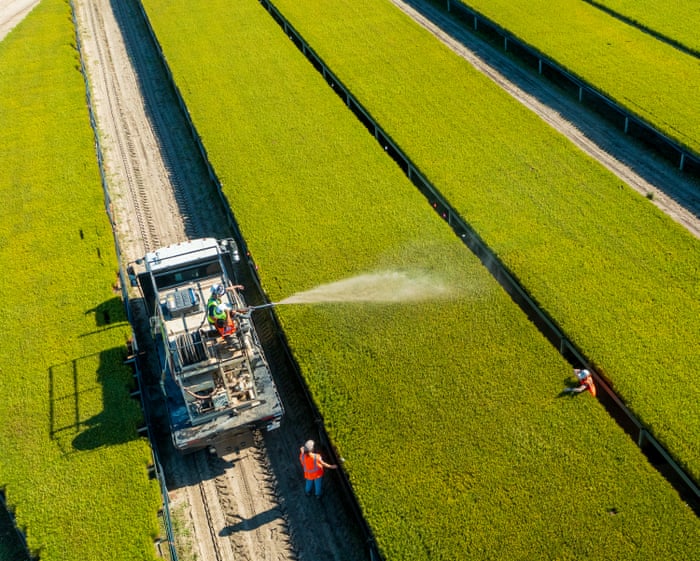
At a commercial tree nursery near Evans in western Louisiana, five million pine seedlings are arranged on twelve vast circular irrigation tables, each as wide as a football field. Last September, many of these young trees were sprayed with what looked like muddy water.
The liquid was actually an extract containing hundreds of species of wild soil fungi. Brad Ouseman, the nursery manager, is confident this fungal treatment will improve yields and reduce the need for artificial fertilizers.
“By the time January arrives, you’ll see the difference between that seedling and this one,” Ouseman says, pointing to separate rows of sprayed and unsprayed pines.
Colin Averill, founder of the startup Funga, which supplied the spray, compares the treatment to a fecal microbiome transplant for young pine trees. Just as doctors now successfully treat certain gut conditions by transferring healthy microbes from donors to patients, Funga treats young pines with wild microbes taken from the soils of thriving pine forests.
“We’re not trying to isolate individual parts of the soil community; we’re taking the whole thing,” Averill explains. “As a result, we get all the complexity and all the interactions that come with it.”
The goal is to produce trees that grow faster, absorb more carbon dioxide, and rely less on artificial fertilizers.
The Evans nursery supplies the extensive network of intensively managed pine plantations that span more than 12 million hectares (30 million acres) across 13 southern U.S. states—an area known as “the woodbasket of the world.”
The fast-growing loblolly pines raised at Evans, a species native to the southeastern U.S., depend entirely on underground fungal partners. Ectomycorrhizal (ECM) fungi weave into pine roots to form what Kabir Peay, a Stanford fungal ecologist, calls a “hybrid organ”—part plant, part fungus—that acts like a trading floor for nutrients essential to growth.
These fungal networks extend into the surrounding soil, gathering nitrogen, phosphorus, and other nutrients, which they then supply to the tree in exchange for energy-rich sugars. Peay notes that pines and ECM fungi depend on each other: “We really don’t find one without the other.”
Peay’s research suggests that soil fungal biodiversity is crucial for healthy trees and forests. A single tree may associate with hundreds of fungal species, each accessing different nutrients under different conditions. In a 2018 study, he showed that even a two-month delay in seedlings acquiring the right fungi can significantly stunt their growth.
Across the southern pine belt, every clear-cut timber harvest severely depletes the fungal communities that young trees need most. As a result, Funga argues, growth is often suboptimal and dependent on artificial fertilizers.
Funga’s own genomic surveys indicate that about 75% of ECM fungal diversity disappears after logging—a figure consistent with studies from Scandinavian and Canadian pine forests. The company says recovery takes about 30 years, but trees are harvested on 15- to 25-year cycles, meaning some pines may never experience fully mature ECM networks.
Rachel Cook, a forestry professor at North Carolina State University, cautions that the timeline for ECM fungus recovery remains an unresolved scientific question. She agrees that major disruption occurs but suspects warmer southern soils allow for faster recovery than Funga’s estimate suggests.
Even so, Funga maintains that trees benefit from being exposed to the most productive ECM fungi from the very beginning of their lives.To achieve this, the team surveys forest soils across the southeast. When they find thriving fungal communities, they use them as inoculants in small trials. The most promising communities are then cultured using natural organic matter as a substrate—essentially creating compost heaps within the forest—before extracts are applied on a larger scale at industrial nurseries.
Founded in 2022, the company inoculated about 500 acres in its first year. By 2025, that had scaled to roughly 25,000 acres. Averill estimates that his startup treated one in every 40 loblolly pines planted in the southeastern pine belt last year.
Early results are encouraging. “We’ve seen growth increases of over 100% in some locations,” he says. “Overall, we target a 30% average growth boost. We believe we’re close to achieving that.”
Cook, who also co-directs the Forest Productivity Cooperative, an international academic-industry forestry research group, notes that a 30% increase from fertilization is “fairly typical.” This means Funga’s biological treatment may be nearing the gains currently achieved with expensive chemical inputs, which is exactly the company’s goal.
“I really think this could be a major next step in managing southeastern forests,” Cook says. “I’m optimistic, but cautiously so, because we need more data.”
Loblolly pine seedlings after inoculation at a commercial nursery. Each small tree must quickly form partnerships with soil fungi—without them, pines struggle to access the nutrients needed to establish and grow.
Many soils under southern pine plantations lack key nutrients, partly due to decades of intensive tobacco and cotton farming before commercial forestry took over in the 1930s. Although these soils are slowly recovering under nearly a century of continuous forest cover, nutrient deficiencies remain.
While the orderly rows of pines across the southeast may resemble agriculture, Cook says the comparison is misleading. Pine stands are fertilized at most three times over 25 years, with soil disturbance only at harvest. “Our ‘intensive’ management is minimal compared to agriculture,” she explains.
But Averill hopes fungal inoculation could eventually replace chemical fertilization altogether—offering a low-cost, self-sustaining alternative to fossil fuel-dependent inputs, whose prices have surged in recent years.
Previously in academia, Averill’s research showed that the composition of soil fungal communities predicts forest growth and carbon sequestration as strongly as rainfall—a finding with significant implications.
He founded Funga in 2022, betting that emerging environmental markets, including carbon markets, could serve as a new “financial engine” to turn promising research into practical solutions for the climate and biodiversity crises. Last year, Funga signed its first major commercial contract: an 11-year, multimillion-dollar carbon removal deal with Netflix.
Carbon markets face serious challenges. A comprehensive 2025 review concluded that most offset schemes have been plagued by persistent problems and have failed to deliver real emissions reductions, though it noted that high-quality projects do exist. Common flaws include non-additionality—crediting projects that would have happened anyway—and impermanence, where carbon stored in trees is later released by fire or the breakdown of short-lived forest products like cardboard.
Averill acknowledges these issues. “Greenwashing is absolutely real,” he says. But he argues that Funga’s model directly addresses these weaknesses. Credits are based solely on the additional growth of trees compared to matched, untreated control plots. And by contractually requiring landowners to grow trees to saw-log size before harvest, Funga’s projects steer timber toward lumber production.In forestry and construction, carbon is stored in relatively durable forms, as opposed to being used for pulp or biomass.
A tractor sprays a fungal inoculant onto pine seedlings on the extensive irrigation tables of a commercial pine nursery. This liquid extract, rich with hundreds of species of wild soil fungi, is applied to millions of seedlings before they are planted across pine plantations in the southern United States.
Since Funga’s treatments are funded by carbon revenue, landowners can participate at no cost. However, for land managers working with limited budgets, fungal inoculation will ultimately need to demonstrate its value compared to fertilizers and other methods.
Funga’s ambitions reach far beyond southern pine. “Our next major target is Douglas fir in the Pacific Northwest,” says Averill, who is also involved in field trials in Wales, inoculating both broadleaf trees and Sitka spruce.
Regardless of whether fungal inoculants transform southern pine forestry, Peay believes the greater endeavor—understanding the ecology of organisms that science has only just begun to catalog—is the true goal. If Funga can identify optimal fungal communities and effectively transfer them to receptive young trees, he says, “that would be a really big breakthrough.”
Frequently Asked Questions
FAQs Hybrid Organs in Forest Management
Beginner Questions
What is a hybrid organ in this context
Its not a single new organism but a powerful natural partnership It refers to intentionally combining specific trees with beneficial fungi to create a supercharged root system that helps both thrive
How do trees and fungi work together
The fungi form a vast weblike network that connects to tree roots The fungi absorb water and nutrients from the soil and trade them to the tree for sugars the tree makes through photosynthesis Its a mutual trade agreement
Whats the main goal of creating these partnerships
To grow healthier more resilient forests faster This can help with reforestation restoring damaged lands and creating forests better able to withstand drought disease and climate change
Is this genetic modification or something artificial
No its not GMO Were simply facilitating a partnership that occurs naturally in forests The innovation is in selecting and applying the best fungal partners for specific goals like using a precise probiotic for the soil
Benefits Applications
What are the biggest benefits for the forest
Faster Growth Seedlings establish and grow quicker with a readymade nutrient network
Drought Resistance The fungal network vastly increases water uptake
Disease Suppression Healthy fungi can outcompete or block harmful pathogens
Improved Soil Health Fungi help build stable soil structure and cycle nutrients
Can this help fight climate change
Yes significantly Healthier trees grow faster and sequester more carbon The fungal network itself also stores carbon in the soil in a stable form making forests more effective carbon sinks
Is this only for new forests or can it help existing ones
Its most effective when applied at the seedling or sapling stage However fungal inoculants can sometimes be introduced to the root zones of stressed or valuable mature trees to boost their health
Are there economic benefits for forestry
Absolutely It can lead to higher survival rates for planted trees reduced need for fertilizers and pesticides and potentially shorter harvest rotations for timber all while improving ecosystem health
Common Concerns Challenges
Does this interfere with natural processes
The goal is to accelerate and guide a