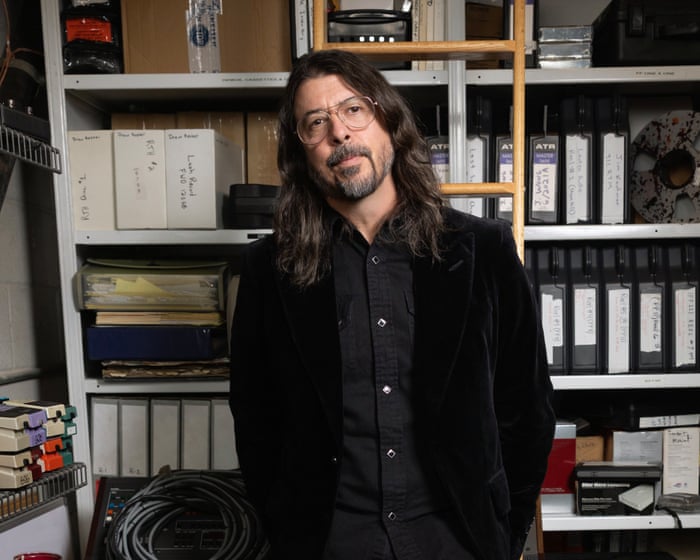
“I’m just going to recline.” Surveying the seating options in a luxury London hotel suite, Dave Grohl chooses the sofa. He leans back, swings his legs up until his black leather boots rest on the upholstery, and folds his hands across his stomach. Beyond the punk-rock disregard for shoe etiquette, it’s the classic pose of someone in analysis. “I’ve been in therapy six days a week for 70 weeks,” he says. “I did the math the other day: over 430 sessions.”
Even by U.S. standards, that’s a lot—but if anyone needed to figure out who they are and why they do what they do, it was Grohl. Nirvana ended traumatically after Kurt Cobain’s death in 1994, but drummer Grohl quickly formed a new band, Foo Fighters, stepping into the role of frontman and turning them into the defining stadium rockers of the new century with hits like “Everlong,” “Best of You,” and “The Pretender.” Grohl was often called “the nicest man in rock,” a label his team says he dislikes, but he was certainly friendly and seemed to be settling into middle age with side projects—documentary series, a memoir, a horror-comedy film—between world tours and moderately successful Foo Fighters albums. He had married his second wife, Jordyn Blum, in 2003, and they had three daughters together. Bassist Nate Mendel recalls: “When we were first rehearsing in the mid-’90s, Dave said, ‘I just want this band to be low-drama and fun.'”
But in March 2022, Foo Fighters drummer Taylor Hawkins died in a Bogotá hotel room, with drugs in his system. Grohl’s mother, Virginia—”my best friend, my hero, my entire world,” he says—died four months later. That grief fueled Grohl’s most heartfelt songwriting in years on the 2023 album But Here We Are. Then, in September 2024, he made a confession that seriously tarnished his nice-guy image: “I’ve recently become the father of a new baby daughter, born outside my marriage,” he posted online. “I plan to be a loving and supportive parent to her. I love my wife and my children, and I am doing everything I can to regain their trust and earn their forgiveness.” Shortly after, Josh Freese, who had taken over as drummer, was fired after a single tour; Freese said he wasn’t given a reason and was “shocked and disappointed.”
Musically, Grohl has responded to all this upheaval by returning to his roots. His first public performance since the infidelity scandal was on drums for a benefit gig with a reformed Nirvana, featuring artists like Kim Gordon and Grohl’s eldest daughter, Violet, 19, on lead vocals. Now, Foo Fighters are reaching even further back, to the hardcore punk bands like Scream that Grohl started with in the 1980s. Unlike recent Foo Fighters albums, recorded in flashy studios with A-list producer Greg Kurstin, their upcoming 12th album, Your Favorite Toy, was made quickly at Grohl’s small home studio without a producer. It’s often fast, loud, and angry.
“The last few records are a lot more produced, a lot more polished,” says lead guitarist Chris Shiflett, who, along with the bespectacled, bookish Mendel, sat on the same sofa during a separate interview. “This one wasn’t at all. It was great—we used whatever amps were on hand, whatever pedals, and didn’t get stuck overthinking options.”
Mendel agrees. “Honestly, the last few years have been a difficult period for us,” he adds, “getting punched in the face a couple of times. So there’s this rough, defiant energy on the new album that, to me, sounds like our band.”
It started with Grohl writing alone, drawing from all sorts of styles and influences, from Massive Attack and Pink Floyd to Bad Brains and the Knack.He describes it as “an eight-minute Led Zeppelin opus.” “The ‘aha!’ moment came when I was up one night listening to all 30 or 40 of the ideas,” he says. “I hit this spot in the sequence that was eight or nine of the up-tempo bangers all in a row. I thought, ‘OK, this is the record.'”
Foo Fighters seem to operate less like a democracy and more like Dave Grohl’s benevolent dictatorship. Bassist Nate Mendel and guitarist Chris Shiflett each make their own music outside the band and are content with this arrangement. “It produces great songs,” says Mendel. “Then I’ll go and make a weird-ass record that no one listens to, and I’m satisfied.” However, Mendel notes that Grohl has “some passive-aggressive ways of communicating things.” For instance, when Grohl was unhappy with original drummer William Goldsmith’s work on the 1997 album The Colour and the Shape, he re-recorded the drums himself without telling Goldsmith, who subsequently quit.
“I didn’t like that,” says rhythm guitarist Pat Smear, who I later speak to by phone; he missed the London trip after breaking his leg while gardening. “Dave was just learning to be a bandleader; we could have handled the whole thing better. It left a bad taste.”
In 2002, Grohl temporarily left to drum for Queens of the Stone Age. Upon returning to Foo Fighters, he expressed dissatisfaction with the band’s direction. They had “a big blow out,” says Mendel, patched things up, and made the double-Grammy-winning album One by One. “After that, I think he got a little bit more comfortable with being assertive.”
“I’m not the greatest communicator,” Grohl admits. “I might be able to hold a conversation but maybe not often able to say the thing that I really want to say. It’s easier in song.” He says therapy has helped him learn to be more communicative, “not only with others, but with myself.”
But even now, says Shiflett, “you have to spend enough time around him to read between the lines.”
“He sends smoke signals, not memos,” says Mendel.
“Exactly,” Shiflett continues. “If you’ve pushed him to the point he gets mad about something, you’ve pushed him too far.” When asked for an example of when he’s pissed Grohl off, Shiflett replies, “How much time you got? Let’s not get into all that! But the classic Dave line, where you have to know him to understand what he means, is: ‘That could be cool?’ That means: no, we’re never doing that.”
All the band members agree that the group is better off with new drummer Ilan Rubin, who won the spot through auditions. “He has a real deep knowledge of classic rock, but he plays like a hardcore drummer,” Grohl says.
“As soon as we got Ilan, I was looking at Dave and thinking: wow, this is the first time I’ve seen him genuinely happy in a year,” Smear says.
I was told before the interview that Grohl wouldn’t discuss the firing of Rubin’s predecessor, Josh Freese, so I ask his bandmates: is it true that Freese wasn’t given a reason? “Yeah,” says Mendel. “We made a decision that it was best for all parties. To get into the personal details [with Freese] of why that didn’t necessarily sync up just didn’t seem like it was going to benefit anybody. Some things are OK to be like: this is what’s best for us, and we’re going in a different direction.”
Mendel does at least credit Freese with “coming into a situation and doing exactly what needs to be done musically to make it work”—helping the band get back on the road after the devastating loss of Taylor Hawkins.
In the months after Hawkins’ death, the band “would get together almost every week,” says Mendel, “with the Hawkins family, people who work with us, and just have meals and drink and talk and laugh and cry, together.” When rehearsing for the tribute concerts to Hawkins in autumn 2022, Shiflett says he “would find myself getting l…””Most of the songs I’d played thousands of times.” A little fill or note that Hawkins would usually add “would not be there, and I’d be adrift.”
Foo Fighters recorded But Here We Are before they hired Josh Freese: Dave Grohl did all the drumming. He did almost no interviews around that album because he was grieving so deeply. Initially, the band tried playing along with drums Grohl had separately recorded, “just speakers with drums coming out of them,” he says now. “And it was almost more traumatic. Like a ghost. Nothing felt natural. There was just this void that we couldn’t fill. But we tried.”
“It was weird Taylor wasn’t there; super weird that he was there,” guitarist Pat Smear says of those sessions, noting Hawkins was “manifested in his absence.” Smear missed “the dynamic that he and Dave had together, when you can be sweeter and shittier to your best friend than you can be to your regular friends. And the push-pull over drum parts.”
Bassist Nate Mendel says Hawkins is “part of the band still… and he made an imprint early on that still sticks with how we are as a band. A conversation that went something like: hey, what if we don’t suck any more?”
Guitarist Chris Shiflett explains: “It was his idea: ‘We have to be a tight unit so Dave can be the guy out front, and we’re the ones holding it down.’ Taylor made Dave feel OK about being a frontman leading the show. Even when I joined the band [in 1999], there was still that residue of ’90s indie-rock guilt about success. Like when we did our first arena tour: should we be doing this? Taylor was like: ‘Fuck yeah we should! We need bigger lights. We’re playing London? Let’s get Brian May to play a song with us. Let’s embrace that classic rock thing.'”
After Hawkins’ death, Grohl says he was visited by his friend and bandmate. “I have had these dreams that seem like visitations,” he says. “Whether it’s from my mother, or my old friend Jimmy, or Kurt, or my father. And in the dreams, I know that I’m dreaming, but those people are here. And it’s as if they’ve never left.”
On this occasion, “I fell asleep on a couch, like this one, in front of a television. I thought that I’d woken up, and he was sitting right next to me.” Grohl’s eyes fill with tears and his voice turns ragged. “It was so fucking real. He was happy. His hair looked great; he was tan. The first thing I said was: oh my God, we miss you so much. He smiled. I said, where are you? And he smiled again and said: ‘Dude—’ And I woke up. I was like: fuck, I almost had it!”
For Grohl, the death of Hawkins and then his mother “was almost too much to feel. And so I did what I’ve always done, which was to just keep my boots on the ground and keep going. From the loss of Kurt to the loss of Taylor, I was afraid to sit and actually let those things into my heart.” His mother’s death was different: “I was with her every day leading up to when she passed. I was with her when she passed. And she never lost her spirit, her light.” His voice is now deep and grave. “But… her body was… going. And so that… I let into my heart. Rather than just kind of keeping it up in my head and continuing on.”
This moment, along with the hundreds of hours of therapy, gave Grohl a new existential perspective. He characterizes himself as someone who was once “pulled in different directions emotionally without having this anchor, this centered feeling.”
Without understanding it, that feeling had made itself known in another of his dreams, this one recurring for 20 years. “I walked into a house, set on a hill in the countryside. There was this door that would lead to an entirely different house: modern, very white, completely different than the other side which is very warm and woodsy. In every dream there was someone with me and I’d say, Oh my God, you have to check this out. I would open this little…”door and bring someone into this other space.” Since starting therapy and realizing “there was this disconnection or division within myself, I don’t have that dream anymore. A lot of the new album deals with exactly that.”
I calculate that his 70 weeks of therapy must have begun soon after he admitted to infidelity. Was that what prompted him to go? He dismisses the question: “There were so many things that led me to therapy.” Later, when I press him further about the scandal, he cuts me off. “I have to be perfectly honest. Writing songs and lyrics about these things is sometimes enough. As for having a deeper, longer conversation about them, I still keep a lot of that for my personal life, no matter how public it may seem. But for many reasons, I ended up in a place where I needed to stop, sit with myself, and re-evaluate. It’s an ongoing process.”
How did it feel to publicly admit the affair on social media? “I had to turn everything off, including my concern for what other people think. Being able to shut that part of yourself off can be a very healthy exercise in focusing on your immediate life. Not letting it consume you to the point of destruction.”
There have been other realizations. “There were years when I was overly ambitious—doing an HBO documentary series, writing a book, whatever. Growing up in suburban Virginia with a public-school teacher as a mother, you took every opportunity. But over time, you spread yourself too thin. Looking back, I think, what was I trying to prove? There’s such a thing as addiction to achievement, and it’s dangerous. You set a goal, pour everything into it, and the world disappears. Then you cross that finish line, feel good for about 24 hours, and that feeling vanishes. There’s that hole again, that emptiness, and you think, I need to fill it with something else.”
Is that how he ended up cheating on his wife? Grohl laughs grimly. “No. I think that’s how I ended up overextending myself and getting lost. I wasn’t sitting with myself and really letting feelings move from my head to my heart. I reached a point where I needed to stop, turn everything off, and find my heart.”
Mendel says he has noticed a change in Grohl since the infidelity revelation. “He’s putting the band’s aspirations in a different place, ambition-wise. Other things have more prominence now: life outside of music.”
When the news broke, the band paused and canceled a tour. Did they worry Foo Fighters could be seriously damaged? “Of course,” says Mendel. “But it was tempered by the fact that it was the third time in five years we’d had an entire tour booked and it went away”—after the pandemic and Hawkins’ death—”so as crazy as it was, it was kind of: we’ll figure it out.”
“We just all wanted to run and give him a big hug,” Smear says, “and let him know, both of them”—including Grohl’s wife—”that we are here.”
“When Dave called me that morning,” Shiflett says, “I just thought: take all the time you need. And then my house burned down a few months later,” in the Los Angeles wildfires. “So having an extensive break wound up being necessary for me.”
Meanwhile, Grohl spent time at home. One song from the new album, “Window,” came from bonding with Harper, the second of his now four daughters. “Her two heroes are KimGordon and Kim Deal,” Grohl says. “She’s a bass player. So I wrote this song that felt almost like a Breeders song from their debut album Pod, and I asked her if she wanted to record something together.” Grohl sings the line: “You were a window cleaner, letting in the sun.” He explains that this was actually inspired by a window cleaner working 30 stories up on a tower block, “seeing the lives of others while never being noticed by the person inside the room… they’re helping brighten your life, your day.” The song feels filled with the kindness and forgiveness of the people around him.
In his public statement, Grohl said he hoped to win back the trust of his wife and family. Has he managed to do that? He points me back to the lyrics again. “I think they speak volumes. Maybe more than I can say right now.” He highlights the song Your Favorite Toy, describing it as “basically one side of yourself screaming at the other: I’m almost taunting myself for all those things that needed to be examined.” Can he put into words what those things are? “No,” he says, offering a mirthless smile with his teeth clenched.
He opens up more about the hardcore punk track Of All People, which starts with the lines: “Of all people, you survived / When no one else could stay alive / You know you should be dead / But you’re alive instead.” He wrote it “after bumping into a drug dealer from the ’90s who was getting everyone messed up on heroin. I hadn’t seen them in 30 years, and they’re alive, healthy, and sober. I was so happy this person survived, but at the same time, I was devastated, thinking of all the people I know that we’ve lost to that same drug”—Kurt Cobain was a heroin user. “I was so fucking angry, yet so grateful to see them alive and well. Again, it’s a conversation within myself, feeling so conflicted and divided. When I read the lyrics back, I mentioned them to my therapist: is this survivor’s guilt?”
Meanwhile, Child Actor directly confronts his need for validation. “It’s like this hungry ghost, an insatiable monster that you try to fill. But if you finally sit with yourself and think about humility, gratitude, and empathy… you can strip away all the other nonsense and find the few things that really matter. But that means turning off the world, stopping, and sitting in silence with yourself.”
On Spit Shine, he yells, “The grass is never greener / Time ain’t no redeemer,” as he tries to get his life together and grapple with a healthier kind of ambition. “Not just career ambition, but ambition in life. I know what I’ve been doing, but what’s next? Where’s the North Star I’m following to get there? And how long do I have to do it?”
A cheesy bumper sticker Grohl saw in LA traffic has stuck with him. “It said something like, ‘Be kind to others because everyone is going through something you don’t realize.’ I think about that with every single person I know. And I believe it’s important to recognize that about yourself and do your best to work on it, to reach a place where you feel whole.” He rolls his eyes. “I don’t want to sound like I’ve been in therapy for 70 weeks, but it’s hard not to. I’m lying on a couch.”
Your Favorite Toy is released on April 24 via Roswell/RCA. The new single Caught in the Echo is out today. Foo Fighters will play at Anfield Stadium in Liverpool on June 25 and 27.
Frequently Asked Questions
Of course Here is a list of FAQs about the topic framed in a natural conversational tone
General Beginner Questions
Q What does Validation was an insatiable monster mean in this context
A Dave Grohl is saying that the constant need for approval and praise from fans and critics became a hungry neversatisfied beast that was exhausting and unhealthy for the band
Q What is the punkrock comeback theyre talking about
A It refers to the Foo Fighters 2023 album But Here We Are After the tragic death of drummer Taylor Hawkins the band returned to a rawer more aggressive and emotionally direct sound reminiscent of their early punk and rock roots
Q Wait Dave Grohl had an infidelity What happened
A In his 2021 memoir The Storyteller Grohl revealed he was unfaithful to his first wife photographer Jennifer Youngblood in the late 1990s He has described it as a major personal failing that led to their divorce
Q So is this interview mostly about his past affair
A No not mostly The interview uses his reflection on that personal failure as a jumpingoff point to discuss broader themes of grief forgiveness and moving forward especially after Taylor Hawkins death
Deeper Advanced Questions
Q How does his past infidelity connect to the bands comeback album
A Grohl frames both experiencespersonal failure and profound lossas catalysts for brutal honesty Just as he had to face the consequences of his actions in his marriage the band had to face the pain of Taylors death headon leading to a more raw and punk sound
Q Whats the practical link between rejecting validation and making a punk album
A Punk rock is often about authenticity over polish and emotion over commercial appeal By calling validation a monster Grohl says they stopped trying to make a perfect Foo Fighters record and instead made an honest cathartic one focused on their own healing not external praise
Q What are some specific songs on But Here We Are that show this change
A Tracks like