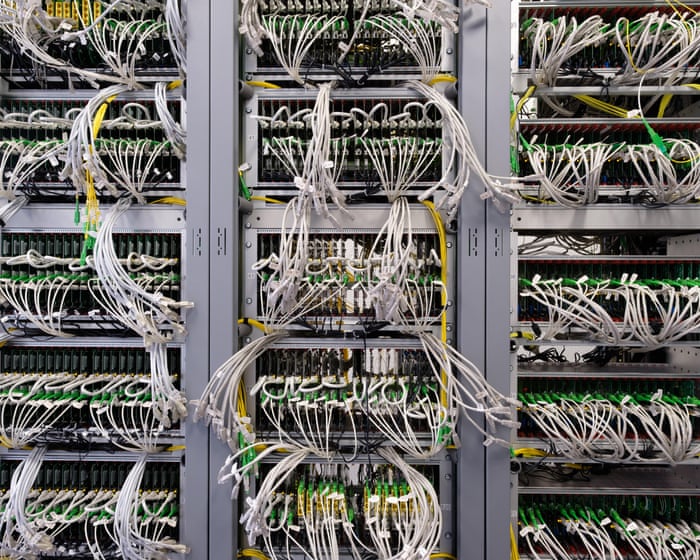
A new report says that the energy demand from data centers in Ireland has added hundreds of euros to household electricity bills, and this trend could spread across Europe.
Last year, Ireland’s growing number of data centers used 22% of the country’s electricity—more than all urban homes combined, according to the Central Statistics Office. In comparison, data centers in the US and UK use about 6% of their electricity.
The report, commissioned by Friends of the Earth Ireland and Beyond Fossil Fuels, found that these data centers have drained €715 million (£620 million) from the Irish economy and increased household electricity bills by an average of €360 in total between 2015 and 2023. It argues that Irish households have been indirectly subsidizing big tech through a “hidden data center tax” on their electricity bills.
Jill McArdle from Beyond Fossil Fuels said: “Ireland’s experience should serve as a warning for Europe. Allowing big tech to expand data centers without limits will have major ripple effects on the economy and European households. Combined with fossil gas, this creates a dangerous mix—driving up energy prices for people already struggling through another energy crisis.”
Data center industry representatives disagreed with the findings, saying the sector benefits the economy.
The Irish government has largely supported the expansion, calling data centers “a core enabler of our technology-rich innovation economy” and denying that they create a hidden tax on consumers.
Seán Fearon, a postdoctoral researcher at the Institute of Environmental Science and Technology at the Autonomous University of Barcelona and the report’s author, said: “Our modeling shows that the high, growing, and inflexible electricity demand from data centers increases the number of hours when gas sets the price in Ireland’s power system, driving up electricity costs.”
He added that historical evidence suggests this effect becomes stronger during energy shocks, with high data center demand and gas dependency combining to amplify price spikes.
Fearon also said that depending on how much data centers grow, the average Irish household could pay an additional €295 to €644 in total from 2025 to 2034, adding up to a national total of between €633 million and €1.43 billion.
McArdle said the European Commission should learn from Ireland’s example and strengthen safeguards as data centers—partly driven by AI—continue to spread across Europe.
“Even Trump, under intense pressure from voters, has acknowledged that big tech should pay its own energy bills,” McArdle said. “Unless data centers are required to use additional renewable energy, they could lock Europe into relying on volatile and expensive fossil gas.”
Industry groups disputed the report, arguing that large energy users buy electricity differently from other users and are investing heavily in the economy.
Maurice Mortell, chair of Digital Infrastructure Ireland, said data center investors have injected €18 billion into the economy in recent years.
Tom Parlon, chair of the Irish Data Centre Supplier Alliance, said data centers pay grid network charges and commercial electricity costs based on their usage and investment. He noted that data centers must meet 80% of their energy needs from additional renewable capacity—the strictest requirement in Europe—and contribute a large share of Ireland’s corporate tax revenue.
Parlon said: “These unprecedented tax revenues allow the Irish state to invest in critical infrastructure and housing, while also funding direct supports for Irish households and climate action programs.”
Frequently Asked Questions
Here is a list of FAQs about the hidden datacentre tax report written in a natural tone with clear simple answers
BeginnerLevel Questions
1 What exactly is the hidden datacentre tax
Its a term used to describe the extra costs that Irish households and small businesses are paying on their electricity bills because of how the grid is being paid for The report argues that big data centres are not paying their fair share of the network costs pushing those costs onto everyone else
2 How does this affect my electricity bill
The report claims that because data centres use a huge amount of power they force the national grid to be upgraded and kept on standby When those upgrade costs arent fully covered by the data centres themselves the shortfall is spread across all other customers adding hundreds of euros to the average household bill each year
3 Why are data centres in Ireland in the first place
Ireland is attractive to tech companies because of its cool climate a strong fibreoptic network and a very competitive corporate tax rate This has led to a massive concentration of data centres especially around Dublin
4 Who wrote this report
The report was produced by a group called the Irish Academy of Engineering They are a respected independent body of professional engineers who study largescale infrastructure issues
5 Is this a new problem
No the issue has been debated for years However this specific report has brought new attention to the cost by calculating the exact financial impact on households and businesses
Advanced Deeper Questions
6 How is the tax actually calculated The report says it costs households millions Can you be more specific
The report estimates that domestic customers are paying an extra 100 million per year and small and medium businesses are paying an extra 200 million per year This amounts to roughly 100150 extra per household annually
7 Is this a literal tax or a hidden charge
Its a hidden charge not a government tax The money is collected through the network tariffs on your electricity bill These are the fees that pay for the poles wires and substations that deliver power to your home The report argues that the current tariff structure unfairly allocates these costs