A year ago, they marched in record numbers, risking fines and facial recognition technology to challenge Viktor Orbán and his government’s growing crackdown on LGBTQ+ rights. This Saturday, Hungarians will take to the streets again for Budapest Pride, this time in a march set against the backdrop of the country’s sweeping political changes.
The event, expected to be peaceful after receiving police approval, will serve as a rallying cry for a community that has resisted all efforts to silence it, said Petra Buzás, a member of the organizing team.
“This year’s Budapest Pride March is especially important because it’s about hope, caution, and perseverance all at once,” Buzás said. “Budapest Pride hopes that LGBTQ people in Hungary will finally be seen not as political targets, but as full citizens.”
Her comments hint at the ongoing turmoil after Orbán’s 16 years in power. As a nationalist leader who portrayed himself as a defender of traditional Christian and family values, he led a determined crackdown on LGBTQ+ rights, culminating in a law—the first of its kind in the EU’s recent history—that aimed to ban Pride events.
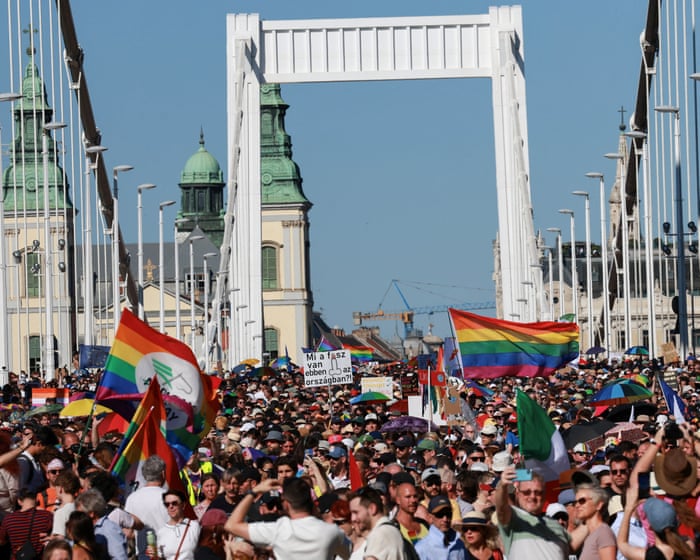
Last year’s Pride was a massive show of defiance against Orbán’s government, which tried to ban the event. Supported by a wide range of civil society groups and the city’s mayor, Budapest Pride went ahead anyway, with over 200,000 attendees turning it into a powerful display of freedom, equality, and the right to assemble.
That strong show of defiance against Orbán’s government was, in some ways, a sign of what was to come. About 10 months later, Orbán’s Fidesz party was ousted from power when Péter Magyar and his Tisza party won a landslide victory in parliamentary elections.
Nearly two months after Magyar took power with promises of “regime change,” many in the LGBTQ+ community are still reeling from the stigma spread by Orbán’s government and its crackdown on rights, Buzás said.
“We can’t yet talk about a meaningful, widely noticeable change in the everyday lives of LGBTQ people,” Buzás said. “Many people are still afraid to be open about who they are, their families, or their relationships, and social stigma remains strong.”
At the same time, there have been “cautiously encouraging” shifts, Buzás added. “Compared to the openly hostile government communication of previous years, there have now been several signs suggesting at least a more open attitude toward the LGBTQ community,” she said. “This gives us reason to hope, but our trust is tied not to words or gestures, but to concrete legislative and institutional steps.”
On the night of his election victory, Magyar called for a Hungary where “no one is stigmatized for thinking differently than the majority, or loving differently than the majority.” More recently, he urged Orbán’s Fidesz party to “get out of the bedrooms of the Hungarian people as soon as possible.”
But Magyar has not mentioned Pride events, nor has his newly formed conservative government moved to reverse Orbán’s legislation banning such events. This month, a coalition of civil society groups called on the government to repeal the law, noting that it has “no place in a democratic state governed by the rule of law.”
Other anti-LGBTQ+ laws introduced by Orbán’s government also remain in place. “The most important obstacles are still there,” Buzás said, pointing to legislation that restricts LGBTQ+ topics in schools, media, and bookstores, and limits adoptions by same-sex couples.Same-sex couples are denied the right to legal gender recognition for transgender and intersex people.
Campaigners say that far-right groups and politicians in Europe are trying to use the rights won by LGBTQ+ communities as a weapon. Photograph: Márton Mónus/Reuters
“Our biggest worry is that change will only be symbolic, while the everyday safety, dignity, and legal equality of community members stay fragile,” said Buzás.
The changing fortunes of Budapest Pride come as campaigners say far-right politicians in Europe and beyond are using LGBTQ+ rights to create divisions, leading to a sharp rise in hate crimes.
This reality has once again turned Budapest Pride into a powerful symbol. When it started in 1997, it was the first march of its kind in central and eastern Europe. Now, the community has stood up against Orbán, one of the world’s most successful populist leaders.
“The story of the Hungarian LGBTQ community in recent years has also shown that repression doesn’t always work,” said Buzás. “Those in power may try to create fear, restrict a community through laws, and stigmatize it through propaganda, but this can backfire: for many people, it makes clear that standing up for the community’s rights is really about the freedom of all of us.”
Frequently Asked Questions
Here is a list of FAQs about the article Many are still afraid hope and caution in Budapest ahead of the first Pride since Orbán written in a natural tone with clear concise answers
BeginnerLevel Questions
1 What is Budapest Pride
Its an annual LGBTQ festival and parade in Budapest Hungary celebrating diversity and advocating for equal rights Its the biggest LGBTQ event in Central Europe
2 Whats the big deal about this years Pride
This is the first major Budapest Pride since Viktor Orbáns government passed a controversial law that restricts LGBTQ content and visibility So its happening under much more hostile political conditions
3 Why are people afraid to go to Pride this year
The government has created a climate where antiLGBTQ rhetoric is common People fear harassment violence from farright groups and potential legal trouble even though the parade itself is still legal
4 What is the Orbán law everyone is talking about
Its a law that bans the promotion of homosexuality and gender reassignment to minors Critics say its a thinly veiled ban on any positive LGBTQ representation in schools media and public life
5 Is the Pride parade still allowed
Yes it is still legal to hold the parade But participants are worried because the government has used other laws to fine or intimidate organizers and participants in the past
IntermediateLevel Questions
6 Why is there hope in the articles title if things are so bad
Despite the fear many people are determined to show up and be visible They see Pride as an act of resistance and a way to show the community is still strong and wont be silenced Theres hope in solidarity
7 What specific challenges are organizers facing this year
They face increased police surveillance potential fines for illegal assembly and a real risk of violent counterprotests from farright groups Getting permits has become much harder
8 How has the general publics attitude changed since the law passed
Surveys suggest public opinion has become more polarized While some are more hostile others have been shocked into supporting the community more openly The law has made LGBTQ issues a major political talking point